Panthalassa's Floating, Wave-Powered Data Centre Technology
If proof were needed that necessity drives innovation, the race to power AI has made the case undeniable.
Since the artificial intelligence boom accelerated in 2022, one of the defining challenges for the global economy has been how to supply the vast amounts of energy the technology demands. Companies across the world are now competing to develop viable solutions.
It is widely recognised that AI systems – along with the data centres that support them – consume enormous quantities of energy.
Indeed, the IEA projects that the sector’s energy consumption will rise by 30% annually through to 2030, when AI is expected to account for 3% of global energy use.
This surge in demand has triggered a wave of unusual and inventive approaches, from restarting nuclear facilities to exploring satellite-based solar power and even investing in fusion.
Among the more unconventional ideas gaining traction is wave energy – a frequently overlooked renewable resource.
Panthalassa, an Oregon-based start-up that has spent the past decade refining its wave energy technology, has recently positioned itself at the forefront of this space.
The company takes its name from the “superocean” that once surrounded Pangea before the continents formed as we know them today – a fitting reference for a business built on harnessing ocean power.
Earlier this year, Panthalassa raised US$140m in a funding round led by venture capitalist Peter Thiel, known for backing Palantir and PayPal.
The strength of investor interest has pushed the company’s valuation to nearly US$1bn, including the new capital.
Alongside Peter, the round attracted high-profile supporters such as Salesforce CEO Marc Benioff, PayPal and Affirm Co-Founder Max Levchin, and veteran investor John Doerr, an early backer of Google, Amazon, Uber and Netscape.
Sustainability leaders won’t want to miss Sustainability LIVE: The Leadership Summit at London Climate Action Week, taking place at Code Node on 25 June 2026.
Register now for this exclusive invite-only event.
How Panthalassa’s floating data centres work
From an engineering standpoint, Panthalassa’s approach is intentionally simple.
Its “nodes” are 85-metre-long steel structures – roughly the height of London’s Big Ben – designed to sit mostly below the ocean surface.
As waves move the structure, water is forced through a turbine, generating electricity that powers AI chips housed within a sealed, seawater-cooled container.
The system avoids complexity: there are no hinges, flaps or gearboxes, and few components are exposed to the harsh realities of open-ocean conditions.
Each node continuously recirculates water internally to drive its generator, producing no direct emissions and requiring no engine.
Once towed out to sea horizontally, the structure rotates upright and travels to its designated location using only the hydrodynamic properties of its hull.
Because these floating data centres operate far offshore, all AI queries are transmitted via SpaceX’s Starlink satellite network.
According to the company, this satellite link is the only land-based connection the system requires.
The energy argument
Panthalassa Co-Founder and CEO Garth Sheldon-Coulson, formerly an AI and energy researcher at hedge fund Bridgewater, has been a vocal advocate for wave energy’s potential.
"Energy from open-ocean waves is low-cost, sustainable, abundant and now we have the technology to make it accessible for people," he recently told the Financial Times.
By positioning its nodes in remote deep-ocean locations rather than near coastlines, Panthalassa aims to avoid the limitations that have hindered earlier wave energy projects, such as grid connections and inconsistent wave conditions.
"The waves are like a battery for sunlight and we can be capturing from it 24/7," he adds.
The company argues that wave and wind power, alongside solar and nuclear, are among the few clean energy sources capable of generating “tens of terawatts” – the level of output increasingly required by AI infrastructure.
With global demand for clean energy accelerating, this proposition is likely to attract attention from both public- and private-sector stakeholders.
‘Go where the energy is’
A defining feature of Panthalassa’s model sets it apart from traditional offshore energy projects: it does not aim to transmit electricity back to land.
Its guiding principle – “go where the energy is” – reflects this strategy.
"One of the key insights that we had was that it's very important to use the electricity in place," Garth Sheldon-Coulson explained to the FT.
This approach eliminates one of the biggest challenges in offshore renewables: the cost and complexity of subsea transmission cables and interconnectors.
It also shifts the company’s business model. Rather than selling electricity, Panthalassa sells compute capacity, simplifying its commercial proposition in several respects.
Panthalassa’s plans for the future
The newly secured funding will support the development of a pilot manufacturing facility in the US, with initial commercial deployments expected as early as next year.
Panthalassa states that its nodes are constructed using “earth-abundant materials” such as steel – a point that may ease pressure on global rare earth and critical mineral supply chains already strained by the energy transition.

The company also maintains that its supply chains are sufficiently resilient to support rapid scaling.
Peter, who has long supported the libertarian “seasteading” movement advocating for floating communities in international waters and has backed Panthalassa since 2018 through Founders Fund, views the company’s work as part of a broader expansion of technological frontiers.
"The future demands more compute than we can imagine. Extraterrestrial solutions are no longer science fiction. Panthalassa has opened the ocean frontier," he told the FT.
While some critics have labelled such ideas as a form of “tech neocolonialism”, Peter’s endorsement is likely to accelerate Panthalassa’s path toward mainstream adoption.
Company portals





Executives
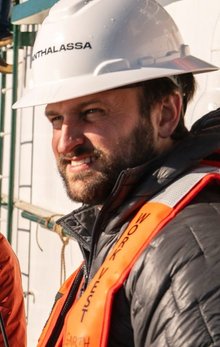
Garth Sheldon-Coulson
Co-Founder & CEO
Marc Benioff
Chair & CEO
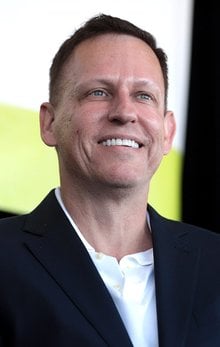
Peter Thiel
Co-Founder