Solar-Powered Charging Drives Britain’s EV Revolution

When Toddington Harper established GRIDSERVE in 2017, he identified a critical gap in the UK's transition to sustainable transport. Public charging infrastructure was unreliable, slow and predominantly powered by grid electricity with questionable renewable credentials.
Toddington's vision centred on a deceptively simple proposition: to harness solar power to charge EVs, creating a truly sustainable mobility ecosystem from generation through to consumption.
GRIDSERVE's proprietary Sun-to-Wheel technology now enables thousands of drivers to charge their vehicles using renewable solar energy. The system represents a deliberate counterpoint to the fossil fuel industry's well-to-wheel framework, reimagined for an era of decarbonised transport.
According to GRIDSERVE, just one acre of solar panels in England can generate sufficient energy to power a million miles of EV driving annually. When combined with advanced battery storage systems, this creates a continuous supply of clean energy that operates independently of fossil fuel inputs.
Solar-powered infrastructure becomes reality
The company's defining moment arrived on 7 December 2020 with the launch of Britain's first all-electric charging forecourt in Great Notley, Essex. Connected to the Clayhill solar farm approximately 50 miles away, the forecourt can rapidly charge up to 36 vehicles simultaneously.
The 350kW chargers can deliver up to 200 miles of range in just 20 minutes, whilst a 6MWh battery storage system holds enough energy for 24,000 miles of zero-emission driving.
The project attracted national media attention and secured the What Car? Innovation Award in January 2022.
The infrastructure demonstrated that renewable-powered rapid charging could operate at commercial scale whilst maintaining the convenience drivers expected from traditional fuel stations.
Transforming Britain's motorway network
GRIDSERVE's commitment to renewable-powered charging infrastructure accelerated in July 2021 when the company acquired Ecotricity's Electric Highway network. The company introduced Electric Super Hubs at numerous Moto service areas, featuring between six and twelve high-power chargers capable of delivering up to 350kW.
The expansion gathered momentum throughout 2023 and 2024. Across 2023, the network delivered more than 1.9 million charging sessions, equating to more than 160 million zero-emission miles.
During 2024, approximately 400 high-power charging bays were added to the network. By early 2025, GRIDSERVE operated more than 190 locations with 1,400 charging bays, facilitating more than 250,000 charging sessions monthly.
The network's growth reflected increasing consumer confidence in electric vehicles and the viability of long-distance electric travel across Britain's road network.

Decarbonising freight and future expansion
GRIDSERVE has identified electric heavy goods vehicle (eHGV) charging as critical infrastructure for decarbonising freight operations. The eHGV charging hubs at Extra Baldock on the A1(M) and Moto Exeter on the M5 represent the initial sites delivered through the Electric Freightway project, supported by Department for Transport funding.
An electric DAF XF completed a 200-mile journey between the two hubs, demonstrating that zero-carbon freight transport has moved from aspiration to operational reality.
The company has also deepened its partnership with Extra MSA, with GRIDSERVE's rollout expected to deliver 96 high-power charging bays across the Extra estate by late 2026. Each Super Hub will incorporate the latest 400kW-capable chargers, providing sufficient energy for contemporary EV models to gain more than 100 miles of range in under ten minutes.
Daniel Kunkel joined GRIDSERVE as CEO in February 2025, succeeding Roy Williamson who had assumed interim leadership following Toddington's departure. Daniel previously served as CEO of ubitricity, which developed into one of Europe's largest public on-street EV charging networks, operating 13,500 charge points.
According to the SMMT, approximately one in five new cars sold in the UK is now battery electric. The company that launched a single pioneering forecourt in Essex now operates Britain's most-used charging network, with expansion plans encompassing freight, retail, destination charging and international markets.
Company portals

Executives
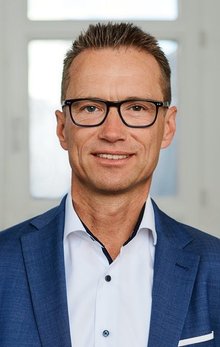
Daniel Kunkel
CEO
Toddington Harper
Founder