PwC Sustainability Webinar Series: Driving Value & Growth
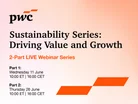
As the global landscape shifts amid evolving regulatory, investor and customer demands, businesses are increasingly driving innovation, resilience and growth through sustainability strategy. PwC’s recent webinar series, hosted by Sustainability Magazine, has become a focal point for leaders seeking to navigate – and lead – in the accelerating low-carbon economy.
Prioritising actionable insights
The series, fronted by Neil Perry, Broadcast Director at Sustainability Magazine and featuring PwC’s Sustainability Principals David Linich, Sammy Lakshmanan and US Sustainability Assurance Services Leader Kevin O’Connell, unpacks the latest trends, challenges and opportunities in corporate decarbonisation and technology.
- How to drive business value and growth through decarbonization
- Using AI and technology to drive business value in sustainability
Drawing on PwC’s Second Annual State of Decarbonization Report, the webinars offer sector-specific insights, practical strategies, and real-world examples of how companies are embedding sustainability across their business strategy.
Decarbonisation as a business imperative
One of the central themes emerging from the series is the growing integration of sustainability into business strategy.
Nearly 40% of the 4,000 companies PwC analysed have raised their climate ambitions, setting more specific targets that reflect the strategic importance of decarbonisation. While only 16% have adjusted their goals, half of those have done so to make their strategies more actionable – a clear sign that companies are focused on meaningful progress, not just rhetoric.
Momentum is not limited to large enterprises – smaller businesses and suppliers are stepping up with science-based targets and tangible actions, responding to the ripple effects set in motion by their larger counterparts.
“We’re seeing steady, quiet progress,” David says. “What sets the leaders apart is bold goals backed by the ability to embed sustainability into how the business operates. From governance and funding to product innovation and supplier collaboration, leaders are getting specific – and strategic – about how they deliver results.”
The Scope 3 challenge: From reporting to transformation
A recurring topic in the webinars is the challenge of Scope 3 emissions – the indirect emissions that occur throughout a company’s value chain.
According to PwC research, 54% of companies are now on track to meet their Scope 3 targets. However, fewer than 22% demonstrate advanced maturity in supplier collaboration, highlighting both a gap and an opportunity.
Large corporations are increasingly leveraging their influence to help drive decarbonisation throughout their supply chains, requiring suppliers to disclose emissions data and adopt their own targets.
“Scope 3 isn’t just a rexporting challenge – it’s a business transformation challenge,” David emphasises.
“The winners are those who engage upstream and downstream, with the data to back it up.”
Independently assured, data-driven sustainability assessments are helping companies demonstrate measurable progress and build trust with stakeholders.
Technology as a sustainability enabler
Advanced technologies like AI and automation are transforming sustainability efforts within businesses, and the rapid evolution of these technologies presents both opportunities and challenges, particularly in implementation and integration.
Companies that fail to keep pace risk falling behind competitors as regulatory demands—such as the EU Corporate Sustainability Reporting Directive—continue to evolve, requiring robust data systems and governance for compliance and value creation.
PwC explores how, while AI and automation can streamline data collection, reporting and compliance, successful adoption hinges on strong processes, data quality and human oversight.
Leaders can distinguish themselves by embedding sustainability into core operations, leveraging technology for decarbonisation, and collaborating with suppliers and customers to deliver measurable results.
PwC’s insights highlight that technology, when strategically integrated, can help convert ambitious sustainability visions into actionable outcomes, driving both business value and progress toward net zero goals

The financial upside of sustainability
The business case for sustainability is becoming ever more compelling.
Companies investing in climate-smart products can see significant returns, with products featuring sustainability attributes delivering a 6% to 25% revenue uplift when supported by quality, customer trust and credible sustainability claims.
For the 700 companies who provided forecasted revenue, they expect to see over one third of their revenue to be associated with the climate transition in 2030.
Cost savings are also in focus, with many organisations pursuing energy reduction initiatives such as lighting optimisation, HVAC upgrades and improved building management systems – measures that can yield up to 31% in energy cost savings.
At the same time, spending is shifting toward renewable energy, carbon offsets and removals, further strengthening both efficiency and resilience.
Explore the latest edition of Sustainability Magazine and be part of the conversation at our global conference series, Sustainability LIVE.
Discover all our upcoming events and secure your tickets today.
Sustainability Magazine is a BizClik brand