How Well is FedEx Delivering on Circularity & Net Zero?
FedEx’s 2025 Corporate Responsibility Report outlines its significant sustainability progress and reiterates its ambition to achieve carbon-neutral operations by 2040.
The report covers ESG initiatives and provides detailed data on emissions reductions, renewable energy usage, supply chain sustainability, workforce development and innovation in sustainable customer solutions.
These efforts span FedEx’s global operations and supply chain, which include more than 100,000 suppliers and 730,000 supported jobs.
Climate strategy and emissions reduction
FedEx continues to advance its decarbonisation strategy across Scope 1, 2 and selected Scope 3 emissions categories.
In FY24, FedEx achieved a 6.1% year-on-year reduction in Scope 1 emissions, with aviation-related Scope 1 emissions from jet fuel decreasing by 4.9% thanks to efficiency upgrades and fleet modernisation efforts.
The company has achieved a 31% reduction in aviation emissions intensity since 2005 and is targeting a 40% reduction by 2034.
Total Scope 1 and 2 emissions intensity has fallen to 179.50 metric tons of CO₂ equivalent per million USD in revenue, representing a 58% decrease from FY09, even as daily package volumes increased by an average of 121%.
Fuel conservation and aircraft modernisation saved the company approximately 140 million gallons of jet fuel and an estimated US$400m in FY24 alone.
FedEx has committed to procuring 30% of its jet fuel from sustainable aviation fuel (SAF) blends by 2030.
“As the world’s preeminent express transportation company, our initial US deployment of this fuel advances our sustainability goals and bolsters the aviation industry’s efforts to source and use more SAF,” says Richard Smith, Chief Operating Officer, International, and CEO, Airline, FedEx.
“While we know further growth of the SAF market is needed, alongside other innovations, we are proud to celebrate this milestone with our world-class air network.”
However, less than 1% of global jet fuel produced in 2024 was SAF, which underlines the challenges ahead.
To offset emissions that cannot be mitigated through technology, FedEx has invested US$100m in the Yale Center for Natural Carbon Capture.
Research includes the development of durable carbon removal methods such as enhanced weathering using basalt, which reduces soil acidity and improves crop yield while sequestering CO₂.
FedEx is also expanding its emissions reporting, including Scope 3 Categories 3, 4 and 6, and has committed to science-based targets pending validation.
- Category 3: Fuel and energy related activities
- Category 4: Upstream transportation and distribution
- Category 6: Business travel
Fleet electrification and efficiency
FedEx operates more than 200,000 ground vehicles, including pickup and delivery (PUD) trucks, long-haul vehicles and off-road equipment.
In FY24, FedEx achieved a 40% improvement in vehicle fuel efficiency from a 2005 baseline.
While the original goal of a 50% improvement by 2025 is now unlikely to be met due to operational restructuring under Network 2.0, the company is progressing toward full fleet electrification.
More than 8,000 electric vehicles were in service in FY24, including e-cargo bicycles and tricycles in markets such as Canada, the UK and Taiwan.
Following successful pilots, FedEx has ordered 150 Shyft Group Blue Arc trucks with larger capacity to better match operational needs.
The company aims to have 50% of all PUD vehicle purchases be electric by 2025 and 100% by 2030, with the entire PUD fleet – including contracted vehicles – fully electric by 2040.
FedEx is addressing the associated infrastructure needs by installing new EV chargers and working with utilities and regulators to build out grid capacity.
It has supported RMI’s GridUp tool with more than US$2.5m to help utilities forecast grid demand from transport electrification.
“Procuring SAF is an important component of our aviation emissions-reduction strategy in the coming years and we are pleased to have executed a deal with Neste to begin using this fuel in our air operations,” says Karen Blanks Ellis, Chief Sustainability Officer and Vice President of Environmental Affairs, FedEx.
“Our aviation network represents the largest amount of FedEx fuel use globally and, as a result, is our biggest opportunity to drive down emissions.
“As we work toward our goal of carbon-neural operations by 2040, we need the SAF market to continue to grow to meet industry demand.”
Facility energy use accounts for around 6% of FedEx’s total emissions.
FedEx aims to source 100% of its facility electricity from renewable sources by 2040, with interim targets of 500 GWh by 2028 and 1,300 GWh by 2033.
In FY24, it generated more than 31 GWh from solar at 34 global sites and made contracts to install 8 MW of new capacity in FY25.
Total energy intensity declined to 3.19 terajoules per million USD revenue.
A project to replace plastic packaging bags with reusable mesh bags at FedEx Ground hubs saved US$20.4m and prevented 50 million plastic bags from going to landfill.
Sustainable solutions and circularity
FedEx handles more than 17 million shipments daily and recognises its role in promoting more sustainable shipping behaviours among customers.
Through its FedEx Sustainability Insights tool, launched globally in FY24, customers in more than 100 markets can access estimated CO₂e emissions data for their shipments, supporting Scope 3 reporting and emissions planning.
More than 13,000 customers have used the tool since July 2023.
FedEx embeds circularity principles in packaging design.
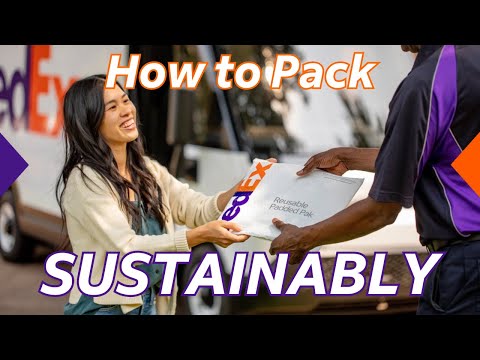
In FY24, 74% of packaging materials came from third-party certified sustainable sources. The company offers reusable options such as the Reusable Padded Pak and Reusable Pak, and it participates in the Circular Supply Chain Coalition alongside Pyxera Global.
This initiative aims to scale the upcycling of rare earth materials, establish remanufacturing hubs and create high-skill jobs in local economies.
Additional AI-driven platforms like the fdx e-commerce platform help customers reduce delivery failures and emissions through rerouting, predictive delivery and return optimisation.
Explore the latest edition of Sustainability Magazine and be part of the conversation at our global conference series, Sustainability LIVE.
Discover all our upcoming events and secure your tickets today.
Sustainability Magazine is a BizClik brand