
How Could the North Sea Ship Crash Impact the Environment?
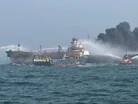
A cargo ship collided with a tanker full of jet fuel in the North Sea on 10 February.
Both ships caught fire and have continued to burn for more than 24 hours.
Jet A-1 aviation fuel was being carried on the Stena Immaculate for the US military, and the Portuguese registered cargo ship Solong was carrying 15 containers of sodium cyanide according to Lloyds List intelligence.
It is not clear if any highly toxic sodium cyanide has entered the water, but jet fuel is leaking into the North Sea.
Dr Paul Johnston, a senior scientist at the Greenpeace Research Laboratories at Exeter University, said: “As more information emerges about what the ships were carrying, we are extremely concerned about the multiple toxic hazards these chemicals could pose to marine life.
“The jet fuel that entered the water close to a breeding ground for harbour porpoises is toxic to fish and other sea creatures.
“While we don’t know about the status of the containers holding sodium cyanide, we’re dealing with a highly toxic chemical that could cause serious harm.
“Any release of bunker fuel could also pose serious risks to nearby nature sanctuaries.
“Authorities need to urgently assess the situation and put in place measures to contain the release of jet fuel and any other toxic substances from the two vessels where possible.
“We must hope an environmental disaster can be averted.”
Sodium cyanide
Sodium cyanide is used for a variety of purposes including to extract gold, mostly from low-grade ore.
It is also used as a feedstock for chemicals including adiponitrile, a raw material used in the production of some nylons.
In water, the chemical breaks down into sodium and cyanide ions which can block haemoglobin, responsible for carrying oxygen.
Sodium cyanide can also be used for widely illegal cyanide fishing.
This involves spraying a mixture of the chemical to incapacitate fish, making them easy to collect.
Whilst this method aims to catch live fish, research has shown that up to 75% of fish caught will die within 48 hours of capture.
The chemical can also kill coral polyps and algae.
Jet A-1 aviation fuel
Jet A-1 is one of the most commonly used fuels for commercial aviation, containing a mixture of varieties of hydrocarbons.
This kerosene-based fuel can contain additives such as antistatic agents, biocides, antioxidants and corrosion inhibitors.
It is not as viscous as heavier types of oil, so is less likely to clog the feathers or fur of animals.
However, it can poison aquatic organisms – particularly those that come into direct contact with the fuel.
Because the fuel is composed of relatively light hydrocarbons, most oil will evaporate or naturally disperse within a day or less according to the US National Oceanic and Atmospheric Administration (NOAA).
NOAA documentation says that fish kills are rarely reported from this type of spill because of the rapid loss by evaporation.
Bunker fuel
Bunker fuel is a general term for fuel used to power ships.
These can include marine diesel oil, heavy fuel oil and marine gas oil which are made of heavier hydrocarbons than kerosene.
Bunker fuels are typically significantly more viscous than crude oil, so it can stick to the feathers or fur of animals
If bunker fuel from one or both of the damaged ships has spilled into the North Sea, it could be difficult to clean up.
There are a variety of methods that can be used to clean up oil spills, including bunker fuel spills:
- Oil booms for containment
- Oil-absorbent materials like sawdust
- Skimmers
- Vacuum pumps
- Bioremediation
Wildlife in the North Sea
Martin Slater, Director of Operations at Yorkshire Wildlife Trust, says: “Our thoughts are with everyone immediately involved in the accident and the emergency response operation.
“This is obviously a very worrying incident and we’re following developments closely, including waiting to see if there is any pollution into the North Sea.
"East Yorkshire’s coast is home to protected and significant colonies of seabirds including puffins, razorbills, gannets and kittiwakes.
“Many birds are gathering offshore on the sea ahead of the nesting season and we still have wintering waders – plus migrant birds stopping here – so we’re very worried indeed about the threat to these birds. Also, there are significant numbers of Atlantic grey seals in the area, many rearing this year’s young, as well as porpoises and other cetaceans around Spurn.
"If pollution spillage enters the Humber, this could potentially be devastating for the wildlife of the estuary, including important fish populations and tens of thousands of overwintering and migrating birds who use the mud flats.”
Tammy Smalley, Head of Conservation at Lincolnshire Wildlife Trust, says: “The north Lincolnshire coast is at risk which includes our special – and vast – nature reserves, Donna Nook and Saltfleetby-Theddlethorpe Dunes.
“The area is home to internationally important populations of seabirds and seals, and fragile habitats including saltmarsh, mudflats and seagrass meadows.
“Depending on wind direction and contaminants, we are also concerned about the Silver Pit Marine Conservation Zone farther offshore – a unique habitat for fish where seabirds and cetaceans feed. Much of the Lincolnshire coast offshore is within marine protected areas for habitat features such as sub-tidal sand dunes.
“Although the grey seals at Donna Nook are not currently pupping, the seals including juveniles are still in the area. They haul out on sand banks offshore and feed in the wider North Sea area.”
Explore the latest edition of Sustainability Magazine and be part of the conversation at our global conference series, Sustainability LIVE.
Discover all our upcoming events and secure your tickets today.
Sustainability Magazine is a BizClik brand