
How can Data Centres be Sustainable in Urban Areas?
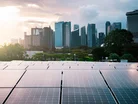
As the global digital transformation grows, the sustainability of data centre infrastructure is key concern for governments, operators and investors worldwide.
This is particularly pressing in Singapore, where data centres contribute to about 7% of the nation's total electricity consumption.
In response, Singapore's authorities imposed a moratorium on new data centres in 2019, a critical move aimed at curbing energy usage and carbon emissions.
A study published in Nature by npj examines the aftermath of this decision and offers insights into how the industry can navigate the complex balance between supporting digital economic growth and meeting sustainability targets.
“Singapore’s experience offers useful insights for existing and emerging DC hubs in other parts of the world,” the report reads.
“Its advanced research, industry and investor networks provide an ideal testing ground for energy efficiency and equipment longevity solutions that could be deployed in the wider region.”
How the data centre market in Singapore has changed
Singapore, despite its limited land area, is home to 93 data centres with a total capacity exceeding 1000MW, positioning it as the leading hub in the Asia-Pacific region and the third largest globally.
However, physical constraints challenged further expansion, prompting the government to ban new data centres in 2019 due to sustainability concerns.
When the moratorium was lifted in 2022, new regulatory measures were introduced.
These include a design Power Usage Effectiveness (PUE) of 1.3 or lower, the attainment of Platinum certification under Singapore’s Green Mark for Data Centre criteria and proof of a path to 100% renewable energy usage.
The Green Mark standard primarily focuses on energy usage to indicate sustainability, though this focus may overlook deeper issues such as excessive data use and unrestrained demand for data centre services.

The report also identifies a regulatory gap regarding the lack of guidance for retrofitting existing “brownfield” assets with 15-20 years of remaining lifespan.
These restrictions have pushed some operators to relocate planned developments to neighbouring jurisdictions with fewer restrictions, such as Johor Bahru in Malaysia or Batam in Indonesia.
It says: “This potentially displaces environmental costs to other locations while services are provided to clients in Singapore and regionally and undermines the intended benefits of more stringent regulatory standards that only apply to certain jurisdictions.”
Building and operating in a tropical climate
Operating in Singapore’s tropical climate presents unique challenges for data centres, with high temperatures and humidity potentially reducing equipment lifespan and limiting the effectiveness of efficiency measures prevalent in more temperate regions.
Solutions such as air, water or liquid cooling are essential, yet these render tropical data centres significantly less energy-efficient.
To address this, the Singapore Infocomm Media Development Authority (IMDA) has recommended guidelines to transition ambient temperatures to 24-31 degrees Celsius, substantially higher than the current norm of 18-22 degrees.
Although initial resistance from operators cited safety concerns, government-backed guidelines and supporting evidence are facilitating gradual adoption.
The report also stresses the importance of collaboration between government and industry to establish training programmes, like the data centre engineering training offered by the Institute of Technical Education and Microsoft’s Data Centre Academy in Singapore.
However, it highlights that the tangible benefits of these efforts may only become apparent when initial cohorts graduate and enter the workforce.
An urgent need for reliable renewables
Energy consumption remains a crucial challenge for the data centre industry, with electricity use potentially increasing fifteen-fold by 2030, representing 8% of global energy demand.
In Singapore, the limited availability of renewable energy complicates efforts to decarbonise.
The country's natural gas-based grid remains the primary energy source due to land scarcity preventing the construction of enough solar panels and hydrogen plants, and the absence of a dependable renewable energy import system from neighbouring Southeast Asian countries.
While some operators attempt to offset energy use through renewable energy certificates (RECs) and virtual power purchase agreements (VPPAs), the study criticises their effectiveness.
RECs can be sold without ensuring actual renewable energy consumption or the creation of new renewable capacity.
Thus, the researchers advocate for investment in developing an ASEAN renewable energy power grid, enabling renewable energy imports from Southeast Asian neighbours.
The research acknowledges the global water and land intensity of data centres, with significant environmental implications, especially for water-scarce regions like Southeast Asia.
Explore the latest edition of Sustainability Magazine and be part of the conversation at our global conference series, Sustainability LIVE.
Discover all our upcoming events and secure your tickets today.
Sustainability Magazine is a BizClik brand