
How Watershed Uses AI to Drive Sustainable Value

Please introduce yourself and your role
Hi, I’m Yubing Zhang. I lead AI products at Watershed. My job is to take the messy reality of sustainability work, including data scattered across finance systems, utility bills and supply chains, and build AI-powered workflows that help companies get to trusted answers faster, with the right safeguards for audit and compliance – and that ultimately steer them towards real decarbonisation opportunities.
Please introduce Watershed
Watershed is a sustainability AI platform that helps companies measure, report and reduce their environmental impact. We work with many of the world’s largest and most complex organisations, and the through-line is always the same: sustainability is a data problem and a change-management problem.
Our platform brings together operational data, ESG data and emissions data in one place, applies rigorous climate methodologies, and then turns that into action, from credible reporting to targeted decarbonisation plans.
Sustainability leaders won’t want to miss Sustainability LIVE: The Leadership Summit at London Climate Action Week, taking place at Code Node on 25 June 2026.
Register now for this exclusive invite-only event.
How can AI be used for sustainability?
Sustainability is a sophisticated, mission-critical discipline that drives business value and guards against risk. Companies are using sustainability data to identify operational inefficiencies, spot risk in their supply chain and earn a competitive advantage in customer deals.
With the right tools, sustainability practitioners can do all of the above while building an ironclad case for sustainability as a value driver. Instead, they’re spending 90% of their time mired in data collection, data cleaning and report drafting. By the time they get the numbers that can show value or inform sustainable decision-making, those numbers are nearly a year old, and the window for action is closing.
Purpose-built sustainability AI is changing this equation. Built with climate science, rigorous quality control, and a domain-specific data foundation, sustainability AI can solve corporate sustainability’s thorniest problems. It can make difficult tasks simple, and impossible tasks possible. It can flip the ratio, so sustainability practitioners spend 90% of their time on decarbonisation.
Difficult tasks made simple by sustainability AI include reporting, data cleaning and data ingestion. Impossible tasks made possible by sustainability AI include strategic analysis to identify emissions hotspots and reductions levers deep within corporate supply chains.
What makes Sustainability AI purpose-built for sustainability?
Sustainability has a few realities that make using generic AI risky:
- Sustainability measurement outputs end up in regulatory filings and audited reports; companies and auditors need transparency into calculations.
- Climate science and measurement methodology factor into the accuracy of carbon footprints, and small errors can lead to big consequences.
- Primary data is often incomplete, inconsistent, and spread across many systems.
“Purpose-built” means we design the system around those realities. Sustainability AI requires three foundational elements:
- A strong data foundation – a single source of truth for all ESG data, standardised, approved and traceable to raw sources. Without this, AI outputs become liability risks. With it, every number in every report traces back to its origin, eliminating hallucination risk. This also needs to be a living database, continuously updating to keep pace with changes to business and emissions data.
- Embedded sustainability intelligence – AI grounded on what great sustainability work actually looks like, not just what the internet says about it. Watershed’s sustainability AI is encoded with the expertise of world-class practitioners who've spent careers building corporate sustainability programmes and leading climate research. This domain-specific layer is what separates tools that sound helpful from tools that are actually right.
- Safeguards and transparency – every output is verifiable, auditable and controllable. Watershed AI combines system-level evaluations, with recurring task evaluations, all underrun by an audit trail and transparency features like match scores. Sustainability AI should have rigorous evaluation systems that check for accuracy, consistency, and relevance. Watershed AI includes human review with a carbon accounting expert each year.
A quick example of why this matters: when we tested generic models on draft sustainability reports, we saw failures like hallucinating executive quotes, misreading methodology changes, or over-disclosing risks. Thoughtfully-designed sustainability AI prevents those mistakes.
How and why has Watershed incorporated AI into its sustainability platform?
We incorporated AI because the bottleneck in corporate sustainability is capacity, not ambition. The work is complex, the datasets are large and requirements keep changing. AI allows us to compress timelines dramatically, but only when paired with the right data, guardrails and human review.
The goal is not “AI for AI’s sake”. The goal is to give sustainability teams more time and leverage to drive real-world outcomes.
What areas of your product currently leverage AI, and how do they improve outcomes for customers?
Today, AI shows up in a few core workflows:
- Data ingestion and cleaning agents that can cut time spent by up to 80% and automated utility bill ingestion where customers can process thousands of bills in hours versus weeks.
- Agents for data analysis and insights that reduce work and surface strategic insights to guide decarbonization decisions.
- Reporting workflows that reduce work that used to take months down to days or weeks.
- Emissions factor and mapping workflows that help map messy operational, spend, and supplier data into the right categories consistently, at scale.
- AI-accelerated Product Footprints, where we automate large parts of the lifecycle assessment (LCA) process so teams can get to product-level insights much faster, which helps them identify hotspots and work with suppliers on targeted emissions reduction initiatives.
Here are some examples of outcomes:
- A large North American beverage company processed more than 1,300 utility invoices in two days, that would have taken three weeks manually.
- An American tech company uploaded a full year of utility bills in 30 minutes for automatic ingestion.
- A North American tech company came to us with data they considered too messy to upload, assuming manual transformation would have taken days. Our AI data cleaning agents helped them finish in 30 minutes.
- A large European manufacturing company with tens of thousands of employees finished their SB 261 (California climate risk disclosure) report in <2 days with AI-powered reporting.
- An American consumer goods company used AI-powered Product Footprints to model the cost-saving impacts of moving to bio-based materials, building a connection between the sustainability and finance teams internally.
How do you decide where AI adds the most value versus where traditional data modeling or human expertise should lead?
We look for a mix of impact and risk.
AI is great when:
- The task is repetitive at scale, like mapping thousands of line items consistently or doing research to understand how a product is manufactured to produce an LCA.
- The work is bottlenecked by human time, like first-pass report drafting or gap analysis.
- The output can be reviewed and validated before it becomes “official.”
We avoid or constrain AI when:
- The system should be deterministic, such as pulling certain factual target data where you do not want the model “deciding” anything.
- The cost of a mistake is too high unless we can build strong guardrails and evaluation around it.
A phrase I use internally is: prescriptive, with guardrails. The more clearly we define the workflow and constraints, the better the AI performs.

Why is it important to develop domain‑specific AI for sustainability rather than relying on general-purpose models?
Because in sustainability, you need:
- Methodology context and consistency (what is allowed to be claimed, what is a claimable reduction vs. methodology change, what was used in last year's methodology to ensure YoY consistency).
- Auditability (where did this number come from, can I trace it).
- Reliability under scrutiny (especially for regulatory reporting).
- Human-in-the-loop workflows (where users can validate outputs before they are committed).
Generic models can be impressive, but they do not come with built-in sustainability judgment, nor the evaluation scaffolding needed for this domain. That is why we talk about sustainability AI as a category: it is not just a model, it is a system with data, methodologies, validation logic and review built in.
What about this challenge building sustainability-focused AI resonates with you and your team?
Two things.
First, sustainability is one of the most important real-world domains where software can move from analytics to outcomes. If we can help teams get trustworthy answers faster, we can accelerate decisions that change supply chains, materials and capital allocation – accelerating decarbonisation.
Second, the bar for success and credibility is high. Building AI that is credible enough for audit and regulation forces rigor: evaluation, traceability and collaboration between climate scientists, sustainability experts and AI engineers.
How do you stay motivated tackling problems that are both technically challenging and globally significant?
I stay motivated because the work is intellectually demanding, deeply grounded in impact and personally significant.
On the technical side, building trustworthy AI systems means doing the hard, unglamorous work: evaluation, governance layers, human review loops and being honest about what is not ready yet.
On the impact side, the leverage is enormous. When large companies change a procurement decision or redesign a product based on better emissions data, there is the potential to drive decarbonisation at a scale that dwarfs the footprint of the AI itself. That is what keeps the team focused: building tools that lead to real-world decarbonisation, not just faster workflows.
And on the personal side, I am motivated to do this work for my two daughters. I want my hours away from them every day to be for them too. Climate change is one of the most challenging problems facing humanity, and I want to do my part to make the planet a better place for my daughters and everyone else. And I believe we can.
Company portals

Executives
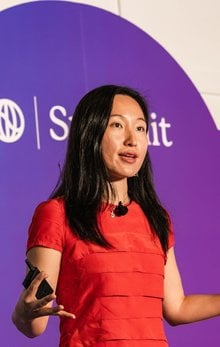
Yubing Zhang
Head of AI and Data Products