
Remora: Converting CO₂ Emissions from Pollution into Revenue
The transportation sector accounts for around 27% of US greenhouse gas (GHG) emissions, with freight railroads and semi-trucks playing pivotal roles in global supply chains.
Road transport, like cars and trucks, was responsible for 12.2% of global emissions in 2021 according to the World Resources Institute.
Transitioning to cleaner technologies is critical, and Remora, a Detroit-based startup, has found a potentially groundbreaking solution in capturing carbon directly from vehicle exhausts and turning it into a revenue stream.
“Remora is focused on extracting, purifying and selling carbon dioxide from vehicle exhaust,” explains Paul Gross, Co-Founder and CEO of Remora.
“We've raised US$117m to deploy our technology on locomotives and semi-trucks, and partnered with Union Pacific, Norfolk Southern, Ryder and Werner.
“Most importantly, our technology works at scale: we've achieved 90% capture efficiency from a real diesel truck engine.”
Remora’s carbon capture technology
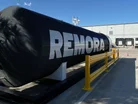
Remora’s patented device captures up to 90% of CO₂ emissions from semi-trucks and locomotives while reducing soot, particulate matter and nitrogen oxides (NOx). The system operates through three steps:
- Capture: A retrofitted device attaches to a vehicle’s tailpipe, filtering emissions in real time without impacting payload or range
- Offload: Drivers offload captured CO₂ in less than five minutes at truck stops or distribution centers
- Sell: Remora purifies and sells the CO₂ to industries like concrete production, sharing revenue with fleet operators.
Each truck equipped with Remora’s technology can capture 135–169 tonnes of CO₂ annually – equivalent to planting 6,200 trees.
This approach not only reduces emissions but also creates a financial incentive for adoption, addressing a key barrier in decarbonising freight transport.
Founding and mission
Remora was founded in 2020 by Paul, Eric Harding and Christina Reynolds whose doctoral research at the University of Michigan laid the groundwork for the technology.

The company’s mission – to decarbonise hard-to-abate transport sectors – stemmed from recognising the limitations of electrification for long-haul freight. By retrofitting existing vehicles instead of replacing them, Remora offers a practical transition for industries reliant on diesel.
“The US faces a national CO₂ shortage, yet trains and trucks emit 375 million tons of CO₂ annually,” explains Paul.
“We generate revenue for railroads and trucking companies by extracting, purifying and selling CO₂ from their exhaust.”
Early trials with trucking fleets demonstrated the system’s viability, leading to expansions into rail, including partnerships with Class I railroads.
Meet Paul Gross, Remora’s visionary Co-Founder and CEO
Paul Gross, named on the Forbes 30 Under 30 list in 2021, co-founded Remora in 2020 after earning a degree in Statistics and Data Science from Yale University.
Under his leadership, Remora has partnered with major players like Union Pacific, Norfolk Southern and Ryder.
His strategic focus on scalability and partnerships has positioned Remora as a leader in mobile carbon capture.
How does the technology work?
Remora’s innovation lies in mobile carbon capture, a departure from stationary industrial systems.
- Zero-backpressure design: The device integrates seamlessly with existing vehicles, avoiding performance losses
- Real-time filtration: CO₂ is separated using advanced adsorption materials, purified and stored onboard
- Tier 4 emissions compliance: The system reduces NOx and particulate emissions to meet stringent standards.
The technology is particularly effective for long-haul trucks and locomotives, which operate under consistent conditions ideal for capture efficiency.
By 2025, Remora aims to deploy systems across thousands of vehicles, potentially mitigating millions of tonnes of CO₂ annually.
Funding and investors
Remora has raised US$117m from top-tier climate investors, including:
- Lowercarbon Capital (lead investor in Series A)
- Valor Equity Partners (lead in the US$60m Series B)
- Union Square Ventures and Y Combinator.
This funding supports scaling manufacturing, expanding CO₂ offtake partnerships and advancing rail-sector deployments.
Pioneering a circular carbon economy
Remora’s model transforms emissions into a commodity, aligning environmental and economic incentives.
With freight demand projected to grow, scalable solutions like Remora’s are critical to achieving net zero targets.
“We're excited to generate new revenue for railroads and trucking companies, while simultaneously building a stronger supply chain for carbon dioxide end-users like beverage carbonators, food producers, greenhouses, welders and wastewater treatment facilities,” Paul says.
By leveraging existing infrastructure and fostering industry collaboration, the company exemplifies how innovation can drive systemic change in the fight against climate change.
Explore the latest edition of Sustainability Magazine and be part of the conversation at our global conference series, Sustainability LIVE.
Discover all our upcoming events and secure your tickets today.
Sustainability Magazine is a BizClik brand