Why is KLM Calling for Stricter SAF Policies from the EU?
Europe stands at a pivotal moment in shaping the future of aviation.
The recent Draghi report highlights three key challenges facing the sector:
- Energy security
- Competitiveness
- Emissions reduction.
Aviation company KLM is calling out to the EU to enforce stricter policies when it comes to SAF and e-SAF usage - a potential solution for aviation emissions.
A strategic opportunity for Europe
e-SAF offers a path to enhance energy security, boost industrial competitiveness and drive cleantech innovation.
e-SAF, also known as electro-Sustainable Aviation Fuel, is a synthetic jet fuel derived from renewable energy sources.
Unlike traditional SAF, which is often made from biomass, e-SAF is produced through a process that combines three main components:
- Renewable electricity (from sources like solar, wind or hydro)
- Water
- Captured CO₂ (from industrial sources or direct air capture).

With the potential to create 20,000 jobs by 2050 and access a €350bn (US$366bn) global market, e-SAF can position Europe at the forefront of sustainable aviation.
Despite approximately 30 announced projects, no facility has reached a final investment decision, highlighting the need for urgent policy support to drive investment and commercialisation.
KLM's leadership in sustainable aviation
KLM has demonstrated significant commitment to reducing aviation emissions through substantial investments in fleet renewal and the adoption of SAF.
KLM has secured the usage of SAF through partnerships and agreements.
Air France-KLM is partnering with TotalEnergies for the supply of 1.5 million tons of SAF until 2035.
“Securing the volumes of more sustainable aviation fuel needed to decarbonise our activity is a major challenge,” comments Benjamin Smith, Chief Executive Officer of Air France-KLM Group.
“This agreement with TotalEnergies is a further step in this direction and a testament to our long-standing support for the development of SAF production in France and Europe.
“A solid SAF sector capable of meeting our industry’s needs is a key factor in Europe’ sovereignty and energy independence.”
As the largest buyer of SAF among airlines, KLM is actively supporting the transition to low-emission air travel.
The airline co-founded Project SkyPower, a coalition advocating for policy reforms to accelerate e-SAF production.
KLM's CEO, Marjan Rintel, serves as one of the three co-chairs of Project SkyPower.
“Only by working together with government, knowledge institutes and industry can we take significant steps to achieve cleaner and quieter operations,” she explains.
“The Netherlands has the expertise, infrastructure and entrepreneurs to lead the way.
“The 10 concrete commitments adopted by the Dutch airline industry show what we stand for, what politicians can contribute to achieve these ambitions and what the Dutch people stand to gain.
“Together, let’s build a future-proof airline industry for everyone.”
KLM’s leadership highlights the critical role of industry players in advancing sustainable aviation solutions and underlines the urgent need for EU policy support to scale e-SAF production.
KLM also supports sustainability initiatives on the ground, contributing to reforestation projects in Panama, Uganda and Colombia since 2017.
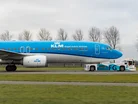
In late 2024, KLM dispersed the first 29 electric equipment tow tractors, adding to KLM’s electrification of ground operations.
Driving e-SAF progress
e-SAF has the potential to reduce global aviation emissions by 400 million tonnes annually while driving economic growth and energy resilience.
With its resources, expertise and industry alignment, the EU can lead the global e-SAF revolution.
Industry leaders have proposed five critical policy interventions to overcome investment barriers and accelerate e-SAF development:
- Prioritise e-SAF in industrial and transport plans: Integrate e-SAF into the clean industrial deal and sustainable transport investment plan to incentivise investment.
- Recycle ETS revenues to support market development: Use EU emissions trading scheme (ETS) revenues to fund a market intermediary, providing revenue certainty for producers and reducing price risk for offtakers.
- Introduce a bridging mechanism for early adopters: Implement a short-term funding mechanism from 2025 to support first movers ahead of the intermediary’s launch.
- Guarantee long-term regulatory certainty: Establish clear mandates, production criteria, and penalties to de-risk investments and enable long-term planning.
- Mitigate project-on-project risk: Provide a government-backed backstop to protect projects from delays in infrastructure delivery.
By implementing these interventions, the EU can catalyse investment, scale production and solidify its leadership in sustainable aviation and cleantech innovation.
Explore the latest edition of Sustainability Magazine and be part of the conversation at our global conference series, Sustainability LIVE.
Discover all our upcoming events and secure your tickets today.
Sustainability Magazine is a BizClik brand