
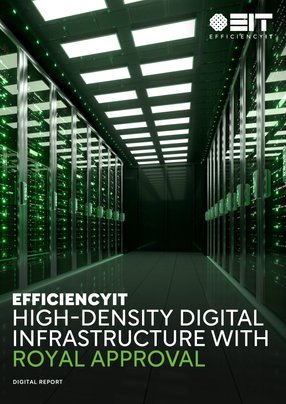
EfficiencyIT: High-Density Digital Infrastructure with Royal
When EfficiencyIT was founded in 2016, the initial aim was to challenge the status quo of what was achievable in data centres and critical IT .
“We wanted to do something different. We could see how the industry was changing, including people’s perception of resellers and what they do, and how what they deliver was changing. We wanted to be at the forefront of that change,” says Nick Ewing, Managing Director of EfficiencyIT.
The company now focuses on data centres, IT and critical communications environments, with a specialism in high-density, prefabricated modular systems.
Within that, Nick explains, it designs and delivers a mix of on-premise and prefab data centres, delivering them with energy efficiency software, power and UPS technology and both air and liquid cooling.
In 2017, the business began its journey into modular and prefabricated facilities. “We kind of fell into building prefabricated facilities quite early on,” he says. “That shift became one of our defining areas of growth.”
The ability to meet customers’ demands for speed of deployment, scalability and and energy efficiency has become a competitive edge for the company.
From the outset, the modular approach enabled it to meet those demands with units that could be built, shipped, powered and connected in weeks rather than months.
Partnership with Schneider Electric underpins modular data centre approach
Schneider Electric is central to how EfficiencyIT designs and builds power and cooling systems.
“One of our primary partners is Schneider Electric,” Nick says. “We’ve had a very long relationship with Schneider Electric, going back to the early 2000s.”
He notes how that alignment extends beyond hardware to core company values.
“Schneider Electric has a fantastic sustainability ethos and it’s something that is very important to us,” Nick says. “their tech supports our customers from the power layer all the way to the chip. We can work with Schneider Electric because their solutions align with our view of sustainability and electrical efficiency.”
That relationship is also evident in the dedicated range of prefabricated solutions that EfficiencyIT has developed, aptly named, ModularDC — power modules, traditional enterprise compute facilities, secure government units and AI pods.
The company’s modular data centres incorporate Schneider UPS and electrical systems, with capacities scaling up to several megawatts. The solutions have been adapted to support high-density applications, including those requiring liquid cooling for racks supporting 50kW to 100kW or more.
Rapid deployment and scaling to meet AI demand
The speed and flexibility of prefabricated systems have become vital as AI drives data and compute intensity beyond current infrastructure limits. “Prefabricated facilities are on the rise and demand will only increase because of the need for speed to market. HPC, AI and GPUaaS are all driving this,” Nick says.
To meet that demand, EfficiencyIT is expanding its UK manufacturing capability. “We’ve taken on a large manufacturing facility that will accommodate many, many, modules. We are investing heavily in that facility,” he explains. “We would expect to be able to have 20 to 40 modules in it at any one time.”
The business applies a strategy of parallel work streams, undertaking civil construction on-site while prefabricating AI and data centre infrastructure off-site. “Once the foundations are built, we turn up and roll in 10, 20 or 30 modules, power solutions, compute infrastructure, connect it up and turn it on,” he says. That approach cuts speed-to-market dramatically.
Nick highlights the economics driving this scale-up. “If you were to look at building a megawatt of compute, it might cost you £5m to £10m (US$6.6m to US$13.3m) to build the infrastructure to support it.
“But that megawatt of compute could then be worth tens, if not hundreds of millions of pounds.
“Obviously, the quicker you are operating that investment, the quicker you are monetising it. And that’s why speed to market is so important.”
Supporting government, defence and scientific research
EfficiencyIT’s customers include government departments, military operators, Formula 1 teams, global legal firms and life sciences institutions such as the Wellcome Sanger Institute.
“For some, it’s all about speed to market, speed to the mission,” Nick says. “With government and military, the fundamental requirement is not efficiency. It is reliability.”
He describes prefabricated modularity as particularly suited to mission-critical applications.
“If somebody needs a small edge-style facility that can be deployed rapidly, maybe five to 10 racks with power and cooling inside a ruggedised box, heightened security given the nature of its possible environment – that’s the kind of context. It’s all about speed to market, speed to the mission.”
The company’s partnership with the Wellcome Sanger Institute demonstrates how technology integration can optimise power use while expanding performance.
“The Wellcome Sanger Institute is an incredible organisation,” Nick says. “They are the foremost genomic research facility in Europe, possibly even the world.”
Over five years, EfficiencyIT has supported the Wellcome Sanger Institute in expanding compute capacity from around 70,000 compute cores to 250,000 while reducing electricity use by approximately 33%.
“We designed and had custom-built a load of Schneider power distribution systems so that we could monitor some of their specific platforms,” Nick notes. “We use the EcoStruxure software that monitors every single element of the data centre. By delivering several different elements, we were able to improve not just their energy efficiency, but also their operational efficiency.”
The Royal Warrant and sustainability leadership
This year, EfficiencyIT was granted a Royal Warrant of Appointment by King Charles III — recognition of its long-term collaboration with the Royal Household.
“It was a tremendous moment for us to receive a Royal Warrant of Appointment by His Majesty the King,” Nick reflects. “Having worked with the Royal Household for many years, that was a pretty incredible day in my house and with my colleagues.”
Receiving the warrant, he says, brought both pride and scrutiny. “The criteria is quite strict, so you have to be serious about sustainability. It’s not just a buzzword for the King, he’s long-championed environmental issues. Although the requirements for being a Royal Warrant holder are rigorous, the responsibility for being the grantee of the company is a huge privilege.”
The recognition, Nick adds, reinforces the company’s environmental commitments.
“It’s encouraged us on our sustainability journey, because sometimes you just need to do a little bit more. We’re a company called EfficiencyIT. Ultimately, if we didn’t care about efficiency, then there would be a bit of a mix-up of our brand’s image and values.
“It means trust. It means security, it means sensitivity, it means commitment, it means that we do what we say we do. So we put our money where our mouth is when it comes to our sustainability efforts.”
Nick’s description of walking into a Royal Household site captures the personal dimension. “Every time I walk into one of the buildings, I just kind of fill up with pride, because I know that what we’re doing is supporting one of the most famous establishments in the world,” he says.
Company culture and long-term direction
EfficiencyIT’s growth has been based on steady development rather than rigid commercial targets.
“We don’t put sales targets on people’s heads,” Nick says. “Our only ambition is that our team build relationships, trusted relationships, with our customers, and deliver deep value.”
The company’s culture is shaped by trust and autonomy. “Micromanagement is still a thing that I hear people having to suffer with, and I can’t think of anything worse. How can you trust people? How can you work in an environment where you don’t trust your staff? You’ve got to trust them,” he says.
Milestones over the past nine years have included its first 15 staff, key revenue thresholds such as the £5m and £10m marks (US$6.6m and US$13.3m) and industry awards that validated customer projects.
Each stage, Nick explains, reflects the team’s approach of growing via relationships rather than short-term sales targets. “The company is in a strong place financially and that means I don’t have to force people to sell on the last day of the month.”
Future challenges in an AI-driven era
Nick says the industry now faces unprecedented change.
“We are headed into uncharted territory, genuinely, because our world has literally been turned on its head by Nvidia,” he says.
The rapid escalation of rack power density, compute demand and cooling complexity is redefining design approaches.
Yet he views this as a phase of opportunity for those adapting early.
“AI and this new world of tech is allowing us to pivot how we use the data centre. We’re now working on a project where we have around 5MW of 55-degree water as the output from a supercomputing cluster. Our plan is to give all of that back to a nearby district heating system.”
That scheme, he says, could prevent nearly a million litres of kerosene being used for heating. “That is the kind of technology and the sustainability use cases that we are working towards.”
Nick concludes that decentralised models will increase as the UK looks to use waste heat more efficiently.
“The requirement to have a data centre in one of the UK availability zones has been reduced, so we can decentralise. And that means we can put our data centres into places where we can use the waste output much more efficiently.”
Here, ‘efficiency’ is the operative word – the clue is in the name, after all.
Company portals
Executives

Nick Ewing
Managing Director