
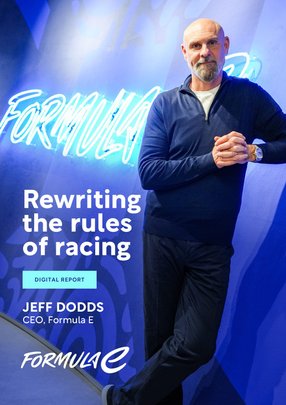
Formula E: How Jeff Dodds is Rewriting the Rules of Racing
In a sport built on speed, Jeff Dodds is playing a long game. The Chief Executive of the world's only all-electric motorsport championship brings with him a career spanning automotive, media and telecoms. He has worked with Volvo, Honda and Virgin Media, and developed a background that blends commercial rigour with an instinct for disruption.
In 2023, Jeff took on the sport’s top job. The appointment connected his years in media and telecoms with a sport he had long been drawn to. "I had an itch to do something different," Jeff explains. "I wanted to do something really purposeful that I felt passionate about, and I have a passion for motorsport. You put those three things together and this would be it."
The series, now in its 12th season, races across 10 countries and is backed by manufacturers including Porsche, Jaguar and Nissan. It is the only motorsport championship to have held a net zero carbon footprint since its inaugural season. For Jeff, this headline achievement is just a starting point.
"When I arrived here three years ago, the business was very proud of its number one ranking in the Global Sustainability Sports Index," Jeff explains. "My challenge back to them was: that is amazing, congrats – very low bar. Sport is a very low bar." His response was to shift the benchmark entirely.
Jeff explains: "My challenge to my team is often when they say, 'We think this is a really good idea,' I'll normally say to them, 'Okay, so how would we test that?' Because if we can test it without breaking the business and learn a load of stuff and iterate it, that's a great win."
Formula E pursued certification as a B Corp, a designation awarded by the non-profit B Lab to companies that meet rigorous standards of social and environmental performance, accountability and transparency. Certification requires meeting a minimum score across five areas including governance, workers, community, environment and customers, and must be independently audited every three years.
"The reason we went through the B Corp process was to pitch ourselves against the 10,000 other companies in the world that are reaching a threshold that's way beyond where sport is," Jeff continues. The series also holds a BSI Pathway to Net Zero certification, issued by the British Standards Institution, which independently verifies an organisation's carbon footprint calculation and reduction roadmap.
These are not branding exercises. They are, Jeff argues, the measures for genuine accountability. Formula E has committed to science-based targets that require the organisation to cut its carbon footprint by 5% year on year until 2050. That means a 5% reduction even as the championship continues to grow, adding races and entering new territories. This means it needs to do everything more efficiently, such as rethinking its entire freight operations and global logistics.
Sustainability is not a compromise
The dominant misconception around sustainability, Jeff believes, is that it means paying more for less. "When people hear the word sustainability, what they really hear is compromise," he explains. "A lower quality product that's more expensive to implement. That's what they hear."
"We can find a thousand examples in this business of sustainability meaning cost saving or even commercial revenue," Jeff says. Transporting cars and equipment around the world to each Formula E race destination used to take three planes, but through re-engineering equipment and changing strategies this was cut down to just two. This both cut emissions by 25% and "saved a chunk of money".
Traditionally, large teams of engineers and broadcast technicians travel with equipment to each race location around the world. Formula E has been shifting towards centralised remote broadcast operations in the UK, reducing the number of people and the volume of equipment that needs to travel. The result is fewer flights, lower costs and a smaller carbon footprint per race. "We have improved engagement and we improved retention of staff," Jeff says. "So this concept of 'yes, but it's a compromise' – for me that is the biggest misconception."
Artificial intelligence is accelerating that process. "Whether you think AI is a force for good or a force for evil, in our world, trying to make us more efficient and more sustainable, it has to be a force for good," Jeff says. "We're using that technology to help us reroute differently, to make different choices around how we broadcast."
The wider workforce of around 200 people at the organisation's central office is also benefiting. Jeff frames this not as automation replacing jobs, but as augmentation. "There is a lot of talk about replacing humans with AI," he says. "I think about supercharging the humans that we have, allowing them to be even more effective in their day-to-day work."
The electrification tailwind
Formula E's sustainability credentials are inseparable from its core product: electric racing cars. The series was founded on the premise that motorsport could be a laboratory for electric vehicle (EV) technology and a platform for normalising electric mobility.
For Jeff, the timing has never been better. "The internal combustion engine is 130 years old," he says. "The battery electric vehicle system is probably only 15 years old in terms of since the first Tesla Roadster was on the road. And in those 15 years, it's already gone to a point where in the EU in December, there were more electric vehicles sold than petrol vehicles." China, where Formula E already has more than 100 million fans, sold nearly as many new energy vehicles in 2025 as the total number of cars sold across all of North America.
"While it's a big, audacious goal to say we want to be the biggest motorsport in the world, we believe it's achievable," Jeff says. "Maybe not in two years or five years – maybe it takes 10 or 15 years – but we think it's achievable."
Formula E's fan base is younger than that of traditional motorsport and is roughly equal in its split between men and women. These are people who have grown up with EVs, who are engaged with technology and innovation and for whom sustainability is not a fringe concern.
"If my job were to come in and try and convince a die-hard Formula One fan that this is better, that would be the least satisfying job in the world," Jeff says. "If my job is to go to my kids, who are 17 and 14 and will probably only ever drive an electric vehicle, and say to them, 'Watch this – these cars are driving with the technology that's going to be in your car', that's what we focus on."
Opening the door
Motorsport has long been the preserve of wealthy families who can afford the hundreds of thousands of pounds required to progress through karting and junior series. The cost of taking a driver from their first kart race to a Formula One seat has been estimated at US$33m.
Women are particularly underrepresented. Of all the licence holders authorised to drive racing cars in the United Kingdom, 97% are men and just 3% are women. Formula E is using artificial intelligence, in partnership with Google Cloud, to address this imbalance through AI-powered simulator coaching.
"Instead of having years and years of being able to drive a car because they can afford to drive a car, they'll go into simulators," Jeff explains. "We're using AI coaches to help them accelerate their learning, to give them a better shot of getting a seat in a car at the elite level." It is, he argues, a concrete demonstration of the positive applications of emerging technology. "You can choose how you view AI – in that sense, it's a huge accelerator of good," Jeff says.
Sharing the playbook
Competitors in commercial sport are not typically given to publishing their operational playbooks. Formula E does so deliberately, through an event series called Change Accelerated Live, which invites outside organisations to hear how the championship is making changes and what impact those changes are having. "If we could help other people to be better tomorrow than they are today by doing some of the things we've done, we will share that with everyone," Jeff says.
He also says he is careful not to position Formula E as a judge of other organisations' records. "A lot of people say to me, 'You must be very critical of Formula One because they produce massive amounts of carbon'," Jeff reveals. "Quite the opposite. I tip my hat to them. They're a 75-year-old business that is making changes. They have a different starting point to us."
The question of systemic change in sustainability reaches beyond sport. Boards and senior leadership teams, Jeff argues, must make environmental commitments a core organisational objective rather than a secondary consideration. The economic pressures and political disruptions of recent years have pushed sustainability down many corporate priority lists, and he is frank about this.
"Fundamentally, nothing's really changed other than they've reprioritised based on what's happening around them," Jeff explains. "If you want true system change, not operational level change, at the very top of those organisations it has to be part of the core set of objectives of the business."
Formula E is not waiting for that shift to happen elsewhere. Jeff is attempting to demonstrate, one race at a time, that performance and sustainability are not opposing forces.
"Our role is to show people that driving electric vehicles doesn't mean a compromise on performance, is perfectly manageable within range and has the fringe benefit of being zero tailpipe emissions," Jeff says. "It's an 'and' not an 'or' – but in this world, people love an 'or'."
Company portals

Executives
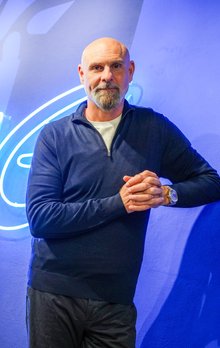
Jeff Dodds
Chief Executive Officer