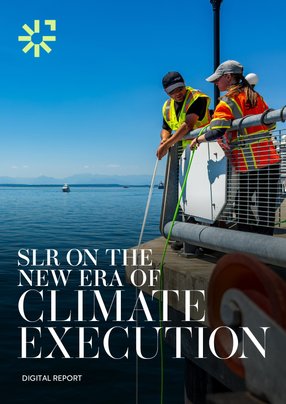
The global economy is pivoting from ‘climate ambition’ to ‘climate execution,’ as the marketplace is becoming increasingly crowded with generalist firms offering sustainability advice.
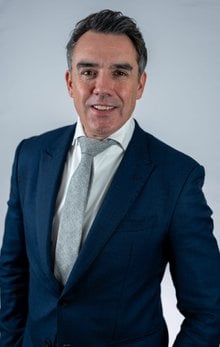
Bradley Andrews, CEO of SLR Consulting, has made it his mission to carve out a different path, describing SLR as a “global pure-play sustainability company” that acts as the essential bridge between deep technical environmental science and commercial reality. Under Bradley’s leadership, SLR has positioned itself at the intersection of three critical pillars: technical expertise, strategic advice and digital foresight.
What really sets SLR apart from the rest is its people. The firm is powered by “4,000 of the world's smartest scientists, engineers and social scientists,” many of whom have “master's and PhD-level expertise in their field,” Bradley says. With work spanning lizards in the Chilean mountains to groundwater in Western Australia, Bradley assures that SLR’s strategic advice is never untethered from physical reality.
This technical rigour sits at the core of the firm’s ability to help clients move beyond standard reporting. “The markets don’t reward ambition, they reward execution,” Bradley says, as he explains that, in his view, sustainability is no longer a boardroom aspiration, and more of a “contact sport” that requires tangible outcomes in the physical world.
Moving from compliance to performance
The current shift from theory to practice is creating a reevaluation of how firms view their environmental responsibilities. For SLR, however, it is important that the term sustainability is used correctly. Recognising it as the balance between environmental, social and economic factors.
Bradley reflects that sustainability has somewhat come to signify the environment, which has further narrowed to focus solely on carbon. Although he notes the importance of this, he states that it’s equally vital to strike the right balance.
“It has to be balanced with the needs of society and the community,” he says. “It has to be economically viable, and it has to encompass other parts of the environment other than just carbon – whether that's biodiversity, ocean health, soils or air quality.
“The biggest thing in today's market is the triple bottom line – the balance of economic, social and environmental.”
Most concerning for Bradley is that he believes sustainability “has stopped being a reporting topic” and has now become “a performance topic.” Yet he insists that “the markets don't reward ambition, they reward execution.”
He says that five years ago SLR’s clients could establish net-zero targets and map how they will work with the community, “and that was enough”. Now, it’s something businesses need to prove. He expands: “They have to show that they're investing in the right things and they're getting the right outcomes. That's been a real shift over the last 12 to 24 months.” This is particularly important, as it demonstrates that industries and society are “not just putting things down on paper,” but they’re understanding the physical, real-world outcomes, says Bradley.
Embedding resilient strategies
When it comes to de-risking the transition for heavy industries – sectors like mining, energy and infrastructure – Bradley is wary of the industry's tendency to promise “bulletproof” strategies. In a world defined by geopolitical shifts and supply chain volatility, he argues that a guarantee is less valuable than a strategy that can bend without breaking.
Instead of searching for a perfect shield, Bradley focuses on building a “resilient strategy.” He notes: “The world is changing very fast, so nothing can be bulletproof,” but rather, he focuses on setting up a strong strategy with a solid implementation plan. From this, resilience can be “baked in.”
This resilience is then built on the bedrock of technical expertise, with Bradley explaining that “a resilient plan involves science, maths, data and expertise. It involves engineering, things that we know we can bank on.”
By looking at every decarbonisation mandate through this rational lens, SLR helps clients navigate the “pragmatic transition.” It’s a partnership approach that acknowledges the complexity of the task: it must be robust enough to withstand the scrutiny of the market, yet agile enough to adapt when “Plan A” meets the reality of a changing world. As Bradley frames it, the goal is to turn knowledge into “decision-grade insights” where the client can move forward with “real confidence.”
Scaling an expert culture with M&As
At SLR, growth is a disciplined response to a volatile market. Although the firm has merged with over 40 companies since 2019, Bradley is firm that it doesn’t “just buy companies to buy companies,” but rather they’re doing what “client demand is telling” them to do.
As a result, every acquisition is a strategic bridge, such as the recent expansion into Chile to support global mining operators. However, the real challenge in such rapid scaling is avoiding the “big firm” trap, which Bradley explains is only done through a rigorous process of “cultural due diligence.”
For a merger to succeed, Bradley insists that the joining firm must see SLR as a “pathway to their strategic success.” He notes that it shouldn’t be seen as a “30-person company joining a big 5,000-person company,” but rather knowing that there’s a clear idea as to what they want to do with a global reach behind them. By upholding this philosophy, niche technical expertise is not diluted by global brands.
Maintaining this agility requires a leadership style Bradley calls “professional empathy,” and, as a scientist himself, he has a huge amount of respect for his fellow experts.
“I can have empathy for others as a human being, but do I have empathy for them as a professional?” he asks. “The fact that you're not an expert in the field that I am in, but that I show I trust your knowledge, really matters. Every voice matters and needs to be heard, as it could be part of the solution.”
He adds: “We’re one team. We collaborate without conditions. We focus on science. We respect the experts.”
Competing in the sustainability talent war
To differentiate against competitors in the global talent war, SLR’s recruitment strategy relies on making a tangible impact, with Bradley sharing a candid approach: “We have a purpose, but we don't sell it,” he says. “What we offer is the ability for you to make a difference and the outcomes that brings.”
Bradley understands that top-tier scientists and engineers are driven by purpose, vision and a sense of accomplishment. He, therefore, believes that elite talent stays engaged when people are part of a team solving problems in the physical world
To do so, SLR encourages recruits to “come in and learn” the teams and people they would be working with, to understand what they can bring to the table together. From this, Bradley wants to demonstrate that employees join to “make a difference.”
“You're going to see outcomes, and we're going to help you get there,” he says. “Sustainably only works when strategy, execution and data come together. Sustainability doesn't work in a boardroom or on a PowerPoint. It works in the physical world.”
By offering a "purpose-led" career path that prioritises measurable results over corporate messaging, SLR attracts those who want to see the literal fruits of their labour, whether that's a restored water system or a de-risked mining operation.
The true meaning of sustainability
Working with already-green technologies is often the easiest path for many in the sustainability space. However, Bradley argues that a “pragmatic transition" requires leaning into the most difficult sectors: cement, steel, heavy transport and traditional energy. He warns that sidelining these legacy players would be “foolhardy and irresponsible.”
“The fact is that coal, oil and gas took billions of people out of poverty in this world,” Bradley notes, after recalling a piece of advice from his grandfather “to never forget where you are from.” He continues: “We shouldn't just dismiss them. We should transition.”
Likewise, Bradley takes a rational rather than altruistic approach to environmentalism, as he is quick to call out “virtue signalling,” which he defines as spending money to look good without making a physical difference.
SLR views this to be just as damaging as greenwashing, with Bradley explaining: “Virtue signalling is the destruction of capital. Greenwashing is the destruction of trust. Both are at the opposite end of the spectrum, but they're equally as damaging.”
Consequently, SLR works inside legacy systems to help industrial giants take practical, measurable steps. The approach prioritises energy security and affordability alongside carbon reduction.
“Nobody wants to ever reduce the standard of living,” he says. “We’ve got to balance these things.” For the critics who argue that partnering with traditional energy slows the transition, Bradley’s answer is simple: if you want to solve a hundred-year problem, you have to work with the people who have the capital, the infrastructure and the smarts to change it.
Focusing on the road ahead
As SLR prepares for the future, Bradley notes that the evolution of the ‘consultant’ is being driven by a hybrid of human ingenuity and AI.
“The advent of digital changed the industry 20 years ago, but AI is going to, and has, changed [the industry] a hundredfold,” Bradley observes. Yet he remains wary of implementing technology for technology’s sake, while keeping SLR’s focus on not replacing humans, but helping individuals build “AI agents” to synthesise data faster and find information more efficiently. It is about the “human element of AI,” ensuring that data leads to better decision-making rather than just more noise.
“We never forget that these things have to happen in concert,” he adds. “It’s about the partnership of how humans and technology work. It’s not just about replacement because then you lose the human ingenuity, you lose the creativity.”
By providing “foresight through data and digital,” SLR aims to move beyond the traditional project-based model, with Bradley noting that the role of the consultant is shifting from a one-off technical advisor to a permanent fixture in a client’s strategic architecture.
While the firm still delivers specific projects, Bradley highlights the importance of long-term relationships with clients, as well as offering a “series of advice.” By turning deep technical knowledge into “decision-grade insights,” SLR provides the “assurance” and “clarity” that boards and executives need to allocate capital in an uncertain world.
Ultimately, this digital maturity is what allows SLR to be more than an advisor; it makes them a long-term partner in their clients' strategic ambitions. “We deliver our promises,” Bradley asserts. “We work with clients to realise the value we bring.”
Over the next 18 months, Bradley is expecting high velocity and significant global change, explaining that the world is in a “very interesting place, to say the least,” while citing shifting supply chains, tariffs and the “world’s biggest capital deployment in AI and data centres.”
As a result, Bradley is giving a sharper focus on the fundamentals, with a focus on “getting rid of the noise.”
Ultimately, Bradley’s goal is to ensure that SLR is a firm that makes others “look up from their phones,” and demonstrates that meaningful change isn't found in net-zero pledges, but in the engineering of the transition itself.
By staying focused on the physical world, SLR is proving that the path to a sustainable future is paved not with ambition but with execution. “We’re going to stay focused on the mission of Making Sustainability Happen,” he concludes.