
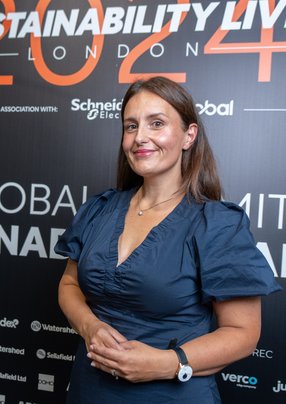
Angela Hultberg
Group Sustainability Director
Sustainability has become a defining issue for businesses, governments and communities worldwide. Yet, its evolution from a niche concern to a boardroom imperative has been anything but straightforward.
About Angela Hultberg
Angela Hultberg is Group Sustainability Director at Kearney, a global management consulting firm renowned for advising Fortune 500 companies on embedding sustainability into their operations and strategies. Her journey to Kearney is rooted in hands-on experience that has spanned both corporate and consulting worlds. Today, based in Copenhagen, Angela helps some of the world’s largest companies navigate the complexities of sustainable transformation.
Kearney itself brings more than nine decades of consulting expertise to the table. Founded in 1926, the firm operates in more than 40 countries and is known for its work with leading global businesses. Kearney’s sustainability practice supports clients in rethinking business models, integrating ESG factors and building resilience for a rapidly changing world.
For Angela, the role is about more than compliance or reputation management. “I advise clients on how to be more sustainable and how to change their business models and embed sustainability throughout their daily operations, core business and strategies,” she explains. This holistic approach is increasingly demanded by stakeholders, from investors to consumers.
The role of the Chief Sustainability Officer
The past decade has seen a dramatic shift in how sustainability is perceived within organisations. Once relegated to a peripheral function, it is now recognised as central to long-term success.
“Sustainability leadership has been to a very large extent female,” Angela notes.
“I spend a lot of time in the transport sector, and it's very common that I am the only woman in the room. But when I have sustainability meetings, there might be only women in the meeting.
“I sometimes wonder if there is something there,” Angela continues. “Most CSOs are women, and it’s a position that is crucial for business survival, for growth, for staying in business, and yet it comes without the mandate and the resources that other C-suite positions come with”.
This unique dynamic, she suggests, may have influenced the collaborative and persuasive style often seen in sustainability leadership.
Is sustainability in the media too niche for impact?
As leaders who have to engage, inspire and influence, CSOs have a relationship with the media that other leaders may not – and Angela is candid about the limitations of current coverage.
“Knowledge sharing is incredibly important, but often sustainability media is too niche – it’s tailored to people like me, but I’m already sold!” she says.
“We need to explain sustainability to business leaders, the general public, politicians, and to do that we have to bring it into every day. It is much like sustainability in business – it cannot be an extra on the side.
“It needs to be embedded.”
The crucial role of partnerships in sustainability
For Angela, collaboration is the linchpin of sustainable progress. “Partnerships are crucial. That’s the only way to make this world sustainable,” she believes.
Even the most sustainable product is meaningless if the ecosystem doesn’t engage – if supporting infrastructure is lacking, there will be no product uptake, or if there is no lifecycle care and the product ends up in landfill, it isn’t sustainable.
“They can produce all the electric vehicles in the world but if there’s no charging infrastructure, nobody’s going to buy these cars,” Angela explains.
The solution, she argues, lies in systemic change and cross-industry collaboration.
“Partnership is the only way to create a truly circular and regenerative business,” Angela says.
Regulation, political shifts and the environmental agenda
The interplay between politics, media and sustainability is another area of concern for Angela. She sees a troubling trend in journalism that mirrors political discourse, which increasingly relies on emotion rather than facts. “We’ve reached a point where it’s less about the politics you want to see and the society you want to see and build, and it’s more again about creating emotion,” Angela explains.
Despite these challenges, she is clear about the power of regulation. “There is no faster way to see change happen than regulation. If you ban fossil fuels, then businesses will find other ways of making money,” she says.
However, she warns that political instability can undermine progress: “Political shifts mean that things become very uncertain. We can’t trust the laws or a system for more than four years. It means companies do not invest their money – they go into ‘wait and see’ mode. And that’s the worst place to be”.
The future of sustainability: acting before the crisis
Looking ahead, Angela is both pragmatic and passionate. She believes that humanity’s greatest challenge is overcoming inertia. Despite clear warnings about climate change, she observes, action often comes too late.
Yet, she remains committed to driving change. “We see climate change coming a mile away. We understand intellectually that this is really, really bad… but we don’t act,” Angela reflects. Her hope is that by embedding sustainability into every aspect of business, media and policy, society can move from awareness to action before the next crisis hits.
To read the full article in the magazine, click HERE.
Explore the latest edition of Sustainability Magazine and be part of the conversation at our global conference series, Sustainability LIVE.
Discover all our upcoming events and secure your tickets today.
Sustainability Magazine is a BizClik brand