
Can Augmented Reality Help to Modernise Healthcare Training?
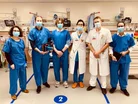
Respiratory infections from hospitals, or healthcare-associated infections, are very common yet can be very dangerous, especially in cold and flu season.
A new training programme has been launched as a collaboration between Dassault Systèmes and Saint-Louis Hospital AP-HP to help improve understanding of infection prevention.
The initiative could help transform the way hospitals prepare for the season and prevent airborne infections.

The hospital’s infection prevention and control team, known as ESPRI, conducted a hospital-wide study exploring hospital-acquired infections.
The survey of 300 healthcare professionals, including doctors, nurses and administrative staff, found that fewer than 20% of staff could answer a question about respiratory cross-transmission correctly.
Respiratory infections are a prominent issue in healthcare settings, especially in open care spaces where airborne particles can spread more easily.
This gap in professional understanding is likely due to a lack of regular and practical training opportunities tailored specifically to these risks, according to ESPRI.
Virtual twins for healthcare training
Through the new training from Dassault Systèmes and Saint-Louis Hospital AP-HP, healthcare professionals can receive training in a hands-on way, rather than sitting through traditional lectures.
The training method is based on Sense Computing and uses virtual twin powered augmented reality (AR) to create a digital version of the hospital spaces.
The system shows airflow patterns throughout the space, meaning doctors and nurses can fully understand the impact of airborne infections in open care spaces.
Traditional training often relies on passive learning through lectures, which may not properly capture the complexity of the real life hospital environment.
By using AR, students and staff can experience an immersive training approach which helps them best perceive and mitigate airborne transmission risks.
This innovative method bridges the gap between theory and practice, allowing staff to make more informed decisions around patient safety.
Dr Guillaume Mellon, Attending Physician, Head of Infection and Control Team at Saint-Louis Hospital AP-HP, says: “Augmented reality brings infection prevention training to life in a way that traditional methods can’t.
“With an iPad in hand, professionals can move through their workspace, see how airborne particles travel and truly grasp the risks in real time.
“This hands-on experience makes training more engaging, memorable and impactful.”
Modelling airflow in open care spaces
The collaboration between Saint-Louis Hospital AP-HP and Dassault Systèmes has expanded through its Virtual Twin as a Service (VTaaS) approach.
This provides healthcare teams with advanced modelling and simulation capabilities without needing in-house technical expertise.
Using Dassault Systèmes’ decades of experience in virtual twin technology, VTaaS provides accurate insights on time and budget to organisations.
The system can help organisations optimise their ventilation systems and the placement of patient beds to mitigate the risk of airborne respiratory illnesses.
Dassault Systèmes has developed realistic simulations to estimate the presence of respiratory particles between patients.
Professor Benoit Plaud, Head of the Anaesthesia and Surgical Intensive Care Department at Saint-Louis Hospital AP-HP, says: “Before, we had very few tools to illustrate air contamination risks.
“The collaboration with Dassault Systèmes has allowed us to develop an innovative educational tool that uses augmented reality to give healthcare professionals a tangible understanding of how air contamination occurs, whether from patients or caregivers, by directly visualising airflow in open care spaces.”
The simulations have helped demonstrate that respiratory particles can travel across a room as far as 25 metres, showing that infectious particles are not confined to the immediate area around a patient.
This has helped reinforce the importance of well-designed ventilation and protective measures.
The project has achieved a more accurate depiction of the spread of particles and airflow compared to Dassault Systèmes’ earlier work.
It showed how patients were exposed to a greater or lesser risk of contracting a respiratory infection, depending on their placement in the unit, providing insights about patient placement and infection control strategies.
Company portals


Executives

Benoît Plaud
Président élu de la sous-section 48-01 anesthésiologie - réa, médecine péri-opératoire du CNU Santé

Dr Guillaume Mellon
Attending Physician - Head of Infection Disease Prevention Control Unit - Hôpital Saint Louis