Amazon: What is the True Energy Cost of Data Centres?

As data centre construction accelerates across major markets, questions remain about whether large facilities drive up electricity bills for nearby communities.
Amazon has attempted to answer this by commissioning what it calls a first-of-its-kind independent economic study examining how its data centres interact with local power grids and electricity prices.
"There’s been a lot of speculation about data centres and their impact on utility rates. It’s an important question — and today, we have an answer," says Kara Hurst, Amazon’s Chief Sustainability Officer, in a LinkedIn post.

"New independent research by Energy and Environmental Economics, Inc. (E3) found that Amazon data centres don’t increase electricity costs for people or businesses. Even more, they can actually support communities.
"This research reflects what we know to be true: doing business and making climate progress aren't mutually exclusive. We can meet growing energy demands while strengthening grids, protecting customers and accelerating the carbon-free energy transition — and we are!"
E3’s research focused on whether the electricity costs tied to Amazon data centres are subsidised by other customers. The results show that Amazon covers the full cost of the power it uses and, in some regions, pays more than the direct cost of service.
Understanding electricity pricing for data centres
Electricity bills reflect a combination of generation, transmission and distribution charges that vary depending on the type of customer. Utilities usually apply different rate structures for households, commercial users and large industrial customers — such as data centres.
In the US, a significant portion of grid infrastructure is ageing, with roughly 70% of transmission lines more than 25 years old. Sustained investment is needed to maintain reliability and meet rising demand fueled by electrification, AI and cloud computing. A Lawrence Berkeley National Laboratory study reported that between 2019 and 2024, US electricity prices climbed by 23%, largely due to the cost of upgrading transmission and distribution networks.
To allocate infrastructure costs fairly, utilities increasingly apply tailored tariffs for high-energy users. Data centres typically pay these specialised rates, designed to prevent costs from being passed on to residential customers.
What the E3 study found
E3’s analysis concluded that Amazon data centres fully pay for their electricity consumption and do not shift those costs to residential or small business customers. In several regions, Amazon contributes more than the minimum required to serve its demand.
For a typical 100MW Amazon data centre, this surplus contribution is estimated at US$3.4m in 2025, rising to US$6.1m by 2030. Utilities can use this additional revenue to modernise grids and enhance reliability for all users.
The study outlines how these effects vary across states. In Northern Virginia, Dominion Energy’s 2024 earnings report showed that residential customers pay about 10% less than the national average for transmission costs, while large users — including data centres — cover 9% of those costs. In California, Pacific Gas & Electric stated that every gigawatt of data centre demand could cut average household bills by 1% to 2%.
Grid investment through regional partnerships
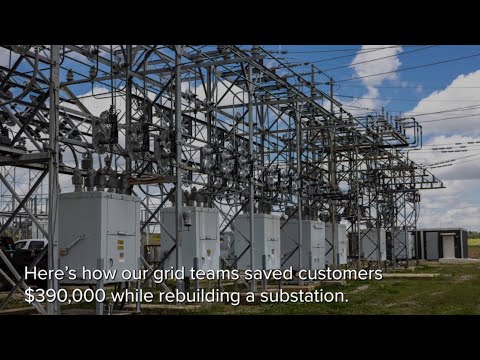
The research also highlights how large customers like Amazon help fund targeted grid improvements. In Mississippi, Entergy is using capital from Amazon and others to support its US$300m Superpower Mississippi programme, designed to strengthen grid resilience and reduce outages.
“Through our ‘Superpower Mississippi’ initiative, we’re making a US$300m investment to transform our grid like never before,” says Haley Fisackerly, President and CEO of Entergy Mississippi.
“Typically, these kinds of large-scale upgrades would translate to higher electricity bills for our customers.
“But thanks to the influx of new customers like Amazon coming to Mississippi, we’re able to fund these critical reliability improvements without passing any added costs on to our residential and small business customers. It’s a true win-win: we’re delivering a more robust, resilient grid, while ensuring our rates remain well below the national average.”
In Oregon, Amazon partners with Umatilla Electric Cooperative under a self-supply agreement that allows the company to procure its own energy — including renewables — without affecting other customers’ costs.
Carbon-free energy and data centre demand
Alongside grid investment, Amazon continues linking its data centre growth to the development of carbon-free energy. The company has invested in over 600 solar and wind projects worldwide, expanding regional generation capacity that also benefits homes and businesses.
Across the four states featured in the E3 study, Amazon is adding about 4.2GW of firm carbon-free energy capacity. It is also backing innovative technologies such as small modular nuclear reactors to meet future data centre needs with dependable, low-carbon power.
For communities hosting large-scale data centres, the findings suggest that well-designed tariffs and long-term utility partnerships can align infrastructure investment with rising digital demand. The study offers valuable data to guide regional planning as policymakers balance economic growth, grid resilience and electricity affordability amid expanding data centre capacity.
Company portals



Executives
Haley Fisackerly
President and CEO
Kara H. Hurst
Vice President, CSO, Worldwide Sustainability