Google Backs America's Largest Solar Project in Arkansas
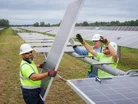
Cypress Creek Energy has started work on the Steel River Energy Center in Mississippi County, Arkansas.
The facility could become the largest solar installation in the US when construction finishes in 2029.
Google is the anchor investor and offtaker for the project. The company will purchase all electricity generated by the facility once it becomes operational.
According to Google, the completed facility will generate 2.5GWdc at peak performance.
The project will also add 2.9GWh of energy storage capacity to the regional grid.
Michael Terrell, Global Head of Advanced Energy at Google, says the project represents a milestone. "Today we reached a milestone in Google's global clean energy portfolio: we're purchasing power from our largest solar and storage facility to date," he says.
"Steel River Energy Center, which broke ground today in Arkansas, will also be the largest solar project in the US once fully operational."
Domestic steel supply chain
Mississippi County is the largest steel producing county in the US. All structural steel for the facility will be sourced and manufactured within the state.
US Steel's Big River facility will provide the steel. PACO Steel's plant, located 20 miles downstream on the Mississippi River, will handle manufacturing.
Amanda Peterson Corio, Global Head of Data Centre Energy at Google, says the location was chosen deliberately. "Mississippi County is a leader in American steel production," she says.
According to Peterson Corio, the project will create 700 local jobs and generate US$300m in tax revenue over its operational lifetime. The economic contributions could extend beyond direct employment to supporting infrastructure and services in the surrounding area.
Battery storage and grid capacity
The first two phases will add 1.6GWdc of solar generation and 1.9GWh of battery storage to the grid. GWdc refers to direct current capacity before conversion to alternating current, which means actual grid output will be somewhat lower.
All three phases combined will deliver 2.5GWdc of solar generation and 2.9GWh of battery storage. According to Google, this capacity could power more than 315,000 Arkansas homes annually.
Kate Brandt, Chief Sustainability Officer at Google, says the combination of generation and storage addresses grid reliability concerns. "By pairing massive solar arrays with battery storage, the project can store the sun's peak daytime output and feed it back into the grid exactly when it's needed most," she says.
Brandt adds that the approach could create "a more reliable, resilient grid that can meet rising electricity demand while keeping power affordable for everyone." The stored energy could be released during evening hours when solar generation drops but demand remains high.
Data centre electricity demand
Google's involvement in Steel River stems from its electricity consumption requirements. The company's data centre expansion has increased power needs, with much of the growth linked to AI infrastructure rollout.
- GWdc, or gigawatts of direct current, is not to be confused with GW. While both metrics measure power capacity, GWdc is specific to solar energy.
- The output of solar panels can vary depending on cloud coverage, the time of year, wind, temperature or the quality and age of the equipment, but GWdc measures the capacity of photovoltaic arrays working at maximum efficiency.
- It can help to think of GWdc as a car driving at its top speed. Solar panels will only be able to generate that much capacity if all the conditions are right.
According to reports, Google's annual energy consumption exceeds that of half the world's individual countries. The company uses more electricity than many nations due to its global data centre operations.
Hyperscale technology companies including Google, Amazon and Microsoft have faced criticism for straining local grids. Some communities have raised concerns that large electricity loads push up bills for residential customers.
Google has disputed this characterisation. The company argues that large loads can help lower costs by funding new infrastructure that would otherwise be paid for by households.
Community energy initiatives
Google has committed US$5m to energy affordability programmes in Arkansas. The funding will support community solar subscriptions for low-income customers in West Memphis.
Additional programmes include home retrofitting and efficiency upgrades for local schools. The initiatives aim to reduce energy costs for families and public institutions.
Adam Elman, Head of Sustainability for EMEA at Google, says large infrastructure projects can benefit communities.
"By pairing massive solar arrays with advanced battery storage, we are not just decarbonising the grid; we are proving that large-scale infrastructure can simultaneously drive domestic manufacturing and long-term economic prosperity for local communities," he says.
Amanda Peterson Corio says Steel River could make energy more accessible in the region. "Our responsibility goes far beyond these clean electrons flowing into the grid," she says.
"We know that many families are focused on simply making ends meet right now. That's why Google is also funding additional energy affordability initiatives to support Arkansas families, including community solar subscriptions, home improvements and energy efficiency projects in schools."

The facility's completion timeline extends to 2029, with phased deployment allowing earlier sections to begin generating power before the full build-out finishes.
Company portals


Executives
Adam Elman
Director of Sustainability for EMEA
Amanda Peterson Corio
Global Head of Data Center Energy
Kate Brandt
Member Board of Trustees
Michael Terrell
Head of Advanced Energy