
H2 Factory® and Green Hydrogen Decarbonisation
In an energy-intensive and “hard to abate” sector like ceramics, decarbonisation presents significant technical challenges, especially when it comes to fully or partially replacing fossil fuels in the ceramic firing phase. In this context, hydrogen plays a crucial role in reducing CO₂ emissions linked to production.
Iris Ceramica Group, a global leader in the design, production and distribution of premium ceramics for residential, commercial and industrial applications, has always stood out for its strong ESG commitment. This vision is well captured by the company’s founding principle from the 1960s: the equation ECONOMY=ECOLOGY.
As part of this commitment, the creation of H2 Factory® marks a major step in the Group’s decarbonisation journey. Speaking at the Future London conference last June in the UK capital, CEO Federica Minozzi explained that this innovative project responds to growing demand in the construction sector for solutions to reduce the embodied carbon of materials. H2 Factory® therefore reflects the Group’s ambition to innovate sustainably while retaining a leadership position in an evolving industry.
About the H2 Factory®
Launched in 2019 at the Group’s production hub in Castellarano (Reggio Emilia), the H2 Factory® project began with the demolition of an old industrial building, the installation of a new kiln engineered to run on a blend of green hydrogen and natural gas, the construction of rainwater collection tanks for use in electrolysis, and the development of an internal hydrogen distribution network alongside dedicated production and storage areas for green hydrogen.
In 2023, Iris Ceramica Group signed an agreement with Edison Next, part of the Edison Group, which helps clients and local areas navigate decarbonisation and ecological transition, to create a new manufacturing standard powered entirely by green hydrogen and start a “test phase”. In May 2024, the pilot plant was activated: two temporary electrolysers with a combined electrical capacity of 120 kW, powered by renewable energy, capable of producing up to 20 cubic metres of green hydrogen per hour. This setup enabled a hydrogen-ready kiln to run on a blend containing around 7% green hydrogen—a figure set to rise with the completion of the permanent facility Edison Next is already building.
The partnership between Edison Next and Iris Ceramica Group is central to the project: sharing the same values and vision, the two companies have combined their expertise to bring an entirely bespoke, pioneering project to life. Iris Ceramica Group contributes its deep knowledge of production processes, raw materials and ceramic technologies, while Edison Next brings its energy sector know-how and technological innovation.
Green hydrogen and ceramics
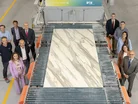
In July 2024, the H2 Factory® produced the world’s first large-format ceramic slab (3.2m x 1.6m, 12mm thick) in 4D Ceramics using a blend of green hydrogen and natural gas—a historic milestone for decarbonising the ceramics sector.
The aim of this first phase is to explore the use of green hydrogen technology in slab production, while carefully assessing the material’s behaviour during firing. This will enable the Group to scale up production with the confidence that its trademark aesthetic, technical and quality excellence is preserved.
Edison Next is already working on a permanent 1 MW facility, which will produce around 132 tonnes of green hydrogen per year. This plant will power the kiln with a blend containing up to 50% green hydrogen, significantly cutting CO₂ emissions and paving the way towards fully hydrogen-powered production.
The green hydrogen production system being developed by Edison Next is designed to be scalable, allowing production to double in the future and power a new kiln running 100% on hydrogen, which is already under study. The ultimate goal is to achieve 100% green hydrogen production within five years and eventually export this innovative manufacturing model to Germany and the United States.
The future of sustainable development
Beyond reducing emissions and decarbonising processes, the H2 Factory® also unlocks new opportunities. “This project shows how companies can act as cultural catalysts, promoting new sustainable development models based on circular economy, technological innovation and the enhancement of skills,” said the CEO of Iris Ceramica Group at the London conference.
In fact, H2 Factory® has demanded not only cutting-edge technologies but also a deep organisational transformation—from talent management to skill development and new operational procedures. This transformation has attracted fresh talent and new clients alike, creating significant opportunities for the Group’s future.