How Sustainable is Microsoft's Most Powerful Data Centre?
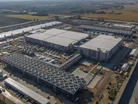
In Wisconsin, US, Microsoft is building what it describes as the world’s most powerful AI data centre.
Construction on the Mount Pleasant facility is in its final phase and is scheduled to be operational in early 2026.
The project represents an initial US$3.3bn investment with a further US$4bn planned for a second data centre, bringing Microsoft's total commitment in the state to more than US$7bn.
The facility is engineered to train frontier AI models, housing hundreds of thousands of NVIDIA graphics processing units (GPUs) in clustered formations.
These specialised processors are designed to accelerate AI model training by performing large-scale calculations in parallel.
While the site will be a hub for technological innovation its operational strategy is rooted in environmental management.
Advanced closed-loop cooling
A key feature of the data centre's design is its approach to cooling the high-performance hardware.
More than 90% of the facility will rely on a closed-loop liquid cooling system, which is filled once during construction and then continuously recirculated.
This method is designed to minimise water consumption.
The remainder of the site uses outside air for cooling, only turning to water during periods of peak heat.
As a result, the facility's annual water usage is expected to be modest, comparable to that of a single restaurant’s yearly use.
“What sets Microsoft’s infrastructure apart is the relentless pursuit of innovation and sustainability,” says Noelle Walsh, President for Cloud Operations + Innovation at Microsoft, writing on LinkedIn.
“Our data centres use advanced closed-loop liquid cooling systems – integrated pipes circulate cold liquid directly into servers, extracting heat efficiently and ensuring zero water waste."
“Nearly 90% of our data centre capacity uses this system, requiring water only once during construction and continually reusing it with no evaporation losses. This breakthrough enables higher rack density and supports the most demanding AI workloads, while dramatically reducing environmental impact.
“Globally, Microsoft has contracted over 34 gigawatts (GW) of carbon-free (renewable) electricity across 24 countries. In Wisconsin, we will match our energy consumption with renewable energy onto the grid.
“To protect customers from future cost increases due to data centre operations, Microsoft is pre-paying for the energy and electrical infrastructure used by the Wisconsin data centre."
Renewable energy and grid stability
Microsoft has committed to covering its energy needs without affecting local prices.
Microsoft is pre-paying for the energy and infrastructure it consumes to help ensure price stability for residents.
It also pledges to match every kilowatt hour of fossil fuel energy used with carbon-free energy supplied back to the grid.

This includes a new 250 MW solar project under construction in Portage County to support the data centre's operations.
Microsoft is also working with local utility WE Energies to manage transmission generation and usage under transparent tariffs intended to protect the reliability of the grid.
Ecological restoration
Beyond the facility's operational footprint Microsoft is funding ecological restoration projects across Racine and Kenosha counties.
These efforts are in partnership with the Root-Pike Watershed Initiative Network and include work at Cliffside Park Lamparek Creek Kirkorian Park and the Shagbark Restoration Area.
This investment extends to the local workforce with more than 3,000 workers employed at peak construction.
Once both sites are fully operational they will employ approximately 800 full-time staff.
Workforce development
Microsoft is also investing in local training through its Datacenter Academy established with Gateway Technical College.
This aims to prepare more than 1,000 students for data centre roles within five years.
For Brad Smith, Microsoft Vice Chair and President, who grew up in Mount Pleasant, the project reflects both personal roots and a broader vision. He states that Wisconsin is not only defined by its industrial history but is also playing a role in shaping the future of US innovation.
“As someone who spent almost five years as a kid going to school and delivering the morning newspaper by bicycle in Mount Pleasant, this moment means more than just personal nostalgia,” he says.
“It shows that Wisconsin has not just a longstanding and proud industrial past – it’s helping define the future of American innovation.
“Mount Pleasant isn’t just becoming a hub for AI – it’s becoming a blueprint for how innovation can serve everyone. We’re not just investing in an AI data centre; we are investing in a community.
"And we are investing in a powerful idea: that innovation is for everyone, and that we can build the future together – with care for people, place and planet.”


Executives
Brad Smith
Vice Chair and President

Noelle Walsh
President, Microsoft Cloud Operations + Innovation