
Helen Clarkson, CEO of Climate Group on Climate Week NYC

The climate crisis is a ticking time bomb. If action isn’t taken at speed, it will be too late and irreversible damage will be done.
Governments, companies and organisations around the world are harnessing the power of partnership to accelerate climate action. Since 2004, international nonprofit Climate Group has been going one step further, facilitating conversations and providing resources at global and regional levels to achieve its mission of driving climate action. Fast.
Helen Clarkson, CEO of Climate Group, is one of the most quietly influential figures in climate. She’s one of the main drivers behind Climate Week NYC and, with her team, works with hundreds of companies and subnational governments to speed up climate progress across continents. For the past eight years, Helen has led Climate Group, guiding its global network of companies and governments to help create urgent policy changes and push markets toward sustainability.

Helen’s journey to Climate Group
Helen’s journey began with humanitarian work and philosophical study. After realising the need for practical skills, she trained as an accountant and soon transitioned into project management roles in humanitarian aid.
“I wanted to do humanitarian work at college, so I trained as an accountant to get the skillset organisations needed,” she says.
After time spent in the Congo with Médecins Sans Frontières, Helen grew deeply interested in how environmental factors directly impact health, particularly women’s health.
“You could see this direct link from how much rain there was to women’s health – not just the physical, but psychological pressures when seasons failed, and women were often left to run the households and work the land while men looked for work in cities,” she explains.
These observations laid the groundwork for her focus on systemic climate solutions.
Her early sustainability work with both public-sector and corporations – setting up the US office of Forum of the Future and consulting for brands like Nike and Walmart – gave Helen first-hand insight into moving environmental issues from peripheral concerns to core business strategy. Companies including Ingersoll Rand and Unilever, she recalls, “shifted from seeing sustainability as someone trying to persuade the business to print less, to building it into long-term strategy”.
Helen’s impact at Climate Group
Grounded in systems thinking and a deep understanding of international development, Helen’s approach at Climate Group is built on evidence-driven collaboration.
“Our mission is to drive climate action fast,” she says. “We do that by building big networks of companies and governments, then harnessing that collective power to shift policy and push markets.”
By aggregating business commitments, like more than 430 companies pledging to transition to 100% renewable electricity, Climate Group identifies gaps where progress is stalled. These serve as foundations for policy lobbying in complex markets, for example in countries such as South Korea, Japan, South Africa and parts of Europe.
Helen says: “We have a theory of change at Climate Group that’s based on systems change: we apply that to key systems like heavy transport, industry, renewable energy and we’re starting to work on food.”
This theory has shaped the organisation’s practical, scalable model for impact, connecting diverse players including CEOs, CFOs and CSOs to drive broad changes and measurable outcomes.
Helen is based in London, where Climate Group’s main headquarters sit. With offices in Amsterdam, New York, New Delhi and Beijing, the organisation’s reach is extensive and its influence localised – for example, partnering with organisations in South Korea to improve corporate market access to renewables. “It’s not just about showing up from London with policies to impose. We work with local organisations, refining policy work around what’s really needed in specific countries,” Helen explains.
Building policy impact across borders
Driving real climate action often comes down to unglamorous but essential policy and regulatory work. In South Korea, for example, Climate Group’s evidence-based approach identified the inability for companies to source renewable electricity as a key regulatory barrier. “We pinpoint very specific policies or regulations and then use the demand of our network to change those,” Helen explains.
In China, Climate Group worked to align the country’s green energy certificates with the RE100 technical criteria, an international standard for sourcing renewables, making it possible for multinationals to buy certified clean energy. Helen notes: “These are quite big things – now companies can buy certificates in China, which matters for their electricity transition.”
Climate Group is also the secretariat of the Under2 Coalition, the biggest network of subnational governments that have committed to net zero by 2050 in the world. Together, they build climate capacity and share knowledge. The ‘Future Fund’ project, for instance, enables officials from regions like India, with populations larger than many European countries, to gain expertise fast through international exchanges. “Our aim is to help these governments get there quicker so not everyone is starting from scratch,” Helen says.
Facilitating connections and knowledge sharing
A core part of Climate Group’s work is bringing together the right people for collaboration, breaking down barriers, celebrating achievements and sharing innovations. Helen describes the organisation’s work as being “a lot about communicating and campaigning – not street campaigning, but pushing behind the scenes.”
“I think a lot of our impact comes from that knowledge sharing,” she says. Climate Group makes it possible for sustainability professionals to pool resources, learn from each other’s experience and accelerate progress across challenging landscapes.
Climate Week NYC
And that’s exactly the reason Climate Week NYC was set up. Climate Group’s flagship event takes place every September alongside the UN General Assembly. The network effect is staggering: in 2024, there were around 900 affiliate events ranging from grassroots poetry readings to global summits with the world’s largest companies and most influential leaders, including Sustainability LIVE.
“It’s a very powerful point in the climate agenda – it serves to shape up what’s coming for COP,” Helen explains.
Affiliate events must pass a climate relevance check, with the Climate Group curating the programme across themes. For example, professionals interested only in the food sector can filter events accordingly.
For two days, Climate Group runs the Opening Ceremony and The Hub Live, a meeting point ranging from high-level sessions to focused roundtables. “We did one last year on the first responsible steel-certified refinery. A small but focused group of a hundred people made real progress there,” Helen says.
A moment of change
Climate Week NYC catalyses transformative moments each year. Helen recalls how California Governor Gavin Newsom announced landmark legislation against big oil companies for decades of misinformation at the event “almost as a forcing function – he was on stage and even his staffers were unsure if the announcement would happen”.
Similarly, the L’Oreal Group made a major €15m (US$17.5m) fund commitment at Climate Week in 2024. “It draws attention to the topic – half the people who get on stage feel they have to say something big,” says Helen.
The event is also “an engine for happenstance,” with collaborations often emerging from chance encounters. “Last year, on stage, someone said their whole project idea was sparked from an introduction at Climate Week NYC two years ago,” Helen shares.
Responding to political and economic headwinds
Changes in the US political landscape have shifted Climate Week NYC’s tone. In 2024, the focus was the Inflation Reduction Act; this year, “the conversation isn’t there – it’s about how to make progress despite headwinds,” Helen explains. This has meant pivoting from climate action to pragmatic implementation and keeping attention focused on climate as a critical agenda.
“Last year was about how to deploy funds at speed and scale. This year, it’s about how we keep going despite challenges,” Helen says.
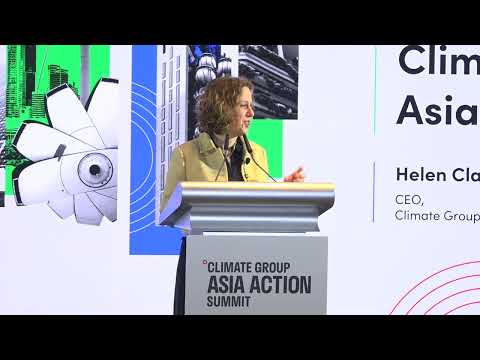
Climate Group is also expanding its global conversations, hosting events like the Asia Action Summit in Singapore, where discussions diverge from Western headlines. “The competitive drive coming from Asia is amazing,” Helen adds. “We had people from the investment sector on stage, and none of them saw companies changing their climate strategies. They’re going ahead.”
The journey to COP30
In 2025, Climate Week NYC stands at a critical juncture ahead of COP30. “A lot of attention is going to be on which national climate plans are ready,” Helen explains, referencing Nationally Determined Contributions (NDCs) that countries pledge under the Paris Agreement. Brazil is promoting COP30 as an ‘implementation COP’ and international pressure is increasing.
Helen highlights US corporate engagement as a key signpost: “US business is still very much in the mix, and I think that will crystallise for people at Climate Week NYC – especially those from Europe who may still have questions about commitment.”
Despite headwinds, including changing US political priorities and regulatory uncertainty, “a lot of our members are US-based. We’re hearing from them – ‘no, we’re still doing this’,” Helen reports. “They’ve set long-term strategies and have to navigate their competitiveness in markets in the US, Europe, Asia and elsewhere. They’re looking to discuss with peers how to do that – and that makes this Climate Week NYC critical.”
Looking ahead, Helen’s advice for corporate leaders is to maintain a global perspective. “For the next 18 to 36 months, attention will be pulled west, but we need to keep eyes everywhere,” she says.
“Those attending Climate Week should come ready to have a conversation about action – our goal is to keep pushing forward, to power on.”