
How Ecosia Uses Search Engines to Boost Reforestation
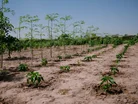
Ecosia is a search engine that plants trees with its profits.
The non-profit organisation is based in Germany and uses revenue from its advertising to fund reforestation projects globally.
It works with partners to help local communities, restore biodiversity hotspots and plant native tree species.
With around 20 million people currently utilising Ecosia, the company has four main objectives:
- To continue to make Ecosia the planet’s largest tree-planting movement, making a difference everyday
- To keep transparency with consumers, sharing how much money it makes each month in comparison to the spend on tree planting/climate action
- Using solar panels to power searches, reducing the use of fossil fuels
- To use all profits for climate actions, focusing on tree-planting projects globally

The company has released its 2024 regeneration report detailing what it has done to boost sustainability.
What Ecosia is doing to support climate action
The organisation says that 100% of its profit is dedicated to climate action.
Reforestation is the core of its work but it has taken on other projects throughout the years.
Ecosia accelerated the transition to clean energy by investing in and producing renewables - in 2024 the organisation produced twice as much renewable energy as needed to power all searches on Ecosia.
It has a growing solar portfolio which includes a dedicated solar parks, commercial-scale rooftop installations and residential systems in Germany.
It also restored vital ecosystems, for example by rewetting the drained peatlands in Zukunft Moor, which re-established the area's ability to store carbon-dioxide and regulate water balance.
“At Ecosia, we’re investing in the kind of climate resilience that protects both people and the planet," says Christian Kroll, CEO, Ecosia.
“That includes regenerative agriculture and building alternatives to the extractive systems that brought us here.
“We can’t greenwash our way out of this.
“We need real, systemic change.”
How does the organisation reforest
In 2024, Ecosia reported planting more than 18 million trees in biodiversity hotspots globally.
These trees were planted to support ecosystems and wildlife, bolster local livelihoods and sequester carbon.
In 2024 the organisation expanded its work to Togo, Vietnam and the Netherlands, planting and protecting 1600 different species.
It also pioneered new planting methods in Madagascar, using foxholes where trees are planted in shallow depressions to restore degraded land.
Although contributing significantly to lower carbon footprint the organisation did create 102 tonnes of carbon emissions throughout the year due to running the headquarters in Berlin, train travel and flights.

Christian says on Linkedin: “Ecosia just committed US$11,600 to plant fire-resistant trees in one of southern France’s most threatened areas creating a strategic firebreak with our local partner, Replanter Notre Forêt Provençale.
“These trees are chosen for a reason:
- "They slow fires
- "Shield homes
- "Restore biodiversity adapted to a hotter, drier world.
“All funded by something as simple as a web search.
“This is the kind of climate action we need more of: Local, fast, and powered by people.”
How can using the Ecosia Search engine contribute to reducing emissions?
Ecosia is dedicated to enabling people to contribute to a better planet, making it as simple as possible.
The organisation created a browser that generates clean energy when used by consumers, with the aim to enable people to be climate active wherever they are.

The organisation pledges to produce 25Wh of renewable energy every time a customer browses, which has already enabled the website to produce enough energy to power searches twice over.
It also pushes out more sustainable options to customers by featuring partner shops that have more environmentally friendly options.
It features an ad blocker which not only enables customers to load pages three times faster than on mainstream browsers but also means that searches consume less data and energy.