How is Standard Chartered Protecting the Amazon Rainforest?
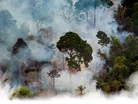
Forests cover around 30% of the world’s land area, but are disappearing at a high rate according to the Food and Agriculture Organisation of the United Nations.
It says that since 1990, the world has lost more than 420 million hectares of forest,
National Geographic says that trees are needed to trap greenhouse gas emissions and slow down the rate of global warming.
Standard Chartered has announced an agreement to sell high integrity forest protection carbon credits over the next five years, co-ordinating with the Brazilian State of Acre, in the Amazon Rainforest.
Marisa Drew, Chief Sustainability Officer at Standard Chartered, says: “Without deploying new market mechanisms, standing forests are unlikely to be protected because the short-term economic incentive for deforestation nearly always outweighs the perceived value of these long-term natural assets.
“We’re leveraging our global network and carbon market expertise to address this challenge directly, offering a means to help preserve standing forests that act as vital carbon sinks, and in turn help the communities that depend on them continue to realise the economic and social returns they provide.”
What the scheme will do
This initiative is one of the first examples of a major international bank working with a sub-national government or state entity to help support forest conservation.
The jurisdictional credits cover an entire area overseen by the government, helping to protect the forests in the State of Acre from deforestation.
It will be in motion over five years, with the potential to provide five million credits by 2026.
The credits will be registered in the Architecture for the REDD+ Transactions registry utilising its TREES methodology.
Acre has committed that the net funds generated from the State from the sale proceeds will be allocated in two places:
- 72% will be allocated to indigenous and local communities, going towards sustainable and low-emissions livestock farming, reforestation of secondary forests, creating clearings without deforestation and sustainable community-based tourism
- 28% will be used to finance project management and governance, including monitoring and verification of adherence to TREES standard and emergency responses to extreme weather events.
The initiative aims to establish a scalable model for jurisdiction wide efforts, tackling deforestation and reducing emissions.
Amarisio Freitas, Secretary of the Treasury of the State of Acre, Speaker and Leader of the State’s Jurisdictional Carbon Project, says: “This arrangement will bring economic and social benefits to the people of Acre, while protecting our natural resources and supporting the traditional communities and indigenous peoples of our state.
“The government has fought for a fair society by providing solutions for all its inhabitants, creating development mechanisms in the regions furthest from the capital without negatively impacting the ecosystem.
“This arrangement provides us an effective tool in the fight for sustainable economic development.
“We are excited to work with Standard Chartered on this groundbreaking innovation.”
What is the TREES methodology?
Architecture for REDD+ Transactions provides an environmental excellence standard laid out for national use.
TREES allows countries and jurisdictions to generate verified emissions reductions and removal credits, if meeting precise and comprehensive requirements:
- Accounting and crediting
- Monitoring, reporting and independent verification
- Mitigation of leakage and reversal risk
- Avoidance of double counting
- Assurance of robust environmental and social safeguards
- Transparent insurance of serialised units on a public registry.
The scheme is in alignment with the Paris agreement and aims to help accelerate the progress achieving emissions reductions and removals at scale.
Germana Cruz, CEO & Head of Financial Institutions, LATAM at Standard Chartered, says: “As the world looks toward COP30, the State of Acre is stepping forward with bold leadership on carbon markets, combining environmental ambition with economic opportunity.
“Standard Chartered is proud to support this vision by bringing our global expertise in sustainable finance to help build credible, scalable carbon market solutions for our markets.”
Why the Amazon Rainforest needs protection
National Geographic reports that 17% of the Amazon rainforest has been destroyed in the last 50 years.
The Amazon conservation says that destruction rose to 21% in 2020, resulting in a loss the size of Israel.
People around the world depend on the Amazon Rainforest for food, water, wood and medicine, alongside on a larger scale to stabilise the climate with 150-200 billion tonnes of carbon being stored in the rainforest, according to WWF.
It also reports that the Amazon releases 20 billion tonnes of water into the atmosphere daily, playing a critical role in global and regional carbon and water cycles.

Marisa said on Linkedin: “This initiative, which speaks to our ambition to drive innovation in sustainability, will help to channel climate finance towards the communities that depend on these forests with the majority of net funds generated through sales allocated for indigenous peoples and local communities.
“This collaboration represents one of the first examples of a major international bank working with a sub-national government in this way and we’re proud to bring our global network and sustainable finance expertise to bear, to help build credible, scalable carbon market solutions.”