
How Stella McCartney’s Denim can Capture Carbon
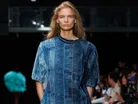
At Paris Fashion Week, Stella McCartney’s SS2026 collection included denim that can help to purify the air around it.
PURE.TECH leverages photocatalysis and catalysis processes to remove CO₂, VOCs and NOx from the air and convert them into safe, inherited particles.
This technology, the company says, can be applied to any kind of surface or material.
This is not the brand’s first use of “air purifying” material, and it came along with other innovations in materials technologies.
Stella McCartney described the show as crafted from 98% sustainable and 100% cruelty free materials.

How does PURE.TECH work?
As air passes over the surface of PURE.TECH fabric, pollutants are absorbed into the surface of the material and converted into carbonites such as CaCOx or nitrates.
These byproducts are then released from the surface gradually through friction.
PURE.TECH says that it can capture more than 2,000 ppm of CO₂ in 10 hours.
This technology is applied to the surface of fabrics through processes like padding, foulard and coating or incorporated into material to avoid altering the feel of finished fabrics.
PURE.TECH is based in Barcelona, Spain and led by CEO Aldo Sollazzo, who was awarded the title of Knight of the Order of the Star of Italy in 2019 in recognition of his scientific and technological work.
“When we first began exploring advanced textiles through the competition Reshape nearly a decade ago, the aim was to integrate design, material technology and advanced manufacturing into the industry,” Aldo says on LinkedIn.
“We believed in design not just as a matter of aesthetics, but as a tool for reshaping material intent, environmental awareness and technology integration.
“Seeing PURE.TECH woven into Stella McCartney’s beautiful garments is a dream realised and a step toward a reshaped industry driven by innovation and sustainability.”
FEVVERS: a vegan alternative to feathers
The Stella McCartney show also introduced FEVVERS, a plant-based alternative to feathers.
This material is still in development and the company has not yet revealed what it is made from.
James West, Co-Founder of FEVVERS, says on LinkedIn: “Somehow we’ve found ourselves at Paris Fashion Week, watching garments made with FEVVERS walk the runway at the Centre Pompidou in Stella McCartney’s SS26 show.
“To say that’s surreal doesn’t come close. The fact that someone of Stella’s standing has endorsed what we’re doing at this stage is epic.”
Stella McCartney told FEVVERS: “The innovation is just insanely beautiful, and we have created some of the most striking couture pieces I have ever seen.
“It’s not only the world’s first plant-based feather alternative, but it’s also proof that brands who continue to use feathers are choosing cruelty over creativity.”
Circularity in fashion
In the Paris Fashion Week show, Stella McCartney showcased denim waistbands upcycled into a variety of different items including jeans, shoes, bags and a dress,
In 2018, the brand signed the Ellen MacArthur Foundation's New Plastic Economy Global Commitment, pledging to reduce the plastic it uses and use only recycled, recyclable or compostable plastic by 2025.
The brand has only used recycled cashmere since 2016 which it says has reduced its cashmere-related environmental impact by 92%.
Stella McCartney also uses ECONYL regenerated nylon made from waste fabrics and fishing nets removed from oceans.
Since 2012, all of its handbags have been lined using fabric made from recycled water bottles.
Airlite’s air purifying coating
In Stella McCartney’s Winter 2024 runway collection it introduced Airlite on two tote bags.
This is a finish that helps to remove pollutants, bacteria and moulds, acting as a catalyst to break them down.
Light and ambient humidity activate Airlite on surfaces which produce negatively charged ions.
These ions, Airlite says, react with pollutants in the surrounding air and break them down.
Airlite also offers this coating as paint and the technology is produced in a facility that uses 100% renewable energy.
Company portals

Executives

Stella McCartney
Founder