
Biogas & Dairy: The Häagen-Dazs Recipe for Sustainability
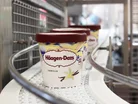
On the outskirts of Arras in the north of France is a factory producing most of the world’s Häagen-Dazs ice cream. Lush fields and cows lined my journey to the plant, before we were greeted by the General Mills team.
Established in 1992, the primary global manufacturing facility for Häagen-Dazs supplies more than 90 countries across Europe, Asia, Australia and South America and produces nearly 80 million litres of ice cream each year.
“When we first started, we were producing classic pints and large tubs for food service,” explains Plant Director Nicolas Cayeux. “In 1993 we started making stick bars and expanded into mini-cups in 1994.
“Our factory in Arras brings together all the core ingredients for Häagen-Dazs’s recipe for success – manufacturing, innovation and sustainability. Our site sends zero waste to landfill and is almost entirely energy self-sufficient.”
Decarbonising the Häagen-Dazs plant
“Our decarbonisation strategy covers energy efficiency, energy infrastructure and action across the wider dairy supply chain,” Nicolas explains. Between 2023 and 2025, the company invested €7m (US$8.2m) in infrastructure.
The team have halved this site’s natural gas needs by optimising its cleaning facilities and installing high-temperature heat pumps. These both recover energy and heat buildings. The site’s existing methaniser was also optimised alongside the installation of a dual-energy boiler.
More than 90% of the site’s gas consumption now comes from its own biogas production and the teams’ ambition is to raise this to be as self-sufficient as possible.
The recipe for premium ice cream
Häagen-Dazs ice cream is known for being high quality, and this was certainly proved in the tasting session they treated me to. After raw materials are mixed, pasteurised and homogenised, the base is sent to the freezer. Batches are churned slowly to minimise the amount of air whipped in, giving it a dense texture. After the adding mix-ins and sauces, the ice cream is dosed and sent through a -40°C tunnel before final packaging, palletisation and shipping. General Mills looks to source high quality ingredients so the taste is just as premium as the texture.

The milk and cream used in this ice cream is overwhelmingly sourced from France – in fact, most of it comes from 300 dairy farms in the vicinity of the Arras site. “The dairy in northern France is some of the best in the world and we want to ensure its quality and freshness,” Benjamin Duché, General Mills’ Regenerative Agriculture Lead for Europe & Australia says. “We want to minimise our transport and cooling footprint and to be embedded in the local economy to help the area to thrive.
“For our other ingredients, we look to the best global suppliers. Our vanilla comes from Madagascar, mango from India, green tea from Japan, cocoa from West Africa and speculoos biscuits from Belgium.”
In 2014, General Mills and Care International launched the Cocoa Sustainability Initiative to improve smallholder cocoa farmers’ livelihoods and wellbeing in West Africa. The company also supports PUR to enable ecological resilience through agroforestry programs in Ghana and Côte d'Ivoire.
Sourcing sustainably
Alongside work on the site itself, General Mills is looking to improve the sustainability impact of Häagen-Dazs ice cream as a whole.
“As a food company, our business is rooted in agriculture,” says Benjamin. “By supporting regenerative agriculture in key sourcing areas, we aim to promote widespread restoration of ecosystems for the benefit of the communities and food systems that depend on them.”
General Mills currently has more than 800,000 acres of farmland engaged in programming designed to advance regenerative agriculture. By 2030, it aims to expand this to a million acres.
Dairy cooperative Prospérité Fermière Ingredia has 48 dairy farms involved with a decarbonisation programme through General Mills. Nicolas explains: “Each farm receives an individual environmental diagnosis, leading to a farm-specific, quickly actionable action plan to optimise agricultural practices and reduce carbon emissions.”
Since this programme launched in 2024, the farms involved have lowered greenhouse gas emissions by 12%. Within five years, General Mills hopes to support a further 7% reduction from baseline.
Benjamin says: “The key principles are minimising soil disturbance, maintaining soil cover, rotational grazing and feeding cows a diverse mix of crops. Throughout the five-year pilot we are carrying out regular monitoring and measurement of the impact on eco-system quality, soil health, carbon sequestration, biodiversity, cow well-being and farm resilience.”
But it is not just about decarbonisation. Around half of France’s 400,000 farmers are set to retire by 2030 and only 100,000 expected to replace them. Unless farming becomes a more attractive profession, these local ingredients may cease to be produced.
“Central to the success of regenerative agriculture programs for all of us is the success of the farmers,” Benjamin explains. “We all have a shared interest in making agriculture fit for the future so that we can continue to source the highest quality of ingredients for decades to come.”
Company portals

Executives
Benjamin Duché
Europe & Australia Regenerative Agriculture Leader
Nicolas Cayeux
Plant Director, Häagen-Dazs Arras