Is Climeworks the ‘Next Big Thing’ in Sustainable Tech?
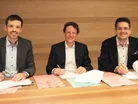
To limit global warming to 1.5°C, carbon removals will be needed on a gigaton scale according to the Intergovernmental Panel on Climate Change.
Climeworks provides carbon removals across a range of solutions including Direct Air Capture (DAC) and has passed US$1bn in funding.
This is the largest carbon removal investment of 2025 to date and will support the company’s technology and Climeworks Solutions CO₂ removal platform.
Christoph Gebald, Co-CEO and Co-Founder of Climeworks, says: "Direct Air Capture has gone from experiment to essential – and we’re focused on scaling it by driving down costs and pushing innovation.
“Our hybrid model builds long-term demand while generating cash flow today, helping us grow a market that investors now see as inevitable.
“Crossing the US$1bn equity mark isn’t just a milestone – it shows that carbon removal is real, needed and here to stay.”
Meet Climeworks
Founded in 2009, Jan Wurzbacher and Christoph were capturing CO₂ from the air under lab conditions at ETH Zurich.
The company reached demonstration scale in 2012 and began operations of its first small-scale DAC plant in 2014.
Today, Climeworks says that it specialises in crafting best-in-class carbon removal strategies combining nature-based solutions with engineered technologies.
This includes its Direct Air Capture (DAC) technology that actively removes CO₂ from the atmosphere.
In 2021, Climeworks launched Orca, the world’s first and largest DAC and storage plant.
It inaugurated Mammoth, its second plant, in 2024 in Iceland that is around 10 times bigger than its predecessor.

Cypress will be its first commercial DAC and storage plant in the United States, set to scale up carbon removal capacity and bring this technology closer to key markets.
Alongside DAC, Climeworks also uses nature-based solutions including reforestation, biochar creation and mangrove planting.
Are these solutions credible?
Climeworks says that its due diligence model uses a rigorous set of criteria to vet the highest quality carbon removal solutions.
Its framework clusters quality criteria across three categories:
- Trust
- Impact
- Risk
Climeworks’ four core attributes of trust are measurability, end-to-end carbon accounting, checking the removal would not have otherwise occurred and third-party certification.
Impact attributes include permanence or durability, co-benefits that are both social and environmental, availability, scalability and price and long-term affordability.
Risk covers a variety of areas including storage reversal, leaked or displaced emissions, negative social and environmental risks and execution risks.
Businesses using Climeworks’ solutions
SAP is just one of the giant businesses working with Climeworks to secure carbon credits.
"Investing in quality carbon removals addresses emissions we can't eliminate directly,” says Sophia Mendelsohn, Chief Sustainability & Commercial Officer at SAP.
“Our Climeworks partnership secures high-integrity capacity at preferred rates while protecting against price volatility.
“This investment also strengthens SAP economically - we can now develop new products that meet evolving customer, partner, and regulatory expectations.”
TikTok has also chosen Climeworks for more than 4,600 tonnes of carbon removal through DAC, biochar and reforestation.
Ian Gill, Global Head of Sustainability at TikTok, says: “We carefully evaluated multiple providers to build a high-quality carbon removal portfolio.
“Climeworks provided a solution that meets our highest standards and aligns perfectly with our sustainability strategy as we work toward carbon neutrality by 2030.”
Morgan Stanley and British Airways are some of the other companies that chose Climeworks for carbon removals.