Logistics: Why Mercedes F1 is Bringing EVs to Formula 1
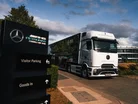
The Mercedes-AMG PETRONAS Formula One Team has begun using all-electric trucks for its European logistics, a first for the sport in the region.
The team has a background in trialling greener energy sources, such as HVO100 biofuel, and this initiative continues its efforts to reduce its environmental impact.
Following a trial at the 2025 British Grand Prix, the Mercedes Team transported its W16 race cars to the 2025 Dutch Grand Prix using an all-electric truck.
The 673km trip from the team's base in Brackley to Zandvoort was completed by a Mercedes-Benz Trucks eActros 600.
This vehicle is part of a new generation of heavy goods vehicles designed for sustainability.

Electric truck technology and emissions
The eActros 600 is equipped with a 600kWh Lithium Iron Phosphate battery, providing a range of at least 500km from a single charge.
Using a megawatt charging system, it can be charged from 20% to 80% in approximately 25 minutes.
The use of green energy and rapid charging means the eActros 600 could save up to 80% in CO₂e emissions over its lifespan compared to an equivalent diesel truck.
This combination of range and charging speed means fewer stops are required for long-haul journeys.
Alice Ashpitel, Head of Sustainability for Mercedes F1 explains: “As a team, our commitment to sustainability means that we rethink how we move, not just how we race.
"While we are driven by performance on track, we are incredibly proud that our innovations travel beyond the grid.
"The use of the Mercedes-Benz Trucks eActros 600, initially piloted at our home race in July, is another important step in our decarbonisation journey.”
A history of decarbonisation
The Mercedes F1 team has been actively working on its decarbonisation strategy for several years with a goal of achieving net zero by 2030.
In 2022, the team piloted HVO100 biofuel and by the 2024 European season it achieved 98% coverage across its race and marketing trucks, saving more than 500 tCO₂e.
The logistics involved in Formula One contribute a large part to its carbon footprint and the sport as a whole has been working to reduce its emissions.
Formula One's carbon footprint decreased from 228,793 tCO₂e in 2018 to 168,720 tCO₂e at the end of the 2024 season.
For the Mercedes team, managing Scope 3 emissions is a key focus.
The company states: "The roll out of HVO100 has been an important step in helping us decarbonise our logistics and the ability to phase in electric vehicles will further reduce our emissions and improve air quality.
"Our long-term ambition is to extend the use of the e-fleet across future European Seasons - demonstrating once again that F1 is the fastest test lab helping to catalyse change beyond our world."
Sustainable supply chains and logistics
By incorporating a mix of sustainable technologies, the team is developing more resilient supply chains with its partners.
This move may also encourage other teams within the sport to evaluate their own logistics and transport emissions.
The partnership between the racing team and the truck manufacturer is central to demonstrating the feasibility of electric long-haul transport.
Ash Armstrong, eConsultancy Manager at Daimler Truck UK adds: “We are continuing to push the boundaries of what is possible with battery electric trucks.
"Our partnership with the Mercedes-AMG PETRONAS F1 Team is key in demonstrating that sustainable, long-haul distribution has arrived with our eActros 600.
"We could not be more thrilled that one of our eActros 600 trucks has been used to transport the team’s W16 cars from Brackley to Zandvoort.
"We are extremely proud to showcase the impressive range and capability of this truck. It just goes to show that the era of electrification is upon us and range anxiety is no longer an issue.”