Could Superconductors Impact Microsoft Data Centre Power?
As AI workloads intensify and rack densities soar, power delivery is emerging as one of the biggest constraints in modern data centre design.
Microsoft is exploring whether high‑temperature superconductors – materials capable of carrying electricity with zero resistance – could redefine how power moves across its global cloud network.
Alistair Speirs, General Manager of Azure Infrastructure at Microsoft, believes the industry must challenge long‑held assumptions about electrical architecture to meet escalating demand.
“As the demand for AI and data‑intensive computing is on the rise, the need for efficient and reliable power delivery is critical,” Alistair writes on Microsoft’s website.
The company is studying high‑temperature superconductor (HTS) technology to identify how its data centres can meet growing power requirements while strengthening operational sustainability. Superconductors allow electricity to flow without resistance, cutting transmission losses and avoiding the heat build‑up typical of copper and aluminium conductors.
Writing on LinkedIn, Noelle Walsh, President of Cloud Operations and Innovations at Microsoft, says: “As we unlock greater electric power to support cloud and AI, we have an even greater responsibility to use that power well.
“That’s why I’m excited about our work exploring breakthrough research in high‑temperature superconductors. By moving power more efficiently and compactly, this technology carries the potential to minimise energy waste and reduce land use in the communities where our data centres operate.”
Rethinking electrical design
Conventional conductors generate resistance throughout transmission, producing heat and restricting current flow within a fixed footprint. When cooled to cryogenic temperatures, superconducting materials behave differently, enabling current to move without resistance.
At the centre of this concept are high‑availability cooling systems that maintain the cryogenic conditions required, supporting the same operational resilience hyperscale facilities demand.
HTS technology could prove especially valuable as AI workloads and high‑performance compute clusters push beyond historical density limits, concentrating power consumption into smaller spaces.
To manage these loads, data centre operators often face difficult choices—expanding substations, adding feeders, reducing rack density, or delaying growth.
According to Alistair, superconductors could “break this trade‑off” by boosting electrical density without increasing the physical footprint. Delivering more power directly to racks supports higher‑density operations with stronger efficiency.
He adds that HTS cables are lighter than copper and can transmit current across greater distances, optimising distribution among racks and pods while mitigating bottlenecks.
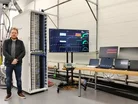
Microsoft shared aspects of this approach at the OCP 2025 Summit, demonstrating a 3MW superconducting cable linked to a rack prototype—proof that direct‑to‑rack power delivery is feasible. In trials, HTS systems have reduced the size of power cables by an order of magnitude when supplying electricity directly to a server rack.
Scaling capacity for AI growth
Power availability is increasingly cited as the chief limiting factor for data centre expansion. As artificial intelligence scales, electrical infrastructure must evolve in tandem.
Alistair argues that updating legacy power systems with superconductors could allow facilities to expand capacity without the need for entirely new transmission corridors or large substation projects.
Next‑generation superconducting lines can handle far higher capacity than traditional lines operating at the same voltage, speeding up site expansion and connectivity so that operators can deploy compute more rapidly.
The technology’s implications extend well beyond individual campuses, enabling designs with higher‑density electrical backbones within smaller physical envelopes.
However, unlocking this potential requires revisiting foundational ideas around voltage levels, distribution topologies and redundancy strategies.
Tim Heidel, CEO of VEIR – a Microsoft Climate Innovation Fund portfolio company – says: “Superconductors are a category‑defining technology poised to transform how power is moved across the electricity value chain, stretching from generation to data centre chips.
“At VEIR, we build complete power delivery solutions that take advantage of these remarkable materials, enabling customers to overcome critical bottlenecks in energy infrastructure, unlock new data centre capacity faster, and achieve higher power and compute density.”
All sustainability, net zero and sustainable supply chain leaders should attend:
- Sustainability LIVE: The Net Zero Summit - QEII Centre, London, March 4-5
- Sustainability LIVE: The US Summit - Navy Pier, Chicago, April 21-22
Co-located with Procurement & Supply Chain LIVE, these events brings together CSOs, ESG leaders and senior decision-makers at a moment when sustainability, supply chains and commercial performance are increasingly interconnected.
Tickets can be booked online today for The Net Zero Summit and The US Summit. Group discounts available.
Grid impact and community footprint
Beyond facility walls, superconducting transmission lines could ease the burden on local grid infrastructure. By minimising voltage drop and incorporating fault‑current limiting functions, they can enhance grid stability for high‑demand data centres and surrounding communities.
High‑temperature systems require smaller trenches and eliminate the need for large overhead lines, trimming the physical and visual impact of new grid connections. With the ability to transmit equal power at lower voltage, they also reduce right‑of‑way needs.
Daniel McGahn, CEO of American Superconductor Corporation, notes: “Superconductors enabled ComEd to interconnect electrical grid substations in Chicago without disrupting local businesses or communities. Our proprietary solution uniquely increases grid resilience.”
For Microsoft, superconductors sit within a broader strategy to modernise data centre infrastructure alongside advances in cooling and networking. If commercialised at scale, high‑temperature superconductors could fundamentally reshape how power travels from generation to server rack – helping resolve one of the toughest challenges of the AI‑era data centre.
Company portals



Executives
Alistair Speirs
General Manager of Azure Infrastructure

Noelle Walsh
President, Microsoft Cloud Operations + Innovation
Tim Heidel
Chief Executive Officer