Net Zero: How Innovation is Driving Sustainability at NTT

The Paris Agreement aims to limit global warming to 1.5°C by 2030.
If not achieved, the Renewable Energy Institute reports that we could face far more erratic weather conditions with far-reaching impacts. For example, coral reefs will not be able to survive in a warmer climate which could lead to the extinction of animals living in the reefs and the demise of entire ecosystems.
The UN estimates that if targets are not met by 2040 one in four children will be living in an area with extreme water shortages.
NTT is a Japanese based company that is focusing on innovation to reach net zero by 2040.
Akira Shimada, CEO, NTT says: “We aim to resolve a variety of social issues, contributing to a world where Earth and humanity can sustainably coexist.
“Striving for a resource-recycling future, not a resource-consuming one.
“To meet the expectations of our many stakeholders, our mission is to continue to contribute to the realisation of a better society by placing sustainability at the core of our management.
“We will continue to take on the challenge of making the NTT Group an organisation that supports global sustainability through the creation of new value.”
Inside NTT’s sustainability strategy
NTT has three pillars of sustainable development:
- Protecting nature
- Maximising wellbeing
- Improving prosperity
NTT says it has a commitment to cultivating a green society, prioritising decarbonisation strategies to minimise human impact on nature.
“We are committed to reducing greenhouse gases by moving to IOWN technology and increasing the development and use of renewable energy sources,” says NTT.
It is driving sustainable innovation with a goal of net zero emissions by 2040, committing to reducing greenhouse gas emissions by 80% by 2030.
As part of this goal, NTT has acquired Japan's second largest wind generating company and is creating a company to develop and manage its renewable energy grids for its own energy usage.
Sustainability in agriculture
NTT is developing technology that turns food waste into fertiliser to boost a circular economy.
The technology is installed at the back of supermarkets, where vegetable scraps and other food waste is fermented and broken down, being used on farms as compost.
The company is also developing a system for sustainable land-based aquaculture farms.
The farms allow for ethical production and scale of microalgae and seafood, even in land locked areas producing an ongoing food source.
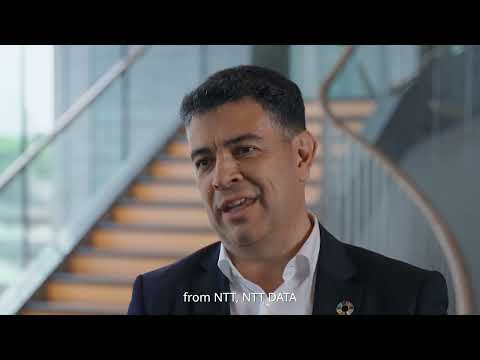
What innovation is NTT planning for the future?
NTT has been researching Innovative Optical and Wireless Network (IOWN) – an initiative for future communication infrastructure using photonic technology – since 2019.
The aim is to power the next internet, transforming electronic connection into photonic connections, improving responsiveness and consuming extremely low levels of power.
IOWN uses different core technologies including:
- Enabling the All-Photonics Network with an end to end solution, connecting devices at the edge of the network.
- Using digital-twin technology, building exact interactive copies of complex systems such as cities, traffic, machines and even the human body, to conduct precise tests and experiments to make highly informed decisions.
NTT aims to change the way people, technology and nature, with potential advantages of integrated wireless and wired networks that are always available. The goal? Making technology invisible, but highly connected and responsive.
It claims cities will be safer as crowds will be monitored and emergency services alerted in real time.
IOWN will make autonomous vehicles that will almost eliminate road congestion and traffic accidents.
It plans to make everything faster, smarter and more energy efficient.
Shingo Kinoshita, Senior Vice President, Head of R&D Planning Department, NTT Corporation says: “NTT announced its vision of an Innovative Optical and Wireless Network (IOWN) in 2019.
“Following this, research, development, and commercialization activities progressed steadily, and in 2023, NTT launched IOWN 1.0 as the first version of IOWN commercial services.
“Going forward, NTT plans to implement the IOWN vision in the world by commercializing photonics-electronics convergence devices, applying them to communications and computer environments.
“Making full use of them in such fields as Digital Twin Computing (DTC) and next-generation general-purpose AI.”