
As AI demand grows so does the concern around its sustainability impact and the potential for AI-driven climate solutions.
At Sustainability LIVE: The US Summit, Tom Chapman, Senior Editor of AI Magazine, chaired the AI in Sustainability panel where leaders from AWS, Google, NHS Supply Chain and NVIDIA explored the impact of data centres and energy usage, as well as the potential to unlock climate action with AI-driven technology.
- Hilary Tam, Sustainability Leader, EMEA, AWS
- Josh Parker, Head of Sustainability, NVIDIA
- Adam Elman, Director of Sustainability - EMEA, Google
- Heidi Barnard, Head of Sustainability, NHS Supply Chain
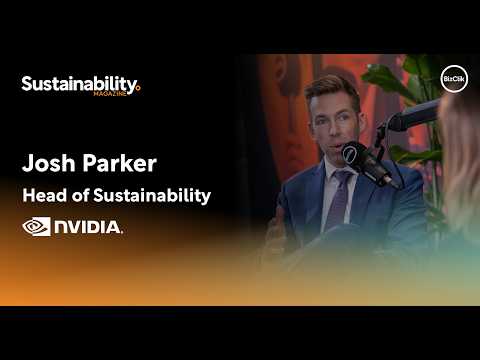
After the panel, Josh Parker, Head of Sustainability at NVIDIA, sat down to discuss NVIDIA’s role in the global expansion of AI.
Please introduce yourself and your role
My name is Josh Parker. I'm the Head of Sustainability at NVIDIA.
The technology that we develop has so much potential for good. The real opportunity for NVIDIA in the sustainability world is to help enable our partners to use it to solve some of these big challenges that we've been working on for decades and AI is actually offering a credible path to solutions for things like climate change in the long term.
So let's talk about AI. Is net zero even possible without the processing power that you're building?
The potential of AI to help us with applications that are pro-sustainability to help improve energy efficiency in other sectors like manufacturing, transportation, and buildings really dwarfs the existing footprint of AI in energy terms.
What would you say to the critics who say you're burning down the house to build a fire extinguisher?
I would say a more apt analogy is that we're burning a candle to build a fire hydrant because if you look again at the scope of the impacts of AI, its footprint, it's small so far and again, growing so we will manage that, we should manage it, but the potential is really transformative. And that's just in things that we've already proven. Things like a 30% reduction in manufacturing energy, which is a much bigger energy consumer than data centres.
Can you walk me through digital twin technology – are we actually simulating a cooler planet before we build it?
Digital twin technology is really fascinating.
With digital twins, we're able to build 3D models that are real-life simulations.
For example, one of our manufacturing partners is building a facility in Guadalajara, Mexico, and they used our digital twin technology called Omniverse to model the factory beforehand and to optimise it for energy consumption. They're forecasting a 30% reduction in the energy consumed by the manufacturing facility over its lifetime just because they used a tiny little bit of energy on the front end.
The digital twin technology is applicable to the world as well.
NVIDIA has developed Earth-2, a digital twin of the Earth that helps us model weather and climate much more accurately than we have in the past.
What you see when you apply accelerated computing and AI in this context is a speed up of climate and weather modelling by thousands of times and also an efficiency improvement of, again, thousands of times over previous simulations that we were able to offer.
Climate in a Bottle is moving from calculating weather to re-imagining it with generative AI – can it fill in the historical gaps and predict the future?
Prediction is actually one of the most powerful features of AI.
Climate in a Bottle is a foundational climate model that was developed specifically to do that, to take existing data and to offer probabilities.
At NVIDIA, we ourselves don't do any weather forecasting. What we're doing is we're trying to offer tools that other organisations can use.
Over the next five years, what is exciting you most in this space?
The prospect of AI accelerating the commercialisation of fusion energy to me is just a dream that it's hard to even conceptualise.
Having abundant clean energy worldwide I think is going to be really transformative for economic development, for the prosperity of humanity, and I think AI, more than any other technology, has a potential to accelerate that, to help with the modelling of the plasma and all of the physics involved.
It thrills me to consider the possibilities of AI and nuclear energy.
Company portals

Executives
Josh Parker
Head of Sustainability