Odfjell: Can The Future of Shipping be Sustainable?

Shipping underpins global trade, but its climate footprint is increasingly under scrutiny.
Odfjell is a Norway-based global shipping company specialising in transporting chemicals in bulk. The company operates around 80 large chemical tankers worldwide, serving industrial customers moving hazardous liquids over long distances.
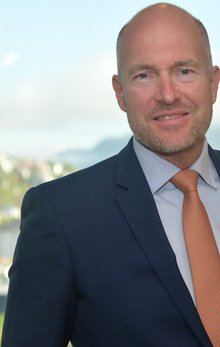
For Øistein Jensen, Chief Sustainability Officer at Odfjell, climate risk is now a central strategic issue. He distinguishes between physical climate risks and so-called transition risks linked to regulation and market change. “The biggest risk is that we are not able to be compliant,” he says.
On the physical side, more frequent extreme weather, flooding in ports and heatwaves all affect day-to-day operations. These events pose safety, reliability and cost challenges for crews and cargoes positioned across multiple regions. “They are risks that we need to adapt to,” Øistein explains.
Yet it is transition risk that dominates his thinking. Shipping is among the most heavily regulated global industries, and climate rules are tightening at the international and regional levels. Regulations from bodies such as the International Maritime Organization (IMO) and the European Union increasingly target greenhouse gas emissions. Compliance is not just a legal obligation; it is a cost issue and a licence-to-operate issue. “If we are not able to follow these trajectories, it will be expensive,” Øistein says.
He stresses that decarbonisation and climate change mitigation are core to the company’s long-term competitiveness. Shipping occupies a paradoxical place in the climate debate. There are currently no scalable alternatives to internal combustion engines for deep-sea transport across oceans. “Shipping is a part of the solution, but also part of the problem,” Øistein notes.

How Odfjell tackles emissions today
Odfjell’s decarbonisation strategy rests on three main pillars: operations, technology and fuels.
On the operational side, the company focuses on how vessels are run day to day. Speed management, hull cleaning frequency, time of arrival and general voyage planning all affect fuel use.
“Speed optimisation is an important area,” Øistein says. Running ships marginally slower and more predictably can cut fuel burn without compromising service. Better planning around port calls can also reduce time spent idling and emitting at anchor.
The second pillar is technical efficiency, centred on what the company calls energy-saving devices. These are pieces of equipment and design improvements retrofitted to vessels to reduce resistance and improve propulsion. “That could be changing the propeller or other systems that make the ship slightly more efficient,” Øistein explains.
Each percentage point of efficiency translates into lower fuel consumption and, therefore, lower emissions. Incremental gains across a fleet of roughly 80 tankers add up over time. “The cheapest fuel is the fuel you don’t use,” he says.
The third pillar – and the most complex – is fuel choice. “What kind of fuel are we putting on board our tanks, and what are we going to burn?” Øistein asks. He considers this the “biggest question” facing the industry today.
Climate-smart marine fuels
The debate around alternative fuels is often framed around specific candidates, from ammonia to methanol and biofuels.
Øistein argues that any solution must be evaluated from a full life-cycle perspective. In shipping, this is known as a “well‑to‑wake” view, covering production through to combustion. He uses ammonia as an illustrative example.
“If you take grey ammonia on board, the ship will not emit greenhouse gases,” Øistein says. “But the production of that ammonia can be higher than traditional fuel, so we need that holistic perspective.”
Affordability and fairness are also critical. Low-carbon fuels remain more expensive than conventional marine fuels such as heavy fuel oil or marine gasoil. “You need to be able to afford the alternative fuel, and no one is able to adopt higher costs than others,” Øistein explains.
He is adamant that the transition must not solve shipping’s problem by creating another one elsewhere. Green electricity, for example, is likely to be a scarce resource for years to come. “If we use green energy to produce fuel in an inefficient way, we might take that energy away from someone who can use it better,” he says.
Odfjell does not expect a single fuel to emerge as the universal answer. “We don’t think there will be one solution,” Øistein continues. “We are trying to be as flexible as possible and do whatever we can today with the technology that is available.”
Sustainability reporting and regulation
Beyond technical change, shipping companies face a fast-moving landscape of sustainability reporting requirements. Odfjell is subject to the EU’s Corporate Sustainability Reporting Directive (CSRD), which mandates detailed disclosures. Among these are double materiality assessments that examine both financial and impact materiality. For Odfjell, this is more an evolution than a revolution.
“We have been very forward-leaning on reporting,” Øistein says. The company has carried out climate risk assessments and double materiality analysis for several years already. The new European Sustainability Reporting Standards (ESRS) have, however, added complexity.
“What was different is the complexity of the ESRS standard,” Øistein notes. He was surprised by how much of the requirement is narrative rather than data-driven. “You would think there were a lot of numbers, but there were a lot of explanations,” he says.
That has turned Odfjell’s sustainability report into a substantially larger document. Øistein views reporting as a mirror of real sustainability work rather than an exercise in box-ticking.
Why biodiversity is a material issue
One area where expectations are rising is biodiversity and nature. In its latest double materiality assessment, Odfjell initially found biodiversity “just below the line” of materiality. Under ESRS rules, that meant the company did not have to report on the topic.
Since then, Odfjell has revisited its analysis. It has conducted peer reviews with other shipping companies and consulted stakeholders on their priorities.
“We saw that the attention and interest in biodiversity was increasing,” Øistein reveals. In the updated assessment, biodiversity moved above the materiality threshold, and Odfjell has now begun reporting on it. The company is using the LEAP methodology, a structured framework, to assess its impacts.
“For a shipping company, it’s related to underwater noise, potential spills, mammal strikes and everything we can emit into the sea,” he explains. Science in this field remains nascent, and many impacts are hard to quantify. “We don’t know exactly how many whales we risk hitting, or what underwater noise is causing,” Øistein admits.
Nonetheless, he expects regulation and expectations on nature to increase significantly over time. “So we are trying to understand this and identify the potential,” he says. “We know a lot within climate, but within biodiversity there is much more that we don’t know.”
For now, Odfjell is laying the foundations for more comprehensive nature-related work in future.
Recycling tankers as a circular economy in action
At the other end of a ship’s life, Odfjell treats recycling as a natural extension of building and operating a vessel rather than an afterthought. “We look at this in a total lifecycle,” Øistein says.
The company has conducted full lifecycle assessments covering construction, operation and recycling of its vessels. Odfjell aims to recycle ships in “the most sustainable way” possible, maximising reuse and recovery.
“A ship that we recycle is a fantastic example of a circular economy,” Øistein argues. When a vessel reaches the end of its life, almost everything on board is reused, resold or recycled. “It has a lot of steel and metal that is valuable for someone else,” he explains.
Even items such as chairs, mirrors, flags, mattresses and cables are recovered. “We have measured that 99.6% of the vessel is actually reused, resold or recycled,” Øistein says.
The company monitors recycling processes closely to ensure they meet environmental and social standards. “That’s just a fantastic example of a circular economy,” he repeats.
A slow-turning industry with growing momentum
Looking ahead, Øistein describes shipping itself as analogous to a large vessel. “Shipping is like a big ship. It takes time to turn,” he says.
Once change gathers speed, however, he believes momentum will be hard to stop. In the near term, he does not foresee “big, massive changes” in shipping’s sustainability profile. An important milestone would have been the adoption of a detailed net zero framework by the IMO.
“We had hoped that the net zero framework would be adopted last year, so it was a big disappointment that it wasn’t,” he explains. The absence of a clear global framework leaves some uncertainty over future requirements. “At the moment, everything is quite unclear what’s going to happen,” Øistein says.
He expects this situation to last for some time, even as companies like Odfjell continue moving ahead.
Meanwhile, geopolitical shocks are adding complexity. Shipping is deeply exposed to global trade flows, including tensions in regions such as the Middle East. “Everything that affects global markets is highly affecting shipping, so we need to adapt every day,” Øistein says.
Despite this, he remains cautiously optimistic about the direction of travel. “I don’t think you will see massive changes in 12 months,” he says. “But we are on a good trajectory.”