SAP’s Framework for Turning Sustainability Impact into Data

In corporate sustainability, there is a challenge in turning complex environmental data into actionable insights.
For example, while companies often report their emissions in terms of metric tons of carbon dioxide equivalent, the measurement is not universally understood.
To help solve this problem, German software company SAP has adopted a new impact measurement and valuation (IMV) framework which quantifies ESG data.
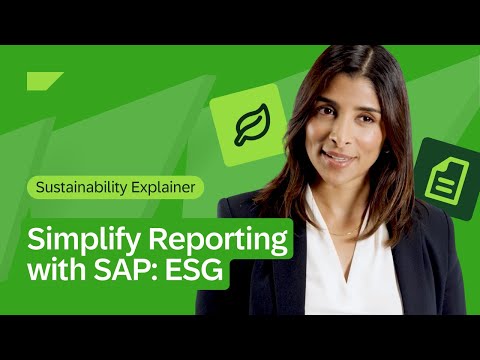
SAP: taking action towards sustainability
SAP’s impact measurement and valuation (IMV) approach helps translate societal impacts into monetary units.
This helps quantify the costs and benefits of a company’s corporate activities to society and the environment, using the ESG data which is already reported.
By using the IMV framework, companies are able to evaluate the trade-offs between different sustainability concepts and compare them alongside financial impacts.
For example, the environmental impact of greenhouse gas emissions can be translated into costs by multiplying reported emissions by the social cost of carbon, which is currently US$244 per metric ton of CO₂e.
Matthias Medert, Global Head of Sustainability at SAP, says: “Sustainable transformation is only possible when we base our decisions on reliable data.
“With IMV, we make sustainability measurable, comparable and actionable.
“This enables us to create transparency, set clear priorities and take responsibility.”
How does IMV work?
After evaluating environmental impact in financial terms, the IMV approach uses impact benchmarks to measure performance.
These benchmarks provide reference values to show how a company’s sustainability performance compares to industry peers.
By using these performance markers, businesses can identify where they are ahead of or behind their peers, helping them make the largest potential positive impact.
In practice, the IMV framework has supported SAP’s human rights risk assessment and double materiality analysis.
Insights from the IMV approach helped the company narrow down the most material sustainability topics and critical value chain stages.
This allows SAP to uncover opportunities where improved sustainability performance can bring competitive advantage and highlight risks.
Collaborative efforts for sustainability reporting
SAP has taken a collaborative approach to analysing its sustainability impacts, working with the WifOR institute, which is a scientific research organisation that specialises in impact valuation.
In collaboration with WifOR, SAP has examined its societal impacts and integrated the insights into its sustainability reporting.
By working together with other companies, it ensures that SAP’s sustainability strategy is independently validated and credible, which allows the company to be as transparent as possible in its reporting for investors and stakeholders.
Dr Richard Scholz, Head of Impact Analysis at WifOR, says: “Impact measurement and valuation provides the scientific foundation for sustainability steering, allowing organisations like SAP to understand their impacts holistically and prioritise decisions based on statistical evidence.”
How can IMV data benefit SAP?
As a result of the analysis of its operations, SAP identified some risks in its supply chain about living wages, allowing the company to take targeted action.
SAP’s human rights team partnered with procurement, suppliers and stakeholder initiatives to develop and implement risk mitigation strategies in the supply chain.
Data from IMV allowed this action to focus on countries, industries and vendors with the highest risk.
SAP also found that its greenhouse gas emissions show progress towards its net zero goal.
IMV analysis allowed the company to ensure responsible resource use in its sites by identifying water consumption hotspots through local environmental management programmes.
“By focusing on areas where we can achieve the greatest positive business and sustainability impact,” Matthias says, “we ensure that our actions are both meaningful and effective.”
Company portals

Executives
Dr. Richard Scholz
Head of Impact Analysis

Matthias Medert
Global Head of Sustainability