
Signify on Lighting’s Role as The 'First Fuel' in Efficiency
According to the International Energy Agency (IEA), lighting in buildings and outdoor applications makes up the majority of lighting demand. Around 8-9% of global electricity demand is consumed by lighting applications, excluding industry and agriculture.
With the development of energy-efficient lighting and smart systems, lighting seems to be an easy win for businesses and governments looking to save money and be more sustainable.
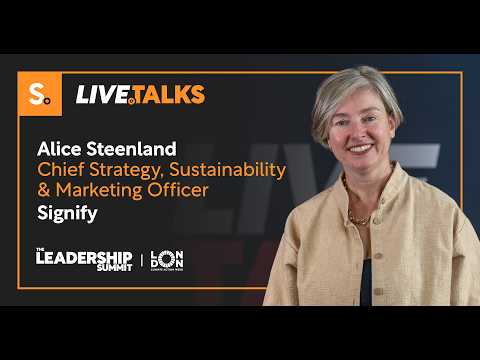
For Alice Steenland, Chief Strategy & Sustainability Officer at lighting specialist Signify, business leaders are beginning to see how renovating lighting systems can deliver quick gains.
“They've really understood the ROI of investing in lighting, especially right now. In some cases, for a city, for example, lighting can account for up to 30% of its electricity consumption,” Alice told the Sustainability LIVE stage at the Leadership Summit in June, as part of London Climate Action Week.
“If you can imagine, with the technologies we already have today, you can reduce that by between 80 and 90%. You've basically removed more than 20% of the cost of electricity from your operations.
“I think the only challenge is kind of the renovation cycle itself. People tend not to change the lights unless you need to. These can sometimes be long cycles and they don't necessarily match with the volatility in pricing and energy.
“It's unfortunate, because financially that investment, even if the existing lights are still working, would still be a smart thing to do financially when energy prices are high.”
The forgotten fuel
Energy efficiency is often referred to as the first fuel. It is also often the forgotten one, with the allure of renewable energy procurement a more visible sustainability strategy.
But with ever-growing electrified demand, lethargic grid expansion and a more complex energy system, efficiency has a vital role in the sustainability future.
“Electrification has a lot to do with the grid and can the grid support the unloading of more EVs, of more heat pumps, of different types of transport and building infrastructure?” explains Alice.
“Again, energy efficiency is probably the easiest way to allow the existing grids to function in that environment. But the fastest way to reduce consumption and allow the grid to function is to focus on energy efficiency measures.
“Lighting represents about 9% of global electricity consumption. The newest technologies can probably reduce that by close to 80%. So, you could essentially pull between 5% and 7% of the energy off of the grid.
“I think a lot of public authorities understand, if you really need to move fast, lighting is one of the fastest ways to do that and the cheapest ways to do that."
Not just light bulbs
In addition to more efficient lighting, such as LED light bulbs, Signify is also developing dynamic lighting systems designed to be energy-efficient. The company calls this “beyond illumination” revenue.
This includes developing systems for agriculture applications. With the changing climate, farming is becoming a more volatile sector. Speaking during London’s recent record-breaking heatwave, Alice explained why Signify entered this space.
“We are experiencing it now, right? The climate is getting warmer. It is going to become increasingly challenging for the food system.
“Our lighting systems precisely replicate sort of the sun and we have what we call light recipes for different crops and it allows you to have a pesticide-free, low-water, low-energy consumption environment in which you can grow food.
“And so we do think that's going to be part of the response or the adaptation we need to put in place globally.”
“Electrification has a lot to do with the grid and can the grid support the unloading of more EVs, of more heat pumps, of different types of transport and building infrastructure?” explains Alice.
“Again, energy efficiency is probably the easiest way to allow the existing grids to function in that environment. But the fastest way to reduce consumption and allow the grid to function is to focus on energy efficiency measures.
“Lighting represents about 9% of global electricity consumption. The newest technologies can probably reduce that by close to 80%. So, you could essentially pull between 5% and 7% of the energy off of the grid.
“I think a lot of public authorities understand, if you really need to move fast, lighting is one of the fastest ways to do that and the cheapest ways to do that."
Not just light bulbs
In addition to more efficient lighting, such as LED light bulbs, Signify is also developing dynamic lighting systems designed to be energy-efficient. The company calls this “beyond illumination” revenue.
This includes developing systems for agriculture applications. With the changing climate, farming is becoming a more volatile sector. Speaking during London’s recent record-breaking heatwave, Alice explained why Signify entered this space.
“We are experiencing it now, right? The climate is getting warmer. It is going to become increasingly challenging for the food system.
“Our lighting systems precisely replicate sort of the sun and we have what we call light recipes for different crops and it allows you to have a pesticide-free, low-water, low-energy consumption environment in which you can grow food.
“And so we do think that's going to be part of the response or the adaptation we need to put in place globally.”
Company portals

Executives

Alice K. Steenland
Chief Strategy, Sustainability & Marketing Officer, Member of the Leadership Team