
Vaishali Sinha: Creating India's Renewable Energy Giant

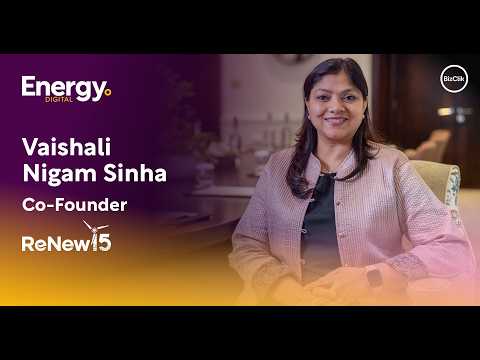
Vaishali Nigam Sinha co-founded ReNew, which has become India's second-largest renewable-energy company, in 2011. Her route into the sector came through finance rather than the more typical engineering pathway.
She spent years on Wall Street and in London after completing a master's degree at Columbia University.
The work measured success in deals and balanced books, but over time she felt a tension between that metric and a different kind of value.
This dissonance would eventually lead her to help build one of India's most significant renewable-energy enterprises, demonstrating that purpose and profit need not be opposing forces in the transition to clean energy.
From policy to power
Vaishali grew up in India and initially pursued international relations. A scholarship from the American Association of University Women took her to Columbia University in New York, where she completed a master's degree in Public Policy.
Environmental themes appeared early in her academic work.
"While I was in college, I was interested in sustainability," she recalls. "It wasn't really a thing then. But I really found it interesting and very calming. It was just a hobby, a part of my college work."
This early interest, though peripheral to her formal studies, planted seeds that would later grow into a career-defining mission.
At the time, sustainability was rarely discussed in mainstream business or policy circles, particularly not as a viable economic sector.
For 10 years she worked in finance. The sector offered intellectual challenge but also prompted questions about purpose.
That unease became the basis for what followed. It was not a sudden revelation but a gradual recognition that her skills in finance, deal structuring and strategic planning could be applied to something with more lasting impact.
ReNew began when Vaishali's husband, Sumant Sinha, proposed they build something themselves. He was then CEO of Suzlon, one of India's wind turbine manufacturers and had developed a deep understanding of renewable energy's potential and the barriers it faced.
Sustainability was gaining attention but not credibility as a commercial proposition. "People in government or in business thought it was a 'nice to do'. But nobody thought you could actually make money from a sustainability-related business," Vaishali explains.
The prevailing view treated renewable energy as philanthropy or corporate social responsibility, not as a sector capable of generating competitive returns. Banks were sceptical. Investors questioned the business model. The regulatory framework was still taking shape.
That lack of certainty became part of the opportunity. "If you're very comfortable with something, the opportunity to create value isn't as great," she adds. "And if something isn't really understood by the ecosystem, but you have the conviction, then perhaps you must go for it."
Vaishali did not expect to have an operational role at ReNew. "I thought there was no real role for me at ReNew. I hadn't been an engineer, hadn't had any experience in that space."
The company initially linked to a financial services advisory platform. Goldman Sachs then funded the business at five times the requested amount, a validation that surprised even the founders and signalled that institutional investors were beginning to recognise renewable energy's potential.
"Suddenly there was a huge amount to be done and we were a small team, so I got sucked into ReNew accidentally, not intentionally," she says. "But as they say, the rest is history."
Her background in finance proved essential as ReNew navigated capital raises, structured partnerships and built the financial architecture needed to scale.
Land, people and learning
The work required for energy infrastructure differed from what Vaishali had done before. "Acquiring land, engaging with communities, dealing with people, it wasn't something we'd done in the past," she says. "It was a steep learning curve."
Renewable-energy projects require large land areas, particularly for solar installations and wind farms. In India, land acquisition involves complex negotiations with multiple stakeholders, including state governments, local authorities and communities whose livelihoods depend on that land.
The company set out specific values from the start. "We were very clear that we wanted to do good business, but also in a good way, a clean-energy business done in a clean way, with good governance, good community engagement and community values."
These principles shaped how ReNew approached land acquisition, employment practices and community investment. The company recognised that renewable-energy projects, while environmentally beneficial at a macro level, must also deliver tangible benefits to the communities hosting them.
The renewable-energy sector in India lacked a deep pool of experienced engineers. "There was no track record of people in the sector because the sector didn't exist," Vaishali recalls. "So while we didn't have a capital problem, which is what most people have, we did have an issue of finding people with the experience and understanding of how to get things done on the ground."
That gap shaped how ReNew built its team and its projects. The company invested heavily in training, brought in international expertise where necessary and developed internal knowledge systems to capture and share learning.
From electrons to molecules
ReNew has grown to roughly 14GW of installed assets and more than 20GW in its pipeline. Vaishali does not frame scale as the only metric.

"We were batting for the sector, not necessarily just the company and that's what was helpful," she says. "Not only for us to grow, but for the sector to grow."
This perspective influenced how ReNew engaged with policymakers, shared knowledge with other developers and advocated for regulatory frameworks that would enable the entire renewable-energy sector to expand.
India's renewable-energy targets have increased from 175GW to 250GW and then to 500GW. ReNew has become one of the companies working to convert those commitments into operational capacity.
The company's name has changed three times. It began as ReNew Wind Power, became ReNew Power and is now simply ReNew.
The shift could show a move beyond electricity generation. "An IPP is just using solar and wind to generate electricity," she says. "But we were moving from electrons to molecules as well."
That expansion includes green hydrogen, battery storage, solar manufacturing, emissions management and partnerships with heavy industry and technology companies. Green hydrogen, produced using renewable electricity, offers a pathway to decarbonise sectors like steel, cement and chemicals that cannot easily be electrified.
"It was really about decarbonisation," she says. "We felt that moving from being an IPP to being a decarbonisation partner to various stakeholders was the opportunity."
Vaishali describes India's 2070 net-zero target as part of a development strategy in a country still extending electricity access. "You have a country with a lot of people below the poverty line, a lot of people without access to electricity. So it was about electricity access first, not just clean electricity," she says.
This context distinguishes India's energy transition from those in developed economies. The country must simultaneously expand energy access, support economic growth and reduce emissions intensity.
As costs fell, the economic case for renewables improved. "When the pricing curve bent in favour of renewables, it became an economic imperative," she says. Solar and wind are now often the cheapest sources of new electricity generation in India.
She argues that sustainability targets must connect to realistic implementation. "Setting a net-zero goal for 2050 means nothing if you're not going to achieve it," she says. "You have to set realistic goals."
ReNew has set a net-zero target for 2040, validated by the SBTi. Vaishali now chairs the company's sustainability function and its charitable foundation.
She also serves as President of the United Nations Global Compact Network India. She is the first person from the private sector to hold the post and the first woman.
Vaishali argues that climate action without the participation of women could mean leaving half the population out of the solution. "You can't solve these problems by leaving 50% of the population behind," she says. "That's a cliché, but it's really true."
She points to rural India, where women manage the effects of climate change without being consulted on responses. "They do all the work. They face the consequences. If there's a drought, they're the ones who pack up the family and move," she says. "They know what to do and how to solve problems. But they're never consulted for solutions, at any level."
Women in rural communities are often responsible for water collection, fuel gathering and food production, activities directly affected by climate impacts. Their practical knowledge of local ecosystems and adaptation strategies represents an underutilised resource in climate planning.
ReNew has programmes to bring more women into clean-energy roles. In Gujarat, the company has reskilled women from salt pan farming for solar jobs. In coal-mining regions, ReNew works with IIT Dhanbad to build pathways for women and families into new careers. The company has set a goal of having 30% of its workforce be women by 2030.
Vaishali sees purpose becoming a more important factor for younger workers. "It's really encouraging to see young people these days who are driven by purpose," she says.
She views the trend as a form of continuity. "When you hire young people from top institutions in India, it's really not only about money and wanting to be in the largest hedge fund. People genuinely care about companies doing good business. That's the good news."
This shift suggests that the next generation of business leaders may be more willing to align career choices with values, potentially accelerating the transition to sustainable business models across sectors.
Company portals

Executives
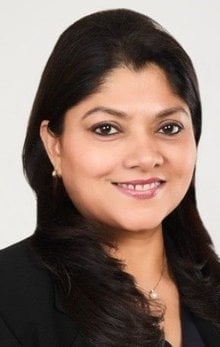
Vaishali Nigam Sinha
Co Founder and Chairperson Sustainability