
Vodafone's Network Strategy: Powering Net Zero Operations
Telecommunications operators face a question that will define the industry's next decade.
Network traffic continues to grow as data demand increases and AI services expand, but operators cannot keep adding capacity if energy consumption rises in parallel.
Vodafone has adopted an approach that positions sustainability as part of network strategy rather than a separate initiative.
The company uses AI-powered energy management tools, next-generation radio equipment, battery storage pilots and renewable-powered mobile sites to support traffic growth without increasing energy use.

Germany reaches net zero operations
Vodafone Germany has become the first market in the operator's European business to achieve net zero emissions from its own operations.
The achievement follows a 93% reduction in Scope 1 and 2 emissions since 2020, according to Vodafone.
The company neutralised remaining emissions through investments in carbon dioxide removal projects.
Vodafone continues to match 100% of the grid electricity it purchases with renewable sources through power purchase agreements and renewable energy certificates.
The operator aims to reach net zero operations across Europe by 2028 and in Africa by 2035. Joakim Reiter, Vodafone Group Chief External & Corporate Affairs Officer, says on LinkedIn: "Tackling climate change requires action across every part of our business. At Vodafone, that means turning ambition into measurable progress."
Vodafone has expanded deployment of next-generation radio equipment designed to consume less power. The company introduced additional energy-saving features across its infrastructure and scaled the use of AI-enabled energy management tools capable of optimising energy consumption in real time.
For operators facing relentless traffic growth, improving energy efficiency is becoming as important as adding capacity. The technology allows networks to adjust power consumption based on actual demand rather than running at full capacity continuously.
Supplier emissions dominate carbon footprint
Cutting emissions from Vodafone's own operations addresses only a fraction of its total carbon footprint. According to Joakim, the company's value chain accounts for 96% of its total emissions.
Vodafone has set a Science-Based Targets initiative-approved goal of reducing value chain emissions by 90% by 2040. The operator has onboarded 60% of its strategic suppliers onto a platform designed to track and accelerate their decarbonisation progress.
Over the past year, Vodafone expanded supplier engagement efforts through a dedicated platform designed to improve emissions reporting. The operator worked through the Joint Alliance for Corporate Social Responsibility to support 46 suppliers in identifying practical emissions reduction measures.
Vodafone is exploring how telecommunications infrastructure can contribute to energy system transformation beyond reducing its own consumption. The company led a distributed energy storage pilot in the Czech Republic and launched a similar project in the UK. These projects examine how grid-connected battery systems can help balance electricity supply and demand as renewable generation increases.
Solar-powered mobile sites are being expanded across multiple markets. South Africa has become home to Vodafone's first virtual wheeling project, which enables renewable electricity generated by independent producers to be supplied into the grid at scale.
In Mozambique, Vodafone trialled a hybrid diesel generator control system that switches to battery power during outages wherever possible. The system reduces fuel use while maintaining network resilience in areas where grid reliability remains limited.
Around one-quarter of vehicles purchased and ordered across Europe are now electric, according to Vodafone.
Circular economy initiatives expand
Vodafone is focusing on extending the lifespan of network equipment and customer devices through circular economy initiatives. The operator reached its target of collecting one million used mobile devices through its partnership with WWF for reuse, recycling or donation.
For enterprise customers, Vodafone's Device Lifecycle Management leasing programme embeds circularity into device management. During 2025, more than 99% of devices returned through the programme were redeployed, according to Vodafone.
Vodafone launched a pan-European recycling tender to increase material recovery from decommissioned network equipment and reduce waste sent to landfill or incineration.
The initiative addresses the lifecycle emissions associated with manufacturing and disposing of network infrastructure.
The progress has earned external recognition from sustainability assessment organisations.
Vodafone was included on CDP's 'A List' for climate change and received an EcoVadis Platinum medal for the second consecutive year.
The EcoVadis rating places Vodafone among the top 1% of companies assessed globally for sustainability performance. These assessments evaluate companies across environmental impact, labour practices, ethics and sustainable procurement.
Joakim says: "We know there's more to do, particularly on Scope 3 emissions, but the direction is clear. Across our value chain, we will continue to deepen supplier engagement, improve emissions data and scale circular solutions."
The Scope 3 challenge remains the largest part of Vodafone's decarbonisation task. Achieving the 90% reduction target by 2040 will require sustained engagement with suppliers and potentially changes to procurement practices as low-carbon alternatives become available.
Company portals

Executives
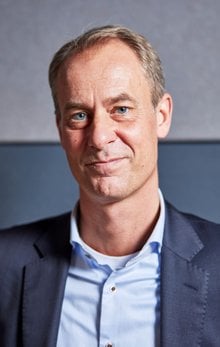
Joakim Reiter
Vodafone Group Chief External & Corporate Affairs Officer