Why Hankook Makes Longboards from Tyre Manufacturing Waste
South Korea-based Hankook manufactures more than 100 million tyres every year.
Its 16th ESG Report, covering 2024/25, shows how the company is aiming to reduce its emissions, including through reuse and upcycling initiatives.
“Uncertainties over sustainability management will only heighten due to the spread of global protectionism, intensifying geopolitical risks and the adoption of ESG regulations,” say Hankook’s Co-CEOs Jong Seon Ahn and Sang Hoon Lee in the report.
“Nevertheless, Hankook Tire & Technology remains confident that ‘sustainability’ will serve as the greatest competitive lever and a new opportunity for us amid the evolving landscape.”
Renewable and recycled materials
Hankook is making R&D efforts to transition to recycled steel from scrap in tyre manufacturing.
The company has succeeded in developing a tyre with 81% recycled and renewable raw materials, including this recycled steel.
Hankook says it is pursuing development of a tyre made from 100% renewable and recycled materials.
A partnership with Solvay Silica also aims to extract silica from industrial waste and repurpose it, aiming to reach mass production by 2030.
Hankook launched the iON GT in 2024, specifically for EVs, made of 77% ISCC PLUS-certified raw materials.
The company says that this is the highest percentage on the market.
Tyres for EVs
While EVs do not legally require specific tyres, they can make a difference in energy efficiency and range.
EVs can be much heavier than traditional cars due to their large battery packs, so EV tyres are often stronger to handle this and prevent premature wear.
The instant torque from electric motors can also put stress on tyres, so stronger rubber compounds can be used to manage this.
The company has succeeded in developing a tyre with 81% recycled and renewable raw materials, including this recycled steel.
Hankook says it is pursuing development of a tyre made from 100% renewable and recycled materials.
A partnership with Solvay Silica also aims to extract silica from industrial waste and repurpose it, aiming to reach mass production by 2030.
Hankook launched the iON GT in 2024, specifically for EVs, made of 77% ISCC PLUS-certified raw materials.
The company says that this is the highest percentage on the market.
R&D for sustainable products
Hankook conducted LCAs on two of its tyre products manufactured at its Tennessee plant and determined that the use phase accounted for the highest environmental impact across the entire life cycle.
The iON evo tyre it tested produced 5.4% more of an environmental impact when foam was attached due to the additional raw material and energy consumption.

Foam is sometimes used inside EV tyres for noise reduction.
Hankook also found that the use of resin materials in EV tyres increase its environmental impact.
In 2015, the company introduced industrial additive manufacturing known as metal 3D printing and uses this to make ultra thin and complex patterns in the tread of tyres.
Hankook says it is working to apply 3D printing technology to tyre manufacturing to achieve environmentally responsible production.
When used for mould fabrication, 3D printing resulted in a 60% reduction in waste while saving energy consumption by more than 80%.
Hankook’s upcycling project
re:move is Hankook’s upcycling project that involves a wide range of collaborations to repurpose waste from tyre manufacturing.
It has worked with shoe brands to develop outsoles and showcased these at the 2025 Seoul Half Marathon.
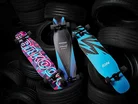
It has also created a longboard from sustainable materials created by upcycling end of life tyres with a rubber cushion to dampen shock and noise and wheels made of algae oil-based bio polyurethane.
In partnership with camping gear company Helinox, Hankook developed ball feet for camping chairs engineered using compounds recovered from high performance racing tyre manufacturing that would otherwise be discarded.

It has also created a longboard from sustainable materials created by upcycling end of life tyres with a rubber cushion to dampen shock and noise and wheels made of algae oil-based bio polyurethane.
In partnership with camping gear company Helinox, Hankook developed ball feet for camping chairs engineered using compounds recovered from high performance racing tyre manufacturing that would otherwise be discarded.