
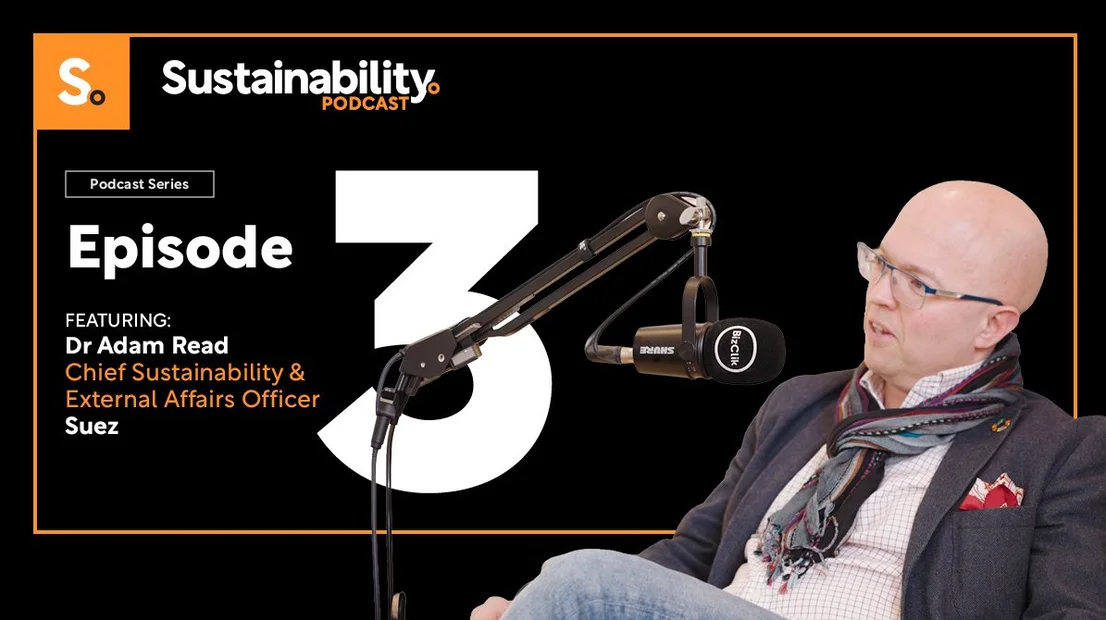
Ep. 3 | Adam Read: Is the Circular Economy Actually Working
Related Podcasts
The economy was designed to be linear. After the Second World War, the entire system was built around making things, using them and throwing them away – because that's what drove growth. Changing it, as Dr Adam Reed MBE puts it, means breaking people's fundamental beliefs about how the world works.
In this episode of the Sustainability Podcast, host Charlie King sits down with Dr Adam Reed MBE, Chief Sustainability Officer at SUEZ, to explore what it actually takes to move from a linear economy to a circular one. Adam has spent more than 30 years in waste, policy and resource management and has a PhD in policy failure – something, he says, makes him an interesting dinner party guest. Here, he brings that same directness to a conversation that goes well beyond recycling.
Listen on Spotify here
Watch on YouTube here
In this episode we explore:
- Why the circular economy has barely scratched the surface, and what's actually in the way
- Why innovation fails when the infrastructure isn't ready to support it
- Where responsibility sits across governments, businesses and consumers – and why none of them can do it alone
- How SUEZ is planning future infrastructure for materials that don't exist at scale yet
- Why Adam doesn't talk about the circular economy when he's talking to the public
Why the circular economy remains difficult
Adam's starting point is historical. Post-war economic growth was built on consumption – make stuff, use stuff, throw it away – because that's what generated tax revenue and jobs. The world that most people grew up in was linear by design, and making circularity the norm means asking people to reject assumptions they've never questioned. When something breaks, you can replace it online within 24 hours. Why would you do something harder when the alternative is cheaper and more convenient? Until that equation changes, behaviour won't.
Designing systems, not just products
Innovation runs ahead of infrastructure constantly. Adam's point is that introducing a brilliant new material into an existing system that can't process it doesn't make things better, it makes the system less efficient, more expensive and harder to run. Novel materials like compostables and biomaterials are genuinely exciting, but if they end up mixed in with traditional plastics, they become a problem rather than a solution. Getting the infrastructure ready before the material arrives is the work, and it requires manufacturers, recyclers, researchers and policymakers all talking to each other years in advance.
Shared responsibility for change
Adam's view on responsibility is clear: it sits equally across governments, businesses and consumers, and none of them can move without the others. Government has a tough job of changing an economic model in a five-year election cycle, without unfairly hitting certain parts of society harder than others, as it is genuinely difficult. Businesses can't get ahead of what consumers will buy or what governments will incentivise. And consumers are already doing more than they think – most people who use secondhand markets, charity shops or refurbished phones don't realise they're participating in the circular economy at all. The language, he argues, is part of the problem. Stop saying "circular economy. “ and start talking about repair, reuse and recycling instead.
Planning for the future
SUEZ's role in this goes beyond collecting bins. Adam describes working with businesses and government to plan infrastructure for materials that are only just emerging like carbon fibre from wind turbines, advanced packaging, biomaterials, so that when those material streams grow, the processing capability exists to handle them. There isn't one circular economy, he says. There are lots of material circular economies, each with different lifetimes, different value chains and different infrastructure requirements. Copper wire has a long loop. Organic packaging has a short one. Planning for both at the same time is the actual job.
Building a more practical approach
Adam's advice to sustainability leaders is practical enough to act on today: find your biggest spend, identify which materials have the highest carbon footprint, and work out which ones can go circular most easily. Often that means a compost bin and a change to the bin layout before anything more ambitious. Talk to your waste provider. Let them look at your bins – he says he loves nothing more than a bin dive, because it tells you immediately what you're buying that you don't need. And treat your supply chain as something you can influence, not just something you're dependent on. Start with the easiest wins. Build from there.
Subscribe and Listen
Episode 3 is brought to you by Sustainability Magazine.
Company portals

Executives
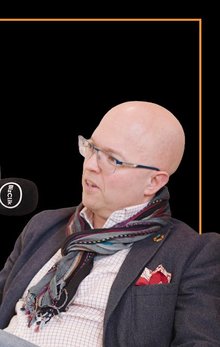
Dr Adam Reed
MBE, Chief Sustainability Officer