Top 10: Sustainability Predictions for 2026
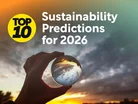
In 2026, leaders predict that sustainability will go through some big changes.
With regulations like the CSRD and California Climate Acts expected to impact, it could be the year where sustainability’s narrative flips.
If companies are not prepared, they risk being left behind.
Sustainability Magazine has heard from leaders across the landscape and ranked 10 of the top sustainability predictions for 2026.
10. Nature-based solutions
Company in focus: Arcadis
Nature-based solutions (NbS) are approaches that work with nature to address challenges and benefit biodiversity. They can provide cost-effective alternatives to conventional approaches and support regulatory compliance.
Daisy Hessenberger PhD, Global Subject Matter Expert, Nature & Biodiversity at Arcadis, explains: “In cities, we manage urban heat, improve air quality and create recreational spaces by incorporating green infrastructure alongside the grey.
“Parks, green buildings and sustainable drainage systems can be designed to support biodiversity as well as improving health and well-being for residents.”
9. Green skills gap
Company in focus: LinkedIn
LinkedIn’s 2025 Green Skills Report shows that demand for green talent is surging across energy, tech and manufacturing, but supplies of experts are short.
LinkedIn analysed its more than one billion members worldwide from 2021 to 2025. The findings show that ‘green hiring’ grew by almost 8% per year, compared with the 4.3% growth in the share of workers with ‘green skills’.
Sue Duke, Vice President of Public Policy and Economic Graph at LinkedIn, says: "We will only close the gap if decisive action is taken now to make skills and workforce training a core part of climate and energy policy.”
8. Supply chain visibility
Company in focus: Blue Yonder
While relationships at the Tier 1 level of supply chains are generally well understood, a Sphera survey found that there is a widespread failure to achieve transparency beyond this. Blue Yonder’s Supply Chain Compass report found end-to-end data connectivity is considered fundamental to the success of many businesses.
Saskia van Gendt, Chief Sustainability Officer at Blue Yonder, predicts that “companies will redesign products for durability, reuse and recyclability while investing in technologies that provide full visibility from raw material to resale.
“Artificial intelligence will be central to this shift, driving efficiencies through predictive demand planning, energy optimisation and smarter reverse logistics."
7. Making AI sustainable
Company in focus: Kyndryl
The energy and water use of AI is increasing the environmental impact of many technology giants. Faith Taylor, SVP Global Corporate Citizenship & Sustainability Officer at Kyndryl, explains: “While the potential of AI to drive new initiatives and achievements in reducing businesses’ planetary impact has been much discussed, there’s no doubt that the technology also comes with real costs.
“AI is, in short, hungry, and so any argument that presents it as a route through the climate crisis needs to be extremely persuasive.”
Surveys by Kyndryl and Microsoft over the last three years show a growth in leaders considering the environmental impact of AI implementation from 35% to 43%.
6. Transparency
Company in focus: Capgemini
“Performative messaging is out, radical transparency is in,” says Rory Burghes, Head of Sustainable Futures at Capgemini UK.
“Organisations are increasingly embracing transparency, openly acknowledging where progress falls short and, in some cases, even admitting their targets may be out of reach.”
Saskia similarly expects sustainability to be seen as a “verifiable operational standard”, particularly across supply chains.
Rory predicts an increase in detailed transition plans with capital allocation and a focus on progress over perfection.
5. Circular economy
Company in focus: Dassault Systèmes

Green investments and markets have grown significantly. According to the IEA, clean energy investment alone will hit US$2.2tn in 2025.
Philippine de T’Serclaes, Chief Sustainability Officer at Dassault Systèmes, predicts that this will “certainly drive a significant shift towards circularity, with companies prioritising new business models, fuelled by the rising cost and complexity of materials.
“This is specifically important in achieving Scope 3 targets and designing products that last longer and can be easily repaired, refurbished or remanufactured, ultimately reducing the need for new, energy-intensive production cycles.”
4. Sustainable data centres
Company in focus: Johnson Controls
Goldman Sachs Research forecasts global power demand from data centres will increase by as much as 165% by 2030. “Soaring energy demand means data centers must become super-efficient,” says Katie McGinty, Vice President and Chief Sustainability and External Relations Officer at Johnson Controls.
“Modern chillers can use 40% less power annually, freeing up energy for compute power and reducing environmental impact. They also operate with minimal on-site water and quieter operation, helping operators conserve precious resources and be better neighbors.
“Embracing super-efficient cooling and thermal management will set the data center leaders apart – delivering more computing power and less grid drain.”
3. Resilience and climate adaptation
Companies in focus: L.E.K. Consulting & Treefera

“Climate adaptation will require significant investment across multiple sectors,” predicts Rebecca Scottorn, a Partner at L.E.K. Consulting. “A few years ago it wasn’t widely discussed, but it has now become inevitable.”
Research from the World Economic Forum and MIT Media Lab says that Earth observation technology can bring about transformative leaps in climate intelligence through advancements in satellite data, AI and synergistic digital tools.
Simon Constance, Head of Partnerships at Treefera, says these technologies can “enable companies to act earlier, build resilience and make informed choices”.
2. Auditable action
Companies in focus: Google & Mars
“For 2026, vague sustainability pledges are out,” says Adam Elman, Director of Sustainability EMEA at Google. “Brands are caught between rising consumer demand and the fear of ‘greenwashing’ accusations, leading to abstract claims that simply don't connect.”
Regulations like the Corporate Sustainability Reporting Directive and legislation on green claims are on the horizon for many businesses and require sustainability data to be treated more like auditable financial data.
Sam De Frates, Vice President, Procurement at Mars Wrigley Europe, says: “The companies that stand out will be those who can substantiate their claims with robust data, communicate progress in a clear, human way and share both successes and what’s not working, without fear of being penalised for imperfection.
“Greenhushing will give way to a new norm: businesses that lead with honesty, measurable impact and openness will inspire trust, shape markets and set the benchmark for credibility in sustainability communications.”
1. Sustainability for profit
Companies in focus: Johnson Controls, Mars, Capgemini, Kyndryl & Google

Nearly 90% of the world’s 4,000 largest companies are connecting decarbonisation efforts to business value, Accenture’s Destination Net Zero 2025 report found. Throughout 2026, many leaders agree that sustainability will be seen, and positioned as, as a profit centre.
“Far from being peripheral, sustainability enables companies to unlock new value, both reputational and financial,” Katie says.
Sam feels that “sustainability and business growth will finally be understood as mutually reinforcing, not mutually exclusive. In 2026, the narrative will shift from ‘growth vs sustainability’ to ‘growth through sustainability’.
“As more businesses publish detailed net zero roadmaps and demonstrate year-on-year progress, the market will reward those linking financial results to measurable environmental impact.”
Rory explains that organisations “are learning that what’s good for the planet can also be good for profit, with sustainability efforts delivering tangible returns through cost savings, operational efficiency and brand differentiation”.
Faith says: “Soon, most businesses will tightly associate sustainability with internal technology expertise. Most businesses will be finding virtuous cycles between emissions reduction and revenue growth and most businesses will be able to point to consistent and proactive sustainability initiatives.”
Adam predicts that proving sustainable value, with tangible benefits like durability and energy efficiency, will come out on top of marketing sustainability. “The most effective green marketing in 2026 may not mention the word ‘green’ at all,” he says.
Company portals










Executives
Adam Elman
Director of Sustainability for EMEA

Daisy Hessenberger
Global Subject Matter Expert - Nature & Biodiversity
Faith Taylor
SVP Global Sustainability and Citizenship Officer
Kathleen (Katie) McGinty
Vice President and Chief Sustainability and External Relations Officer
Philippine de T'Serclaes
Group Chief Sustainability Officer

Rebecca Scottorn
Partner
Rory Burghes
Vice President Sustainable Futures, INVENT UK

Sam de Frates
Vice President, Procurement - Mars Wrigely Europe and Central Eurasia
Saskia van Gendt
Chief Sustainability Officer
Sue Duke
VP, Global Public Policy and Managing Director for EMEA & LATAM