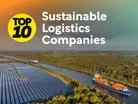
Top 10: Sustainable Logistics Companies
Logistics is responsible for at least 7% of total global greenhouse gas emissions according to McKinsey research.
The World Trade Organization’s Trade Costs Index shows transport and travel costs are the largest component of overall trade costs, meaning logistics performance directly sets how competitive cross-border trade is.
Reducing the negative sustainability impact of logistics could therefore have a big impact on not just the planet, but companies, communities and global trade.
Sustainability Magazine has ranked 10 of the top sustainable logistics companies.
10. DSV
Vice President Road Sustainability: Kenneth Riis Jensen
Headquarters: Hedehusene, Denmark
Employees: 75,000
Founded: 1976

DSV has committed to reaching net zero emissions by 2050 both in its own operations and across the value chain with targets and accounting principles developed in line with SBTi framework.
By 2030, it has set a target to reduce emissions under its direct control by 50% and indirect emissions by 30% against its 2019 baseline.
Kenneth Riis Jensen, Vice President Road Sustainability at DSV, says: “I’m incredibly proud of what we’ve achieved so far, and truly excited to be part of scaling the new technologies that will make an even greater impact in the years ahead.”
9. CMA CGM
VP CSR & Sustainability: Anne-Sophie Cochelin
Headquarters: Marseille, France
Employees: 160,000
Founded: 1978
By 2050, CMA CGM has committed to reach net zero carbon across all activities with a decarbonisation strategy based on reducing energy consumption and increasing the share of low carbon energies in the energy mix.
The company has agreed to a 50/50 joint venture with TotalEnergies that brings liquefied natural gas (LNG) refuelling infrastructure to Europe’s marine fuel supply in the Amsterdam–Rotterdam–Antwerp (ARA) port region.
"With this joint venture, CMA CGM and TotalEnergies are taking a new step to support the energy transition in shipping,” says Rodolphe Saadé, Chairman and CEO of CMA CGM Group.
8. La Poste Groupe
Director of Societal Engagement: Stéphanie Dupuy-Lyon
Headquarters: Paris, France
Employees: 232,000
Founded: 1991

La Poste Groupe, with its subsidiaries including Geopost, aims to reach net zero by 2040.
Working with Orange, La Poste has extended the lifespan of network equipment used at the Paris 2024 Olympic and Paralympic Games, reusing thousands of WiFi terminals and other telecom gadgets.
“In the face of scarce resources and the increasing digitalisation of services, La Poste Group is committed to reducing the environmental footprint of its tools and applications,” says Philippe Bajou, Secretary General of the La Poste Group and President of La Poste Group Immobilier.
7. Uber Freight
CEO: Rebecca Tinucci
Headquarters: Illinois, US
Employees (Uber): 31,100
Founded: 2017
Tech giant Uber’s logistics arm Uber Freight aims to shift 80% of its global brokerage shipments to clean transportation by 2040.
By 2030, its global corporate operations aim to achieve net zero climate emissions.
Uber Freight offers emissions visibility through the Uber Freight Emissions Dashboard, giving a holistic view of operations across entire supply chains and accounting for all modes of transportation.
Since the beginning of 2023, Uber Freight has eliminated more than two million empty miles.
6. A.P. Moller - Maersk
Director, Head of Corporate Sustainability & ESG: Lene Bjørn Serpa
Headquarters: Copenhagen, Denmark
Employees: 100,000
Founded: 1904

Maersk aims to decarbonise global logistics and enable sustainable trade.
Its ambition to reach net zero greenhouse gas emissions across all operations by 2040 is the most ambitious target in the shipping industry.
It is electrifying inland transport and warehousing, investing in alternative fuels and operates the world's first ocean-going methanol-enabled container ship.
Lene Bjørn Serpa, Director, Head of Corporate Sustainability & ESG at Maersk, says: “Measures to close the price gap between green fuels and fossil fuels is one of the most meaningful and impactful steps that governments can take to accelerate a green and just transition.”
5. DHL Group
EVP Corporate Communications & Sustainability: Nicola Leske
Headquarters: Bonn, Germany
Employees: 600,000
Founded: 1969
Logistics heavyweight DHL is targeting net zero emissions by 2050.
Sustainability is rooted in its Strategy 2030, which introduces 'Green Logistics of Choice' as a fourth bottom line.
With investments in fleet electrification, sustainable aviation fuel (SAF) and circular practices, DHL is focused on driving a climate-positive impact worldwide.
In November 2024, DHL Express signed a one-year deal for the delivery of 25 kt of SAF at Brussels Airport.
Travis Cobb, EVP Global Network Operations and Aviation at DHL Express, said: “Our customers benefit from our continuously increasing SAF coverage across different regions, now including our investment in SAF at Brussels Airport.”
4. DP World
Group VP Sustainability: Carlin Naidoo
Headquarters: Dubai, UAE
Employees: 115,000
Founded: 1972

DP World says it is scaling electrification across its fleet such as tractors and straddle carriers. The company is also investing in cleaner vessels like hybrid-electric ferries.
The company’s “Our World, Our Future” initiative holds several sustainability aims, like improving the number of women in industry and committing to a zero harm guide that aims to prevent incidents and builds a stronger safety culture.
DP World has reduced its emissions by 15% since 2022 and now sources 65% of its electricity from renewable sources according to its 2024 ESG Report.
“The journey to a sustainable future is critical,” says Sultan Ahmed Bin Sulayem, DP World’s Group Chairman and CEO, in the report.
“As a leader in global trade, we recognise that achieving meaningful change requires sustained innovation, strong partnerships and a clear commitment to our targets.”
3. Union Pacific Corporation
General Director, Sustainability: Thad Call
Headquarters: Nebraska, US
Employees: 33,000
Founded: 1862
By 2030, Union Pacific aims to reduce its absolute greenhouse gas emissions across Scopes 1, 2 and 3 by 50.4%.
In 2024 it achieved a 37% reduction and in 2025 it aims to utilise 10% biofuels.
For more than 20 years it has worked to identify repairable parts from its equipment, including locomotives, and worked with suppliers to repair and return them to service.
Union Pacific has also partnered with Remora, a startup capturing emissions directly from vehicle exhausts and turning them into a revenue stream.
Remora’s patented device captures up to 90% of CO₂ emissions from semi-trucks and locomotives while reducing soot, particulate matter and nitrogen oxides (NOx).
Each truck equipped with Remora’s technology can capture 135–169 tonnes of CO₂ annually, equivalent to planting 6,200 trees.
2. FedEx
Chief Sustainability Officer: Karen Blanks Ellis
Headquarters: Tennessee, US
Employees: 500,000
Founded: 1971

“Effective sustainability leadership is guided in equal parts by the past, the present and the potential of the business,” says FedEx Chief Sustainability Officer Karen Blanks Ellis.
FedEx aims to achieve carbon neutral operations by 2040.
Since 2005 it has reduced its aviation emissions intensity by 30% and has optimised more than 300 locations under its Network 2.0 efficiency initiative.
The company’s fuel conservation and aircraft modernisation saved the company approximately 140 million gallons of jet fuel and an estimated US$400m in FY24 alone.
FedEx has committed to procuring 30% of its jet fuel from SAF blends by 2030 and to offset emissions that cannot be mitigated through technology, it has invested US$100m in the Yale Center for Natural Carbon Capture.
Research includes the development of durable carbon removal methods such as enhanced weathering using basalt, which reduces soil acidity and improves crop yield while sequestering CO₂.
1. UPS
Chief Sustainability Officer: Scott Childress
Headquarters: Georgia, US
Employees: 500,000
Founded: 1907

UPS is embedding sustainability across its logistics network through efficiency, AI-driven route optimisation, fuel initiatives, renewable energy and carbon neutral solutions.
Its customers can benefit from carbon impact analysis, supply chain optimisation and paperless invoicing.
The company also offers a carbon neutral shipping option that supports projects that help to offset emissions associated with customers’ shipments.
Through this option, it addresses emissions from the combustion of fuel in its fleet, aircraft and stationary sources, indirect emissions from purchased electricity in UPS-controlled facilities and indirect emissions from the combustion of fuel in ocean, air, rail and ground transportation operated by third parties providing delivery services to UPS.
UPS aims to achieve carbon neutrality by 2050 alongside plans to use 100% renewable energy for its facilities and 30% SAF in its air network by 2035.
ORION cuts 10-14 miles driven daily per driver, saving hundreds of millions of dollars for UPS.