Google’s Support for AI Nature Preservation Initiatives
More than half of the world’s GDP is at risk from the loss of nature according to PwC – equivalent to US$58tn.
Google has announced three new efforts to support the protection and restoration of nature using AI.
It has launched its first accelerator focussed on startups using technology to support nature, provided US$3m to launch an open call for grant submissions for AI enabled solutions and released SpeciesNet, an open source AI model designed to identify animal species through photos from camera traps.
“This builds upon more than 15 years of investments in tools like our geospatial platform, Earth Engine, that enable partners, NGOs, governments and academics around the world to address nature and biodiversity loss,” says Kate Brandt, Chief Sustainability Officer at Google.
Google for Startups Accelerator: AI for Nature and Climate
Google’s AI for Nature and Climate Accelerator is a 10 week programme for seed to Series A technology startups based in LATAM and North America.
The company supports startup founders with their top technical challenges by pairing them with experts from Google and the industry.
Google says it provides eligible participants with up to US$350,000 in Google Cloud credits and participants can receive 30 days of free Cloud TPU access through the TPU Research Cloud platform.

Along with this support, accelerators include deep dives and workshops focussed on product design, customer acquisition and leadership development with dedicated support from startup experts and access to key industry events.
The programme is scheduled to kick off in May 2025.
Google’s grant fund for nonprofits
Google.org has provided US$3m to iCS to launch an open call for grant submissions.
This aims to support AI-enabled solutions from Brazilian nonprofits and research centres chosen by iCS.
Google’s funding will support organisations using AI in three areas:
- Reversing biodiversity loss, including solutions supporting the global 30x30 effort in compliance with the Global Biodiversity Framework
- Bioeconomy, supporting the value chains of timber and non-timber forest products and services associated with socio-biodiversity in Brazil
- Regenerative agriculture, including activities that support resilient agriculture, particularly for small farmers.
Robert Little, Head of Sustainability for gTech at Google, says: “These initiatives represent significant steps towards a more sustainable future.
“By empowering startups, non-profits, and researchers, we can harness the power of AI to address critical environmental challenges.”
SpeciesNet
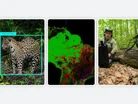
SpeciesNet is an AI model designed to identify animal species by analysing photos from camera traps.
Since 2019, thousands of wildlife biologists have used Google’s SpeciesNet through a Google Cloud-based tool called Wildlife Insights.

The tool can help to streamline biodiversity monitoring and inform conservation decision making.
Google has now released the SpeciesNet AI model to support tool developers, academics and biodiversity-related startups to scale monitoring of biodiversity in natural areas.
Mike Werner, Head of Sustainability Programmes and Innovation, Global Sustainability at Google, says: “It is available to anyone working to advance the effective management of conservation areas and scaling biodiversity monitoring around the world.”
Explore the latest edition of Sustainability Magazine and be part of the conversation at our global conference series, Sustainability LIVE.
Discover all our upcoming events and secure your tickets today.
Sustainability Magazine is a BizClik brand