Inside the Met Office & Microsoft's Climate Supercomputer
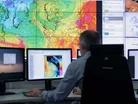
The Met Office has been at the forefront of UK meteorological predictions since 1854.
The organisation has come a long way since the 19th century, when it used to rely on local knowledge, observations and telegrams to London.
As its latest technological advancement, the Met Office has adopted a cutting-edge supercomputer driven by Microsoft Azure.
This partnership with Microsoft marks the Met Office's 14th generation of its supercomputing capabilities.
With the capacity to execute 60 quadrillion calculations per second, the new cloud-based technology is set to not only refine weather forecasts but also propel climate research forward.
"This advancement is crucial for industries such as aviation, energy, shipping, and emergency services, aiding in better preparation for extreme weather events caused by climate change," explains Darren Hardman, CEO of Microsoft UK.
The next era of meteorology
The new supercomputing system aims to deliver more precise and extended-range weather forecasts.
"People ask how a bigger computer improves the weather forecast,” says Charles Ewen, CIO at the Met Office.
“One big thing this new computer will allow us to do in the near future is to be able to produce 14-day forecasts with a similar kind of accuracy than we can today for seven, eight, nine days.”
This improvement stems from the ability to process about 50 billion weather observations daily, allowing the Met Office to complete more complex weather models and data analyses.
Science as a service
The transition to Microsoft Azure grants the Met Office adaptable computing resources, scalable to specific research demands.
"Essentially there's more science than we have the compute power to deliver, so it's not a question of how much compute do you need, it's how much you can get," Charles explains.
This shift is set to eliminate the need for building new physical infrastructure for each project, transforming the traditional supercomputing model into what Charles calls "supercomputing for science as a service".

Climate research powered by cutting-edge tech
Beyond daily forecasting, the Azure platform significantly boosts the Met Office's climate research capabilities.
Ségolène Berthou is the Scientific Manager at the Met Office and leads a research team focusing on environmental predictions. She believes that the new system will have immediate benefits for her team.
"The coupled system we're preparing is running faster and more smoothly on the new supercomputer,” she says.
“This is very good news because it means we can now be even more confident in our climate projections and have longer slices of time running this model.”
She notes that the new system allows for more confident climate projections and longer model runs, thanks to smoother and faster operations.
Researchers can now run multiple scenarios simultaneously through "ensembles," enhancing the accuracy and timeliness of extreme weather forecasts.
How the Met Office uses data
A major benefit of the Azure platform is the improved accessibility to the Met Office's extensive historical weather data.
"One of the reasons Microsoft is such an exciting partner for us is that we feel that there is much more value that can be extracted from our data by other people as well as by us," says Penny Endersby, CEO of the Met Office.
The Met Office is also gearing up for artificial intelligence integration, with over 100 staff members trained in foundational machine-learning skills and approximately 20 pursuing advanced studies in the field.
Sustainability and efficiency
While the transition was complex, requiring parallel operation of both old and new systems for more than a month, the cloud-based approach optimizes resource use, enhancing sustainability.
The Azure platform should allow the Met Office to utilise only the necessary computing resources for specific tasks, avoiding the constant operation of physical infrastructure.
"A big change like this is like changing the engines when you're flying over the Atlantic because you can never have a stop, which is why we did the long parallel run with the old supercomputer," Penny explains.
This technological evolution represents a foundational transformation for the Met Office, aiming to deliver better, more valuable forecasts to industries, governments, and citizens.
The focus on sustainability and efficiency ensures that the Met Office continues to lead in meteorological innovation while addressing environmental challenges.
Explore the latest edition of Sustainability Magazine and join our global conference series, Sustainability LIVE.
Discover our upcoming events and secure your tickets today.
Sustainability Magazine is a BizClik brand