Q&A: EY Legal Experts on the EU Omnibus and CSRD
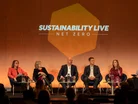
Michelle Davis is Global Sustainability Legal Services Leader at EY and Partner, Law at Ernst & Young LLP.
She has been involved in sustainability and clean energy for more than 25 years.
Her key focus is on helping clients operationalise sustainability so that they can better manage or avoid risk and importantly access value.
Her and the team’s clients include some of the largest corporations, banks, asset managers and institutional investors globally as well as governments, public sector bodies and NGOs.
Jess Etherington is a lawyer on the Sustainability Team at EY.
She is a sustainability regulatory lawyer and works with Michelle to provide sustainability and regulatory advice for clients.
At Sustainability LIVE: Net Zero, Michelle featured on the Future of Energy Transition panel, a discussion highlighting the importance of the energy transition in determining how governments and businesses can build a sustainable and resilient economy.
Michelle and Jess shared their expertise with Sustainability Magazine at Sustainability LIVE: Net Zero.
Could you talk us through the EU omnibus package and its sustainability impacts?
Jess
The European Commission last year announced that it had plans to simplify some of the existing regulations and directives which had passed through years ago. Its main focus at the moment is simplification of the reporting requirements. As part of its first omnibus package, what it's proposing to do is simplify the CSRD and the CSDDD, as well as packaging in simplification for the EU taxonomy regulation and CAM as well.
Quite interestingly, what it's proposing to do is increase the thresholds for the CSRD. This could bring up to about 80% of companies that are currently in scope out of it. It's quite a substantive and substantial change that it's proposing, which we really didn't expect to happen. It's also reposing to delay the reporting requirements for large entities by two years. In addition to that, simplifying some of the requirements that the CSDDD is imposing in respect of its due diligence obligations for some of the largest entities.
A lot is happening right now. It's yet to be seen whether this proposal will be enacted as proposed; it's got to go to the European Parliament and the Council now to be debated. There is a lot of change at the moment including with the current political environment. A lot of our clients specifically are thinking, ‘how do we best deal with these changes?’ ‘How do we best approach it?’ What we are kind of seeing at the moment is potentially a wait and see approach.
Michelle
We always say what you have to do is not just what the regulation tells you to do, but what your key stakeholders require of you. Even if organisations fall out of scope, but their stakeholders still want reporting on that information because maybe they've got used to it or were expecting it, or were recalibrating their own risk assessment because they were assuming they were going to get this information, they may still require it.
It's not as straightforward as just looking at the law. You have to look at what those that are keeping you in business and keeping you valuable want you to do.
It is complex to get your head around at the best of times. Even though the EU is saying that it wants to simplify things, that's not always as simple as it sounds.

What would your advice be to your clients on that front?
Michelle
Really, sustainability should just be embedded in strategy. It shouldn't be something that sits over here and gets dealt with separately. It does need to be embedded, because there are risks associated with it and key stakeholders need to be aware of those risks.
The key advice I would give to business leaders right now where there is a juxtaposition between sustainability activity and perceived value fiduciary duties is to have a very clear transition or sustainability strategy.
Be aware that the only thing that's certain is uncertainty at the moment around sustainability, so be prepared to change your plan. Have a very clear engagement strategy with your stakeholders and be transparent with them as you adjust and recalibrate your strategy or plan. It's all about transparency, clarity and engagement.
It's absolutely critical that sustainability and value are now linked and there is a very, very clear narrative and engagement around it.
Explore the latest edition of Sustainability Magazine and be part of the conversation at our global conference series, Sustainability LIVE.
Discover all our upcoming events and secure your tickets today.
Sustainability Magazine is a BizClik brand