
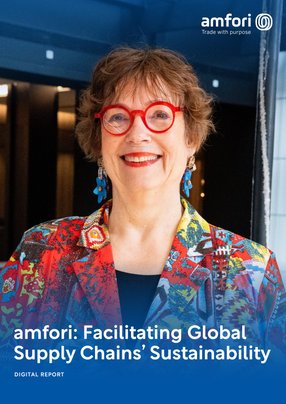
amfori: Facilitating Global Supply Chains’ Sustainability
‘Together, stronger’ may be a cliche, but – in the area of sustainable supply chains – it is a must.
When it comes to bringing companies together and driving socially and environmentally responsible supply chains, amfori stands out as a shining example.
The leading business association for sustainable trade was founded in 1977 by a coalition of companies determined to make global commerce more responsible.
From its earliest days, amfori has championed open trade, with a sharp focus on managing social and environmental risks across global supply chains.
At the helm of this mission today is Linda Kromjong, amfori’s President since January 2022. Her experience in leadership roles at companies including Sodexo, DHL Group, Samsung Electronics and the International Organisation of Employers shaped her conviction that businesses can be a force for good when sustainability is central to strategy. This belief now drives her leadership at amfori.
In conversation with Sustainability, Procurement & Supply Chain magazines, she explains how amfori is laser-focused on promoting sustainablility, responsible trade and supporting businesses in managing their supply chain risks.
Driving impact through collective action
To support companies worldwide in operating successful and responsible businesses, Linda explains that amfori’s approach is rooted in collective action: “Our members discovered they were sourcing from the same factories and countries and realised they could use their collective leverage to drive positive impact on the ground, particularly to improve working conditions in supply chains.”
This realisation led to the creation of amfori BSCI (Business Social Compliance Initiative) in 2003 — a pioneering effort in social due diligence. Over time, as sustainability expectations grew, amfori built on that foundation by developing a comprehensive suite of ESG solutions, designed for supply chain risk management and due diligence.
amfori’s solutions are underpinned by internationally recognised frameworks such as the United Nations Guiding Principles on Business and Human Rights, the Organisation for Economic Co-operation and Development (OECD) Guidelines and the International Labour Organization (ILO) Core Conventions.
These standards serve as a “guiding star” for companies navigating the fast-changing world of due diligence and responsible business conduct, Linda explains.
With the goal of helping companies manage risks, build resilience and drive continuous improvement, these actionable solutions include, for instance, amfori BSCI (amfori Business Social Compliance Initiative), amfori BEPI (amfori Business Environment Performance Initiative), amfori ESG Risk Compass, amfori SustainaPass and amfori Sustainability Platform.
They all play a key role in helping to build stronger, more resilient supply chains by supporting activities such as supply chain mapping, risk assessments, social and environmental audits, capacity building and legislative guidance. They also help companies meet regulatory requirements and turn risks into opportunities for positive change.
Linda reveals that amfori’s value lies in its ability to translate complex legislative landscapes into practical, member-focused solutions.
“With new sustainability and human rights legislation emerging across multiple jurisdictions, our members need timely, accurate and actionable insights to navigate compliance while continuing to grow their businesses responsibly,” she says.
Data and digital solutions for real-world challenges
Data are at the core of amfori’s approach to ethical sourcing. The aforementioned digital platforms provide structured frameworks for data collection, analysis and reporting.
Linda explains that businesses need real-time, reliable data to make informed decisions and demonstrate impact.
“Our digital platforms make it easier for members to understand where risks exist and how to address them,” she says.
The insights generated through these solutions help companies comply with regulatory demands and drive continuous improvement in ESG performance.
However, Linda warns that the true value of data lies not just in its collection, but in how it is used.
“If these insights are only included in reports to check a box, a significant opportunity is missed,” she says.
She adds that, when used strategically, data can inform robust risk management, support impactful decision-making and drive genuine progress — far beyond compliance alone.
amfori’s commitment to innovation ensures that its digital solutions evolve alongside emerging best practices and technological advances.
Collaboration as a catalyst
The association’s collaborative ethos is central to its success, as it brings together companies, auditing firms, producers, factories, policymakers and NGOs to share knowledge and drive collective impact.
This collaborative ethos is reflected in the way the association’s members share best practices in ESG due diligence and in the way amfori harnesses collective leverage to drive meaningful change.
How member engagement drives progress
amfori’s 2,400-plus members range from small businesses to multinational corporations, operating in over 100 countries. This networked approach enables members to learn from each other, raise standards and embed responsible practices across global supply chains.
Linda says: “The challenge for a more sustainable world cannot be tackled on an individual company basis.”
She highlights how amfori’s local networks provide on-the-ground support, helping members navigate cultural and regulatory complexity while fostering long-term relationships with suppliers and stakeholders.
How amfori harnesses collective leverage
To drive meaningful change, amfori partners with organisations including APSCA (the Association of Professional Social Compliance Auditors), ILO (International Labor Organisation), BRICA (the Belt and Road Industrial and Commercial Alliance) and the Confederation of Indian Industry, among others.
These alliances enable amfori to increase its impact and support the United Nations Sustainable Development Goals (SDGs).
Navigating the regulatory landscape
The regulatory environment for supply chain sustainability is becoming increasingly complex. New legislation, particularly in the European Union, is raising the bar for corporate due diligence on human rights and environmental impact.
Companies are now expected to demonstrate not only compliance but also proactive risk management and continuous improvement.
Linda notes that many companies underestimate the impact of proactive risk management – prevention is better than cure.
“Relatively simple actions derived from audit findings are likely to result in more stable and predictable supply chains through managing risks to people and the planet,” she says.
However, she warns that resilience is not a one-off effort but a continuous process that requires ongoing collaboration with suppliers at every level of the supply chain.
One common blind spot, according to Linda, is a lack of visibility beyond Tier 1 suppliers. She says many businesses focus on direct suppliers and ignore vulnerabilities further upstream, such as Tier 2 and Tier 3 suppliers.
Building constructive, long-term relationships with suppliers is essential for anticipating disruptions and managing crises, she explains.
Linda also highlights the importance of people and culture in supply chain resilience.
“Too much focus is often placed on technology and logistics and less on the importance of trained, empowered employees and suppliers,” she says.
Stakeholder engagement, often treated as a secondary concern, plays a vital role in understanding and integrating local realities. “This forgotten element can be a game changer as it effectively helps to uncover risks, build trust and ultimately strengthen the resilience of supply chains,” Linda continues.
amfori’s advocacy team plays a crucial role in helping members stay ahead of regulatory developments.
The team monitors legislative procedures, maintains relationships with policymakers and represents members’ interests in regulatory debates.
This proactive approach ensures that amfori members are well-positioned to adapt to new requirements and demonstrate leadership in responsible business conduct.
amfori’s Sponsorship of Procurement & Supply Chain Live Chicago and industry leadership
amfori’s influence extends beyond its membership through its sponsorship of industry events such as Procurement & Supply Chain Live Chicago, including at its co-located Chicago event with Sustainability LIVE.
These events bring together leaders in sustainability, procurement and supply chain management to share insights, discuss challenges and explore solutions for responsible business.
Linda reveals that amfori decided to sponsor the Procurement & Supply Chain Live Chicago events series because it believes in a collaborative approach to evolving procurement and supply chain operations.
She says: “We were eager to learn from other experts and engage in discussions with executives who share a common goal: improving procurement and supply chain operations.”
Through its sponsorship and participation in industry forums, amfori raises awareness of the importance of ESG and ethical sourcing.
The association advocates for a holistic approach, where business success is aligned with social and environmental responsibility.
Linda says: “We want to inspire others to join us on the journey towards trade with purpose. Collaboration is key to achieving lasting change.”
amfori’s work is underpinned by a belief in the power of collective action. Its members, partners and stakeholders are united by a shared commitment to building a more sustainable and equitable global trading system.
Linda concludes: “We believe that together, we can create supply chains that deliver benefits for people, planet and business.”
Company portals

Executives

Linda Kromjong
President