
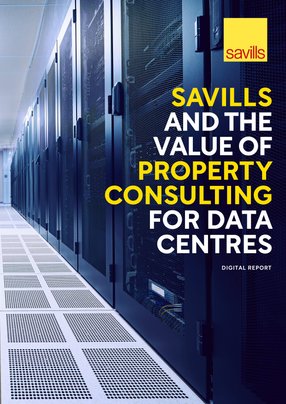
Savills & the Value of Property Consulting for Data Centres
The data centre sector has undergone a dramatic transformation over the past five years. Power demands have surged as hyperscale operators have started to expand across the globe – largely accelerated by the meteoric rise of B2B and B2C AI technologies.
Savills, the global real estate advisor, has looked to position itself at the very centre of this evolution, offering comprehensive consultancy services spanning the entire data centre lifecycle. Its EMEA data centre division works with major hyperscalers, well-capitalised operators and institutional investors alike.
Cameron Bell leads Savills’ data centre transactions business for EMEA and his career path into the sector reflects how rapidly the industry has matured.
"About five years ago, data centres were part of our European industrial business run out of London," Cameron explains. The firm received numerous enquiries about data centre opportunities, and the technical complexity demanded specialists who could focus solely on this kind of asset class.
Marc Edmondson joined Savills in the spring of 2025 as Data Centre Director within the Project Management team, part of the company’s Building & Project Consultancy (BPC) division. His arrival speaks to the firm's ambition to offer integrated lifecycle services in this booming sector. Marc brings with him deep technical expertise from his background in architecture and hyperscale project delivery, where he worked on hyperscale projects across the UK, Dublin, Finland and the Netherlands.
Savills already possessed multiple service lines relevant to data centres such as planning and energy. The opportunity for the company lay in uniting these capabilities under coordinated leadership.
From land acquisition to operational delivery
Savills’ data centre offering begins with land identification and acquisition, with the firm's historical strength in rural land providing valuable connections. These relationships with major estates and landowners give the company competitive advantages.
Modern data centres – especially the hyperscale and colocation facilities – are substantial construction projects that require large land parcels with very specific characteristics. Power availability and grid connectivity rank as critical factors. Fibre optic infrastructure determines site viability for low-latency applications.
"There are different types of data centres, so this is quite a nuanced detail," Marc explains. Edge data centres serving local populations need proximity to users. Geography-agnostic facilities can be located anywhere with adequate power and connectivity.
The team receives enquiries from both landowners and operators. Some landowners approach Savills seeking site suitability assessments. At the same time, the firm proactively sources land matching client requirements across Europe.
The client base remains relatively concentrated, though. This concentrated market enables deep client relationships and detailed requirement understanding.
"It's such a small market, and there's a core number of operators or investors that we work with," Cameron says. The team also keeps up to date with European location strategies, making Savills agile to the differing specifications and priorities of clients.
Honest advice on project viability
One thing that helps Savills stand apart is the kind of candid advice it offers clients. The rigorous technical requirements for data centres inevitably means that most sites prove unsuitable.
Cameron says: "Finding something that does is the golden goose." This kind of honesty in consulting scenarios goes a long way towards protecting client resources and strengthening long-term relationships.
But why exactly do most sites fail to meet the criteria for a data centre? Power availability often presents the biggest constraint, with grid capacity limitations affecting many regions across Europe. Then there is the issue of planning consent, where pathways vary significantly from jurisdiction to jurisdiction.
Expert counsel is invaluable when it comes to navigating these pitfalls, with early intervention helping to maximise value for clients and preventing wasted investment in unviable opportunities.
"We can clearly identify at pace what a good data centre opportunity is," Marc says. “We can provide that timely advice, and equally the support necessary to realise those projects as well, because it is an incredibly complex set of criteria that we need to satisfy before we end up in a situation where we have something that could be suitable.”
Old buildings, new life
An interesting development is the growing appetite for refurbishing older data centres rather than always building from scratch. Technology moves fast, and facilities built even a decade ago can feel obsolete.
Server racks have become more powerful but also hotter, straining cooling systems designed for less demanding equipment.
"Technology is advancing at pace," Marc notes. "That hasn't changed – if anything, it's increasing." The heat generated by modern high-density racks creates engineering headaches for operators using this new technology in legacy buildings.
Some operators are repositioning their portfolios or exiting certain locations entirely, creating opportunities for new entrants or companies with different requirements. Rather than demolishing everything, smart money can refurbish and upgrade existing structures.
The economics are compelling. Projects reach operational status much faster than greenfield developments. Capital returns accelerate when you avoid lengthy planning battles and multi-year construction programmes. There are environmental benefits too, which matter increasingly to sustainability-conscious investors.
"If we can repurpose these buildings in a more sustainable manner, it's a far quicker route to market," Marc says. Not every legacy facility is right for refurbishment, but the ones that are offer an attractive route for certain investors.
Commissioning and operational transition
Savills’ involvement extends well beyond site acquisition and planning. The team works through construction, commissioning and even into live operations. Modern data centres don't really have a defined endpoint where construction ceases.
"The construction in these buildings never actually stops," Marc explains. Operators continually upgrade technology inside live facilities. That means construction crews working carefully around operational equipment worth millions of dollars.
It requires a different mindset than traditional build projects; you can't just cordon off an area and make noise and dust. Life safety systems must remain operational. Temperature and humidity need constant control. One mistake could crash servers handling critical workloads.
Savills has teams experienced in these environments, having executed work adjacent to or above live hyperscaler operations. The planning is meticulous, but it's absolutely possible with the right expertise.
Commissioning itself has become more collaborative. Historically, contractors handed over the keys at practical completion and walked away. Now they often stay involved as operators bring in racks and begin setup. This is especially true for liquid cooling systems, which require careful coordination between building services and IT equipment.
AI driving exponential demand
AI represents the latest demand wave, though Cameron is careful to distinguish hype from reality. People have talked about AI for years. Only recently have purpose-built AI facilities moved from PowerPoint presentations into actual construction and lease negotiations.
"They're being delivered now, being negotiated now, and we're heavily involved in some of those across Europe," he says. These projects have distinct requirements compared with traditional hyperscale deployments, particularly around power density and cooling.
The computational demands of today dwarf previous generations of cloud computing workloads, meaning that existing data centres struggle to accommodate the heat loads these AI chips generate.
The UK investment announcement from the US, whatever its ultimate details, captured genuine momentum. Marc notes that demand was already climbing steeply before, but the announcement simply accelerated what was already an exponential trajectory.
Economic and employment multiplier effects
Government enthusiasm partly reflects anticipated economic benefits beyond direct data centre employment. The sector creates ripple effects throughout the economy. AI-enabled industries will generate entirely new job categories and career opportunities.
Data centres also unlock regional development. Grid reinforcement and improved connectivity benefit surrounding areas. Residential and commercial development follows. The economic impact extends well beyond the construction phase into decades of operations.
"It's not just the people who will be operating these data centres, it's the economic growth that will come from the new positions created," Edmondson explains. Regional economic development strategies increasingly treat data centres as anchor infrastructure.
Marc draws parallels with education and research facilities. Both create foundations for future innovation. Data centres aren't the entire solution to economic challenges, but they're enabling infrastructure. You can't have an AI-driven economy without them.
What comes next
With AI growing all the time, the demand for data centres is expected to continue to skyrocket well into the foreseeable future. Marc mentions autonomous vehicles as just one technology that will require huge data centre infrastructure to operate.
"If we look at the decision-making computing that's going to be required to support that, and this is just one aspect, that in itself is significant," Marc notes. Each new application category adds incremental requirements.
The sector also faces competition for grid capacity. Electric vehicle charging infrastructure needs substantial power, while commercial vehicle electrification will demand even more. Residential heat pumps replacing gas boilers add to the load. Everyone wants the same constrained resource.
Renewable energy expansion offers partial solutions. Data centre operators champion renewables both for sustainability commitments and cost management. But building generation capacity takes time, just like everything else in the energy sector.
With so many things to consider, Cameron, Marc and the team at Savills are always kept on their toes.
Cameron says,“I pick up some sort of new piece of knowledge on an almost daily basis. I absolutely love the fact that I'm constantly learning.”
For Marc, the huge growth of data centres is an incredibly exciting prospect, not just for his career, but for society more generally.
"I see data centres as a force for good within the world, and I remain very optimistic about that future," he says.
Company portals

Executives

Cameron Bell
Director - EMEA Data Centres