


Walmart CSO Kathleen McLaughlin on Sustainable Value Chains

Walmart CSO Kathleen McLaughlin on Sustainable Value Chains
Walmart is one of the world’s largest retailers, serving millions of customers daily across thousands of stores and digital platforms.
From agriculture and apparel and electronics to e-commerce, Walmart’s value chains span continents, ecosystems and communities. With such scope, the company faces sustainability challenges – but also opportunities.
Sustainability leadership in action
Helping to guide the company’s sustainability work is Kathleen McLaughlin, Walmart’s Chief Sustainability Officer. Kathleen has spent more than a decade at Walmart, following a 23-year career at McKinsey & Company.
“My team and I help Walmart teams transform our business by addressing social and environmental issues,” she says.
This transformation covers climate, human rights, economic opportunity and community resilience, all integrated into business decision-making.
Rather than treating sustainability as a separate function, Walmart positions it as a driver of long-term value creation. For Kathleen, this is about aligning business performance with societal outcomes, an approach often described as “shared value”.

“Our purpose as a company is to help people save money and live better,” she explains.
“That's been true for decades – it's very simple and sustainability is core to that.”
Embedding sustainability into everyday business decisions
A defining feature of Walmart’s strategy is affordability. Sustainable products must not remain niche or premium offerings.
“For us to fulfil our purpose, we want to make the sustainable choice the one that's the everyday, affordable choice,” Kathleen explains.
“We can't have a world where the sustainable choice is the premium offering that only certain people can afford to choose – it's about shifting business models, including our own, to embed sustainability.”
This principle shapes decisions across sourcing, operations and product design. It also reflects a broader industry challenge — how to scale sustainable solutions without increasing costs for the customer.
Walmart’s approach focuses on transforming existing systems rather than creating parallel ones. This includes enhancing sustainability within Walmart’s operations as well as working with suppliers, NGOs and others to embed climate mitigation, nature protection and circularity into core processes along the value chain. The company also works with others to address social issues within supply chains, including tackling systemic risks to human rights and advancing economic opportunity for workers.
“How do you embed sustainability into sourcing, operations and facilities management?” Kathleen poses. “That's really what we're trying to do. It matters for the long-term success of business, as well as helping us fulfil expectations that our stakeholders have of what we ought to be focused on as a retailer that they trust and want to do business with.”
How supply chain complexity creates both risk and opportunity
Walmart’s supply chain is extensive and complex, encompassing thousands of suppliers across multiple sectors. This complexity presents challenges, but also significant opportunities for impact.
“There are clear business benefits from working on value chains,” Kathleen explains. “Including enhancing surety of supply – an antidote to volatility and uncertainty – enabling growth, managing cost structure and mitigating risk.”
Supply chains are increasingly exposed to environmental risks such as climate change, resource scarcity and biodiversity loss. They also face social risks, including labour rights issues and economic inequality.
“There are many challenges in value chains – but the sustainability practices help mitigate those,” Kathleen says. She believes that solutions to individual issues can benefit multiple stakeholders, strengthening Walmart’s supply chain in turn. “We prioritise hotspots and work in partnership with suppliers, NGOs and policymakers.”
This collaborative model recognises that no single company can transform global supply chains alone.
Regenerative agriculture
One example of this approach is Walmart’s work with rice farmers in the southern United States.
“We're working with the rice producers and policymakers in the state of Arkansas to help adopt more regenerative practices,” Kathleen says.
Alongside the environmental benefits in soil health and emissions reduction, this lowers the need for inputs – things like fertiliser, water and chemicals – while improving resilience and yields and lowering production costs over time, all of which, in turn, lead to societal benefits for the longevity of people in farming communities.
This integrated approach delivers value across the system. It also ensures that affordable products remain available to consumers. The rice produced through this programme is used in Walmart’s Great Value range, its entry-level private label, highlighting how sustainability can be embedded into everyday products rather than confined to premium lines.
“You can get those benefits for the customer, for the business, for the producers, through one integrated approach to problem solving,” Kathleen explains. “And that's the kind of thing that we're working toward across all the commodities.”
Engaging suppliers through Project Gigaton
In 2016, Walmart became the first retailer to set an SBTi-approved target for emissions reduction and launched Project Gigaton, an initiative aimed at avoiding, reducing or sequestering one billion metric tonnes of greenhouse gas emissions from retail product value chains.
“Project Gigaton is a way to get real climate action,” Kathleen says.
The programme focuses on Scope 3 emissions, which, at 98%, represent the largest share of the retailer’s carbon footprint.
More than 50,500 suppliers are now involved, representing more than 75% of Walmart’s net sales.
Project Gigaton engages suppliers in practical, measurable actions to reduce emissions – and achieved its original target six years ahead of schedule.
Kathleen credits the success to four key areas:
- Keeping it practical and focused. “We designed the programme with some of the best scientists from World Wildlife Fund, from CDP, from World Resources Institute, from Environmental Defense Fund to help us identify the biggest concentrations of emissions in value chains,” she explains. “That allowed us to focus on practical projects that can get at sources of emissions that matter most instead of going to suppliers and asking them to measure or work on the emissions impact of every single item they sell in every part of the world, which would not be a very practical or high impact approach.”
- Clear business benefits. “We encouraged people to pursue the projects that mattered most for them and would create business benefits,” Kathleen explains. “Things like energy efficiency that help lower cost, or things that would give them security in commodity supply, like avoiding deforestation.”
- Relevant support. “Some of our suppliers are big companies that don't need a lot of support from us,” she continues. “Some of them do need support. So we offer learning modules, webinars, summits, to help people get practical ideas about how to go faster, alongside practical tools like Circular Connector, a tool that connects suppliers to third-party packaging solutions. HSBC has also offered lower cost financing to suppliers engaged in the programme.”
- Recognition. “We publicly recognise the suppliers that are engaged in reporting,” Kathleen says.
Importantly, the emissions reductions achieved are not exclusive to Walmart. Suppliers’ improvements benefit all their customers, amplifying the programme’s impact.
Balancing cost, innovation and sustainability
One of the central challenges in supply chain sustainability is balancing cost with environmental performance.
“There are trade-offs all the time,” Kathleen acknowledges.
Some interventions, particularly in sectors like animal protein, remain prohibitively expensive at scale. This requires continuous innovation to identify viable alternatives.
For example, feed additives for livestock are being explored as a way to reduce emissions more cost-effectively. Walmart’s approach involves system-level optimisation rather than isolated interventions.
If one change increases costs, it may be offset by efficiencies elsewhere in the value chain.
The regenerative rice example illustrates this principle. While some practices may initially increase costs, savings from reduced inputs and higher yields can compensate.
This mirrors broader business innovation processes, where trade-offs are managed to deliver overall value.
“It’s a problem-solving challenge, like any other business innovation,” Kathleen says.
Governance, trust and long-term value creation
Walmart evaluates sustainability initiatives through three key lenses: business relevance, stakeholder alignment and capability.
This ensures that efforts contribute to long-term shareholder value while addressing societal expectations.
The company also prioritises initiatives that have the potential to bring stakeholders together rather than create division. As a retailer serving diverse customers, maintaining confidence is critical. “We want to earn and sustain the trust of our customers,” Kathleen explains.
This approach extends to corporate governance, ethical practices and responsible use of data and technology.
It reflects a broader understanding of sustainability as encompassing ESG factors.
Optimism amid global challenges
Despite the scale of environmental and social challenges, Kathleen remains optimistic.
“We are facing a lot of challenges,” she acknowledges. “But we’re also seeing a really exciting expansion of the capabilities and assets available to us through AI and technology and through a shared value approach and a broader systemic view to these problems.”
At the same time, there is growing alignment between business objectives and sustainability goals, creating opportunities for innovation and impact.
“There’s never been a more important time to work at this intersection of society and business,” Kathleen says.
For Walmart, the journey continues, driven by the belief that sustainability and business success are mutually reinforcing.
“I’m excited about where we can take things.”
Did you know?
Company portals

Executives
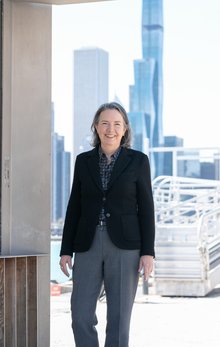
Kathleen McLaughlin
Board Chair