
ABB: The 0.2% Decision to Unlock Financial & Carbon Savings
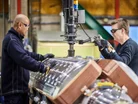
A 0.2% decision may sound negligible in industrial engineering, but ABB argues it can scale into billions.
In its report The Industrial Efficiency Gap: How a 0.2% Decision Scales to Billions, ABB says large motors and generators are a critical but often overlooked lever in industrial decarbonisation, especially because these assets run for decades and their use phase accounts for about 99% of lifetime CO₂ emissions.
The company’s analysis, based on more than 1,000 large motors and generators delivered from its Västerås facility between 2015 and 2025, shows how specification choices made today can shape energy bills, emissions and productivity for years to come.
"Industry has spent decades optimizing what happens inside a plant. Yet large motors and generators have rarely been part of that conversation, even though they run continuously for 25 years and sometimes even more, converting more energy than almost anything else on site,” says David Bjerhag, Global Business Line Manager, High Speed Synchronous, ABB.
“What our data shows is that the gap between a standard machine and a TIE-optimised one is not technological. It is a specification gap. The companies closing it fastest are the ones where the engineer who selects the motor and the CFO or CSO responsible for energy performance are aligned around a single metric: total cost of ownership. That alignment is what TIE is designed to create."
Why electrification isn’t enough
Industrial electrification is accelerating across sectors including oil and gas, metals, chemicals, utilities and pulp and paper, but ABB warns that electrification alone is not enough.

The report says overall system efficiency depends on the full motor-driven system, including driven equipment, controls and operating profile, yet the motor or generator still sets the core conversion efficiency.
In that context, ABB positions its Top Industrial Efficiency, or TIE, option as a practical route to higher performance without added complexity or compromised reliability.
Sustainability leaders won’t want to miss Sustainability LIVE: The Leadership Summit at London Climate Action Week, taking place at Code Node on 25 June 2026.
Register now for this exclusive invite-only event.
Procurement priorities
For procurement teams, the report’s message is straightforward: every request for quotation on a large motor or generator is a chance to lock in long-term value.
ABB says the main barrier is not technology, cost or complexity, but a short-term buying mindset shaped by regional energy prices and fragmented value chains that separate purchase decisions from operational costs.
That makes procurement a strategic lever, because the upfront premium for the most efficient option can be offset by years of lower energy spend.
The report argues that buyers should weigh total cost of ownership rather than only the initial purchase price. ABB says asking for the TIE option can deliver payback from a few months to up to three years, while the remaining years of the asset life then contribute directly to productivity and cost reduction.
Manufacturing impact
ABB says large motors rated above 375 kW account for an estimated 10.4% of global electricity use today, with demand projected to double by 2040. Because these machines are everywhere in heavy industry, even small efficiency improvements can compound across factories, plants, and regions.
ABB says a typical TIE improvement lifts synchronous machine efficiency from around 98.5% to 98.7-98.8%, while induction-based systems can often achieve 1-1.5 percentage points more.
The report highlights a 56 MW TIE-optimised synchronous motor delivered to a steel plant in India in 2025 as a proof point. ABB says the machine achieved a verified efficiency of 99.13%, set a new world record and is expected to save US$5.9m in electricity costs and avoid 45,000 tonnes of CO₂ over its lifetime.
The billion dollar saving opportunity
ABB’s financial argument is built around scale and time.
The report says that if every standard machine delivered by ABB’s Västerås factory over the past decade had been specified under the TIE option, global industry could already have saved 11.1 TWh of electricity and nearly US$1bn at US energy costs.
It also says 5.9 million tonnes of CO₂ could have been avoided, equivalent to roughly 1.3 million cars off the road for a year.
Looking at the broader installed base, ABB says a 0.2% efficiency uplift across large industrial motors could save 4 to 6 TWh a year, and a 25-year lifetime basis could translate into 100 to 150 TWh of electricity saved, US$9.5bn to US$12bn in cumulative cost savings and 60-75 million tonnes of CO₂ avoided.
Company portals

Executives

David Bjerharg
Global Business Line Manager