Combining Seaweed & Renewables: Amazon’s $100m Climate Fund
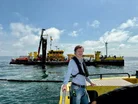
Off the coast of the Netherlands, an innovative seaweed farm has achieved its first commercial-scale harvest, right in the middle of an offshore wind farm.
North Sea Farm 1, developed by non-profit North Sea Farmers and supported by Amazon’s US$100m Right Now Climate Fund, is the first project of its kind globally.
By combining seaweed cultivation with renewable energy infrastructure, the farm offers a promising model for sustainable food and material production, biodiversity protection and climate resilience.
Its successful harvest marks a key milestone in the pursuit of scalable, nature-based climate solutions.
A commercial-scale seaweed farm
Seaweed farmers have completed the first-ever harvest at North Sea Farm 1, a pioneering commercial-scale seaweed farm located in the North Sea off the coast of the Netherlands.
What makes this initiative globally unique is its setting, strategically positioned between offshore wind turbines within the Hollandse Kust Zuid (HKZ) wind farm, around 18 kilometres from Scheveningen.
Conceived in 2022 and planted in October 2024, the project marks a major milestone in the intersection of marine renewable energy and sustainable aquaculture.
Developed by non-profit North Sea Farmers and funded with €2m (US$2.3m) from Amazon’s Right Now Climate Fund, a US$100m initiative backing climate and biodiversity projects, this seaweed farm presents new opportunities to advance climate resilience, biodiversity and carbon capture.
“The inaugural harvest of North Sea Farm 1 is a significant moment,” says Eva Faict, Amazon Netherlands and Belgium Country Manager.
“Together with North Sea Farmers, we have proven that cultivated seaweed farming among offshore wind turbines is a viable commercial concept.”
Innovation in offshore space
The location of North Sea Farm 1 is a key part of its innovation.
By establishing the farm between existing offshore wind infrastructure, the project avoids competition for space in the busy North Sea and ensures protection from maritime traffic.
“Through ongoing scientific research, we aim to demonstrate whether farms like this can have a positive long-term impact on both biodiversity and climate change mitigation,” explains Eef Brouwers, Managing Director of North Sea Farmers.
“At the same time, we're proving that seaweed production within an existing offshore infrastructure is possible at a commercial scale.”
The harvesting process relies on specialised vessels navigating between turbines to collect mature seaweed from four expansive nets, each 50 by three metres, securely anchored to the seabed.
Covering five hectares, the farm is a significant footprint within marine renewables territory.
Is seaweed a climate solution?
Seaweed holds substantial promise in the transition to a low-carbon economy.
It does not require land, fresh water or fertilisers and can be used as a sustainable input in textiles, foods and wellness products, as well as a biological alternative to carbon-intensive materials traditionally grown on land.
A team of researchers from Plymouth Marine Laboratory, Deltares and Silvestrum Climate Associates has been working closely with North Sea Farmers to study the farm’s climate impact.
Using satellite data, water samples, seabed analysis and eDNA monitoring, the researchers are analysing how seaweed cultivation affects carbon storage, water quality and local ecosystems.
“We’re very excited to understand the effects of the seaweed farm on the immediate and surrounding marine environment,” comments Professor Ana M Queirós, Climate Change Lead at Plymouth Marine Laboratory and Lead Scientist on the project.
“Our analysis will follow the carbon from the seawater into the seaweed and the environment and any effects on biodiversity.
“We will be taking seabed samples, water samples and in-situ monitoring of marine life and the use of advanced eDNA techniques to gain a detailed understanding of the developing habitat and the various species it may or may not be supporting.
“Its vital projects like this are underpinned with rigorous scientific evidence, particularly given the urgency of the climate and biodiversity crisis and the need to find scalable mitigation measures that produce genuinely beneficial and sustainable outcomes.”
A model for climate and biodiversity
The long-term vision of North Sea Farm 1 is to serve as a model for scalable, science-backed seaweed farming across Europe and globally.
Post-harvest data will help determine how such farms can be integrated into offshore renewable energy zones, shaping policy and commercial investment strategies in sustainable blue economies.
“North Sea Farm 1 is unlike anything else in the world,” wrote Kara Hurst, Chief Sustainability Officer at Amazon, on LinkedIn.
“It’s the only commercial-scale seaweed farm located between wind turbines, protecting the crops from busy shipping lanes.
“The farm was created by North Sea Farmers, a nonprofit we support through our US$100m Right Now Climate Fund.
“Not all crops grow in the ground, I’m excited that Amazon is part of the first seaweed harvest off the coast of the Netherlands in the North Sea!”