
How Does the World’s Largest Foldable Solar Roof Work?
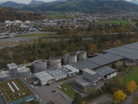
The launch of the world’s largest foldable solar roof system in Uetendorf, Switzerland, is a huge step in the evolution of renewable energy solutions.
The roof – the size of three football (soccer) pitches – is designed to integrate seamlessly into existing industrial and municipal sites.
For sustainability and energy executives seeking scalable, land-efficient technologies, it demonstrates how photovoltaic (PV) generation can be embedded within operationally sensitive environments without compromising output.
The project blends extensive area coverage with structural adaptability.
Constructed as a multifunctional canopy above wastewater treatment basins and service areas, the system transforms the site into a productive renewable asset.

Maximising energy on existing sites
Located in the Canton of Bern, above the basins of the ARA Thunersee Wastewater Treatment Plant (WTP), the installation is a positive example of energy-infrastructure design.
It also highlights Switzerland’s leadership in advancing PV innovation for land-constrained regions.
In areas where land availability is limited and competition for space is high, the ability to build upwards rather than outwards is increasingly attractive.
The Uetendorf system contributes directly to decarbonisation targets without occupying new ground.
Designing for high-demand public utilities
The foldable solar roof spans 20,000 square metres and is positioned over pre-treatment and biological basins, some of the most energy-intensive parts of any wastewater treatment facility.
Wastewater treatment accounts for more than 1% of electricity consumption across Europe, making on-site renewable generation a strong contributor to operational decarbonisation and cost reduction.
The array uses the patented HORIZON system developed by dhp technology.
Scale, performance and material efficiency
Across its huge footprint, the system supports an installed capacity of 3,000 kilowatt peak (3 MWp).
The projected annual output of 3 to 3.4 gigawatt hours (GWh) would be enough to supply electricity to around 700 homes.
For utilities and industrial operators, it can reduce purchased electricity, mitigate exposure to volatile energy markets and support long-term sustainability commitments.
The system’s cable-supported, lightweight design enables high efficiency, reducing material usage by approximately 50% compared with comparable rigid systems.
Automated retractability and operational security
Arguably the defining innovation of the HORIZON system is its retractability.
The solar roof automatically folds into a protective storage position during severe weather events such as high winds or heavy snowfall. This reduces structural stress, extends asset life and simplifies engineering requirements.
Inspired by cable-car technology, the non-glass PV modules are suspended from high-tension cables.
Large supporting trusses are pre-assembled at ground level, reducing the need for complex elevated construction and improving site safety during installation.
The retractable nature of the HORIZON system addresses one of the primary limitations of floating PV solutions: restricted access.
Wastewater treatment basins require constant visibility and periodic intervention for maintenance, inspection and chemical dosing.
Even lightly buoyant structures can impede workflows.
With 20-metre spans and a roof height of up to 7 metres, the system maintains full accessibility and retracts completely.