How EDF & Holtec Plan To Expand Nuclear Energy In The UK
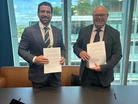
A brownfield site in Nottinghamshire could host four small modular reactors under plans submitted by EDF and Holtec International to the UK Government. The location at Cottam previously operated as a coal-fired power station before decommissioning seven years ago.
The proposal centres on Holtec's SMR-300 units.
Four reactors at the site could generate 1.3GW, which according to Carbon Brief equates to roughly 3% of UK energy demand.

The two companies have signed Heads of Terms to establish a joint venture for the project.
The partnership brings together EDF's position as the world's largest nuclear operator with Holtec's reactor technology.
Simone Rossi, the CEO of EDF UK, says the location suits nuclear development.
"The Cottam project supports the UK government's ambition to expand nuclear capacity and will facilitate significant re-development of a region that has given so much to the UK through its coal heritage," she says.
Nuclear policy and energy transition
The proposal aligns with government policy on energy infrastructure.
Last year Ed Miliband, the UK's Energy Secretary, announced a US$18.5bn investment in nuclear power across the country, describing this moment as a "golden age" for the energy source.
Ed outlined the policy rationale at the time.
"The truth is that we have this massive challenge to get off fossil fuels. That is the central driving ambition of the government's clean energy superpower mission. We know that we're going to have to see electricity demand at least double, by 2050," he said.
He added that expert consensus supports nuclear deployment.
"All of the expert advice says nuclear has a really important role to play in the energy system. In any sensible reckoning, this is essential to get to our clean power and net zero ambitions."
The government wants to increase nuclear's share of the electricity mix as part of efforts to reach net zero and reduce reliance on gas.
Small modular reactors form a central part of that strategy because they could be quicker to build and cheaper to finance than conventional large-scale plants.
Partner organisations and track records
EDF operates 20% of UK nuclear power plants.
The French company runs the bulk of France's reactor fleet alongside UK stations including Hinkley Point B and Sizewell B.
The firm is leading construction of Hinkley Point C and Sizewell C.
EDF acquired British Energy in 2009, which brought much of the country's nuclear generating capacity under its control.
- Employees: 197,360
- HQ: Paris, France
- Number of nuclear reactors: 70+
- Operational reach: 30+ countries
- Group CEO: Bernard Fontana
The American firm built its reputation on spent fuel storage and handling equipment for nuclear plants rather than reactor construction.
The company later moved into decommissioning and acquired shuttered plants including Indian Point in New York and Palisades in Michigan. The Cottam proposal combines EDF's operating experience with Holtec's reactor technology and fuel cycle expertise.
Rick Springman, the President of Holtec, says the conditions exist for progress. "Our long-standing partnership with EDF, combined with the opportunity created by the UK's Advanced Nuclear Framework, provides a strong foundation for advancing SMR-300 deployment at Cottam."
Rick added that the company plans expansion. "Holtec plans to substantially expand its presence in the UK with a significantly larger operation center and is evaluating a manufacturing plant to build nuclear equipment in the country."
That would represent a shift from project development towards domestic manufacturing capability.
Regulatory frameworks and approvals
The Cottam submission falls under the UK's Advanced Nuclear Framework. That framework was established to accelerate deployment of advanced reactor technologies and attract private capital.
It favours a market-led approach over the heavily subsidised models used for large reactors such as Hinkley Point C. The companies say both projects could benefit from closer cooperation between the UK's Office for Nuclear Regulation and the US Nuclear Regulatory Commission.
The two regulators have been working to align their processes. Design approvals in one jurisdiction could carry more weight in the other under the cooperation framework.
For developers, that cooperation matters because duplicated regulatory review has historically been one of the slower and more expensive parts of bringing reactor designs to new markets.
Testing the small reactor model
Whether small modular reactors deliver on promises of faster construction and lower costs remains to be tested at scale anywhere in the world. The Cottam proposal is one of several SMR projects now competing for government backing and grid connection slots.
The Advanced Nuclear Framework's ability to move projects from paper to construction will face an early test. Progress at Cottam will be watched as an indicator of how the policy mechanism functions in practice.
The site's previous use as a coal-fired power station could mean existing grid infrastructure and brownfield status support development timelines. The partnership says it has worked together in various forms for more than three decades.
EDF brings operating experience from the UK nuclear fleet spanning decades. Holtec brings the reactor design and stated manufacturing ambitions for domestic production facilities.
Company portals
Executives

Rick Springman
President
Simone Rossi
Chief Executive Officer