
How Lowe’s embeds Sustainability in Home Improvements
Lowe’s Companies is an American home improvement retailer, aiming to help homeowners, renters and professionals to improve their homes and businesses through the company’s products and services.
Its sustainability strategy focuses on its products, people and communities while striving for ethical and responsible operations.
For its efforts, Sustainability Magazine has ranked Lowe’s Companies 60th in its Top 250 World’s Most Sustainable Companies 2025.

What is Lowe’s sustainability strategy?
Lowe’s is pursuing its goal of reaching net zero greenhouse gas emissions by 2050 across Scopes 1, 2 and 3.
It plans to achieve a minimum of 90% reduction in its emissions and offset all remaining residual emissions.
Its short term targets are to achieve a 42% reduction in Scope 1 and 2 emissions and a 25% reduction in Scope 3 emissions by 2030, compared to a 2021 baseline.
To achieve net zero, Lowe’s has set three main areas of focus:
- Electrification: transitioning from fossil fuels to electricity.
- Efficiency: reducing the amount of energy required for its operations.
- Renewable energy: leveraging solar, wind and other renewable sources to power its products and equipment.
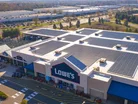
By the end of 2024, more than 100 of Lowe’s US stores in California, Illinois and New Jersey have rooftop solar installations.
These help to generate more than 100 million kilowatt-hours of electricity per year, which is enough to power more than 6,500 homes.
Chris Cassell, Vice President of Corporate Sustainability at Lowe’s Companies, says: “At Lowe’s, we are focused on operating responsibly and reducing our impact on the environment.
“Investing in renewable energy lowers operating costs and is an important step in reducing emissions associated with our stores and distribution centres.
“This initial rooftop solar portfolio is one example of the collaboration we seek with partners as we work toward our long-term and interim net zero goals.”
How does Lowe’s create sustainable products?
Lowe’s says that the sustainability of its products is a top priority, ensuring that it always provides high quality and innovative items to its customers.
Its goals are for all of its private brand packaging to be recyclable, reusable or compostable by 2030, as well as 100% of its wood products to be responsibly sourced by 2025.
In 2023, its progress included 81% of its wood products being responsibly sourced and 96% of its strategic suppliers had sustainability goals in place.
Lowe’s is working towards improving the sustainability of its wood supply chain, extending its focus beyond lumber to additional products that contain wood.
Its wood sourcing policy aims to protect valuable forest resources by using a risk-based strategy that involves factors like deforestation, illegal harvesting, endangered species trade, human rights and corruption.
In 2024, Lowe’s invested almost US$500,000 in reforestation projects in Canada, the US and Vietnam, funding projects to help boost carbon sequestration and biodiversity in key sourcing regions.
Marvin Ellison, Chairman and CEO of Lowe’s Companies, says: “Lowe’s embraces the philosophy of ‘doing well by doing good’ because we believe we can create social and environmental benefits while maximising shareholder value and providing exceptional service to our customers.
“We bring our sustainability goals to life through our operational excellence, so our day-to-day processes can be efficient and effective.”
Lowe’s focus on sustainable products extends to consumer use, with the company working on finding ways to advance a circular economy.
The company says the most effective way to minimise waste is to prevent it from being created in the first place.
It is working with suppliers to design products with their entire life cycle in mind, aiming to reduce environmental impact from raw material extraction to the product’s end of life.
Company portals
Executives

Chris Cassell
Vice President of Corporate Sustainability

Marvin Ellison
Chairman and CEO