LCAW: How are Top Execs Decarbonising Their Organisations?
Global decarbonisation rates remain below the levels required to stay aligned with the Paris Agreement’s 1.5C pathway, despite efforts to reduce emissions.
Sustainability leaders are facing the challenge of cutting emissions at the scale and speed required to meet global climate targets.
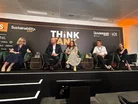
This was the issue at hand at Sustainability LIVE: The Leadership Summit during London Climate Action Week, where leaders gathered to discuss how companies can reduce emissions while maintaining business growth.
The Global Decarbonisation Strategies panel explored how organisations are addressing Scope 1, 2 and 3 emissions, implementing science-based targets and developing credible net zero roadmaps.

The impact of geopolitics
With global geopolitical tensions rising, especially in recent months, there has been a large impact on companies’ decarbonisation efforts.
For some, these uncertainties have led to a setback in progress on emissions reductions.
Garrett Quinn, Group Head of Sustainability, Branding and Communications at Smurfit Westrock, said: “I would say a concern would be that the noise in North America since January last year has not been helpful.
“Half of our global footprint is in the US, so we have seen – consciously or subconsciously – it’s impacting how people see sustainability. It doesn’t impact how we operate as a business.
“My concern is, to the people on the street, our customers and our employees, they’re being told that it doesn’t matter, and even though they might disagree, I think that’s going to wear people down.”
Nicole Sautter, Senior Director, Global Sustainability at American Express Global Business Travel, added: “In terms of geopolitics, I see that it really has an effect from where we sit in business travel, with the business case for decarbonisation. So I think that is shifting, and it has an impact on how we talk about decarbonisation and the rationale for it.
“Most emissions from business travel come from air travel, a hard-to-decarbonise sector. The majority of the pathway towards decarbonising aviation would have to come from sustainable aviation fuel (SAF).
“Aviation is obviously by nature highly exposed due to its dependence on crude oil jet fuel markets. The crisis we’ve seen with the Hormuz Strait has directly changed the perspective, or maybe broadened the perspective on SAF, of it just being a decarbonisation solution to also a solution for things like energy resilience from a government perspective and from a corporate perspective, supply chain resilience.”
How can decarbonisation be profitable?
For most companies, decarbonisation should be seen as a profitable strategy in order to be successful.
This involves the issue of products labelled as sustainable having a premium price tag, making them less attractive to customers and consumers.
Tomas Dahlman, Head of Group Environmental Sustainability at Electrolux Group, said: “10 years ago, the appetite of paying a premium was there for sustainability. I don’t see that appetite today.
“It should be more or less the same cost, at par or even cheaper. It’s very difficult to get through with the management or the board if it doesn’t make business sense.
“Maybe the economy is not as good as it was in the past, but paying a premium is not as easy today as it was in the past.”
Annelie Selander, Chief Sustainability Officer at WSH Limited (Westbury Street Holdings), said: “People are not prepared to pay a premium if it’s an everyday thing.
“People need it and they’re not going to pay you more for something that is sustainable.
“But what we do find is that if you add it to something, if you focus on the health benefits of more sustainable food, then people are prepared to pay more.”
Engaging across the value chain
To close out the panel, the leaders discussed how organisations can best succeed in decarbonising their business.
The panellists advised on different key stakeholders across the value chain to engage with, including consumers, employees and suppliers.
Sandrine Duquerroy-Delesalle, Vice President Global Sustainability & External Affairs at Crown Holdings, said: “I would say engage with your procurement team. I think for me, 80% of our emissions are in the material we buy.
“So if there is anyone that can do that work and help, it’s the procurement team. So I need to build that trust, understanding and education, so that when they negotiate the product for me, they also negotiate the right product.
“I need to educate them to deal in the negotiation so that they switch to suppliers with lower emissions. That way it’s a win for the company and for decarbonisation.”
Company portals





Executives
Annelie Selander
Chief Sustainability Officer
Garrett Quinn
Chief Sustainability Officer

Nicole Sautter
Senior Director, Global Sustainability

Sandrine Duquerroy-Delesalle
Vice President, Global Sustainability and External Affairs