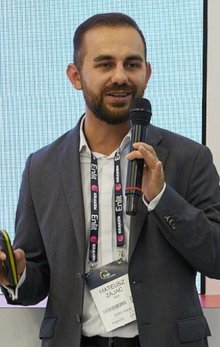
ABB's Mateusz Zając: Retrofitting is Key to Energy's Future

On a cold winter evening many years ago in southern Poland, a young engineering student came home after a long day to a house that was both dark and unheated. At the time, most homes in Kraków relied on coal-fired boilers, which required daily manual loading.
That evening, however, Mateusz Zając’s mother had fallen asleep before tending the boiler. The result was no hot water and an indoor temperature of just 16°C.
Looking back, Mateusz now views the freezing shower he took that night as a defining moment. “That was the moment I decided that everybody should have access to resilient, modern, affordable and clean energy,” he says. “That’s the philosophy I bring to work every single day.”
That conviction has since shaped a career influencing energy strategy across 50 countries in his role as Sustainability Leader for ABB’s Electrification Service.
For me, sustainability has never been about tightening the belt. It's about freedom – freedom for our engineers, our equipment and our energy.
Mateusz describes his upbringing plainly as one marked by “energy poverty”. While heating standards in Poland have improved significantly — and Mateusz himself now uses a heat pump — energy access remains a critical global challenge.
His career path has taken him from Rolls-Royce’s Marine Division, where he worked on propulsion systems, to a procurement role at Shell, and ultimately to ABB. He has spent the past 11 years at the Swiss industrial company, focusing on electrification, automation and energy management.
Across each role, his guiding philosophy has remained consistent. “For me, sustainability has never been about tightening the belt,” he says. “It's about freedom – freedom for our engineers, our equipment and our energy.”

Companies like ABB play a central role in enabling that freedom, particularly as their technologies underpin climate solutions worldwide. “You cannot do the energy transition without the equipment to power it,” Mateusz explains.
Sustainability leaders won’t want to miss Sustainability LIVE: The Leadership Summit at London Climate Action Week, taking place at Code Node on 25 June 2026.
Register now for this exclusive invite-only event.
What is ABB’s Electrification Service?
ABB Electrification today represents a US$16bn business employing 55,000 people globally — roughly half of ABB’s total workforce. Within this division, the Electrification Service unit (ELSE) is relatively new structurally, but built on more than a century of engineering expertise.
Generating US$1.4bn in annual revenue, with 4,000 engineers operating in over 15 countries and responsibility for more than 18 million installations, ELSE acts, in Mateusz’s words, as “a silent enabler of the energy transition”.
ABB’s presence spans virtually all mission-critical power environments, from utilities and data centres to heavy industry and power generation.
Its technologies are found everywhere from the summit of the Burj Khalifa to subsea interconnector systems deep beneath the ocean.
At the same time, the challenge ELSE addresses is intensifying. Global electricity demand is rising by around 4% annually, with AI-driven data centre expansion accelerating that growth.
Meanwhile, much of today’s grid infrastructure was built 40 to 50 years ago, long before current demand levels were conceivable.
“Think of the electrical grid as a three-lane motorway,” Mateusz says. “A lot of it was built decades ago, and it's aged well because it's been well maintained. But in many countries, demand has tripled since it was designed.
“Imagine suddenly having three times as many cars on the motorway. And then imagine some of those cars starting to drive the wrong way – that's what distributed energy resources feeding back into the grid feels like.”
You cannot do the energy transition without the equipment to power it.
In effect, ABB is helping to rebuild and expand that road system for the future.
The retrofitting philosophy
Across the energy sector, a key question persists: how can capacity be doubled without dismantling and replacing entire systems?
For Mateusz, the answer lies in modernisation through retrofitting.
Take ABB’s ZS1 switchgear as an example. Weighing around 1,000kg, approximately 800kg consists of structural elements such as copper bus bars and steel frames — durable components that do not degrade significantly over time.
The remaining 150kg comprises the active elements responsible for protection, control and power distribution.
“By retrofitting just those 150kg we keep all the rest intact,” Mateusz says. “You save the embedded carbon in those 650kg of steel and copper, you avoid the civil works and recabling, and you extend the life of the asset by up to 30 years.
“It takes hours rather than weeks, costs roughly 80% less than a full replacement, and saves around 80% of the associated carbon emissions.”
Given the scale of ABB’s installed base, the impact is substantial. Within ELSE’s 18 million installations, the amount of copper alone is equivalent to the annual output of two copper mines. “You cannot simply replace all of that,” he explains. “Nor would you want to.”
Energy freedom
Retrofitting and resource efficiency feed directly into what Mateusz calls “energy freedom”.
This concept sits at the core of ABB Navigate, a newly launched business line designed to help customers map their transition to net zero.
Its first offering, Battery Energy Storage as a Service, addresses what Mateusz identifies as the three core dimensions of the energy challenge — power, price and planet — by reducing reliance on fossil fuels.
Europe’s dependence on imported fossil fuels has recently heightened concerns around both price volatility and energy security. “How do we give Europe freedom from that volatility?” he asks.
“Electricity is three to four times more energy-efficient than fossil fuels for converting energy into useful work. And with the right storage and smart pricing, it can be dramatically cheaper and cleaner,” he adds.
Battery storage is rapidly becoming integral to modern energy systems. In one example in England, an ABB customer planning to install a large number of EV chargers faced significant delays in securing sufficient grid capacity.
We're no longer asking customers to spend money to be sustainable. We're showing them how sustainability pays.
By deploying a battery energy storage system, ABB enabled the project to bypass grid constraints entirely. The battery effectively delivered capacity that the grid could not.
Additionally, its flexibility allowed the customer to participate in grid balancing markets, generating revenue immediately. The outcome was zero upfront capital expenditure, predictable operating costs and positive cashflow from day one.
“We're no longer asking customers to spend money to be sustainable,” Mateusz explains. “We're showing them how sustainability pays.”
ABB’s approach to circularity
Alongside these innovations, Mateusz and the ELSE team are advancing circularity initiatives both internally and with customers.
ABB now provides end-of-life services for its products across 22 countries, with particularly strong demand from data centre operators.
By reclaiming retired equipment and ensuring materials remain in use, ABB is building a model of resource sovereignty that parallels the energy sovereignty it enables for customers.
The company is also applying these principles within its own operations. Its Mission to Zero programme focuses on decarbonising factories, while its Zero Waste to Landfill initiative aims to eliminate production waste.
Beyond emissions reduction, Mateusz emphasises the importance of these efforts for reputation and talent attraction.
The energy sector currently faces a significant shortage of skilled engineers, and he believes ABB’s sustainability leadership is a key differentiator.
“The new generation of engineers wants to work for a purposeful company,” he says. “They want to be part of real change. We get to be the good guys in this story.”
Company portals
Executives
Mateusz Zając
Sustainability Leader, Service Division, Electrification